



Adaptive Security in an Oracle Database
This is my presentation to the UKOUG last December on Adaptive Security in an Oracle Database.
- Slide 1 - Adaptive Security in an Oracle Database
-
Adaptive Security in an Oracle Database
- Slide 2 - Legal notice
-
Adaptive Security in an Oracle Database
Published by
PeteFinnigan.com Limited
Tower Court
3 Oakdale Road
York
England, YO30 4XL
Copyright © 2025 by PeteFinnigan.com Limited
No part of this publication may be stored in a retrieval system, reproduced or transmitted in any form by any means, electronic, mechanical, photocopying, scanning, recording, or otherwise except as permitted by local statutory law, without the prior written permission of the publisher. In particular this material may not be used to provide training of any type or method. This material may not be translated into any other language or used in any translated form to provide training. Requests for permission should be addressed to the above registered address of PeteFinnigan.com Limited in writing.
Limit of Liability / Disclaimer of warranty. This information contained in this course and this material is distributed on an “as-is” basis without warranty. Whilst every precaution has been taken in the preparation of this material, neither the author nor the publisher shall have any liability to any person or entity with respect to any loss or damage caused or alleged to be caused directly or indirectly by the instructions or guidance contained within this course.
TradeMarks. Many of the designations used by manufacturers and resellers to distinguish their products are claimed as trademarks. Linux is a trademark of Linus Torvalds, Oracle is a trademark of Oracle Corporation. All other trademarks are the property of their respective owners. All other product names or services identified throughout the course material are used in an editorial fashion only and for the benefit of such companies with no intention of infringement of the trademark. No such use, or the use of any trade name, is intended to convey endorsement or other affiliation with this course.
- Slide 3 - Background
-
Pete Finnigan – Background, Who Am I?
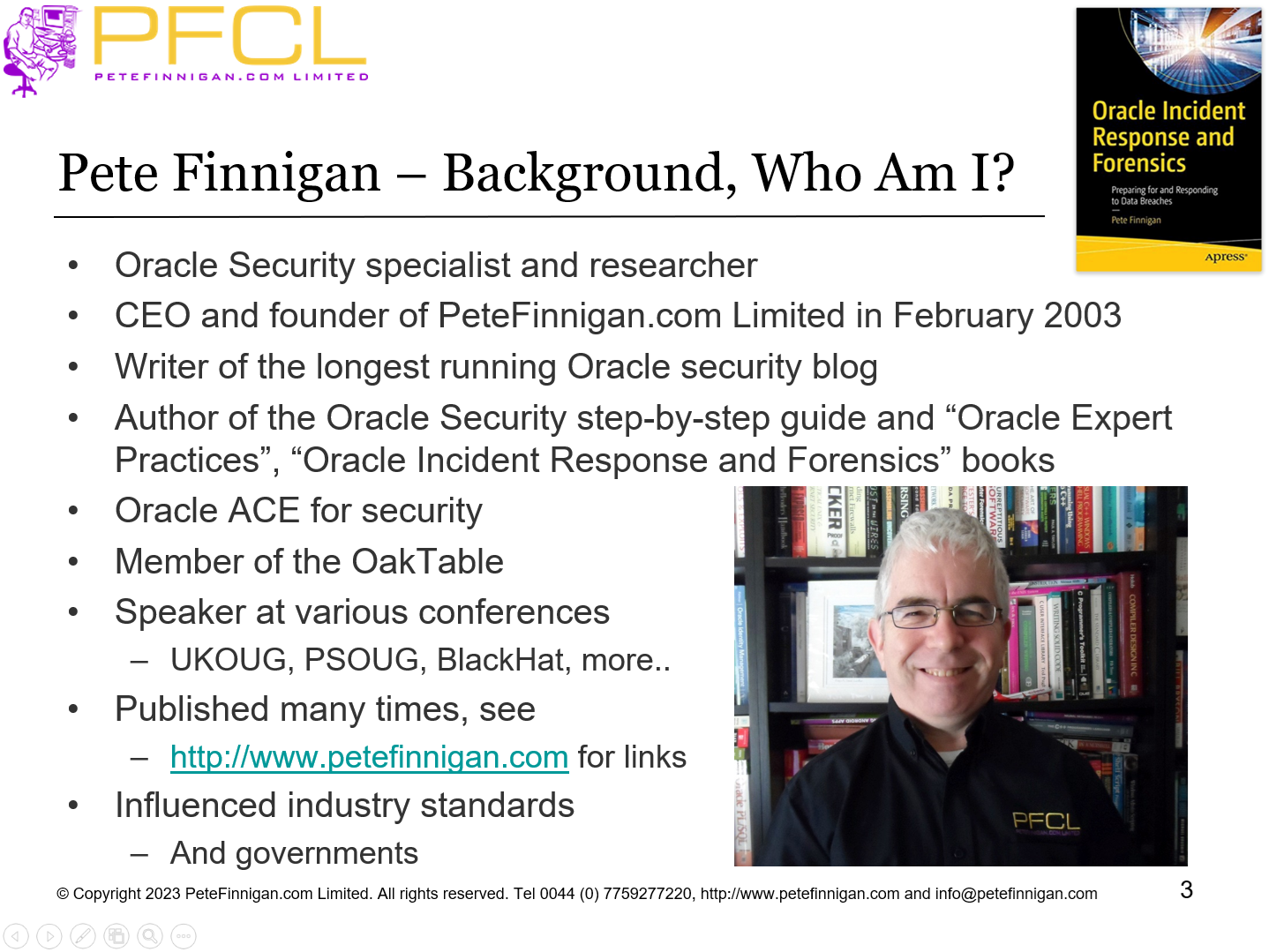
- Oracle Security specialist and researcher
- CEO and founder of PeteFinnigan.com Limited in February 2003
- Writer of the longest running Oracle security blog
- Author of the Oracle Security step-by-step guide and “Oracle Expert Practices”, “Oracle Incident Response and Forensics” books
- Oracle ACE for security
- Member of the OakTable, SYM 42
- Speaker at various conferences UKOUG, PSOUG, BlackHat, more..
- Published many times, see http://www.petefinnigan.com for links
- Slide 4 - Agenda
-
- A bit of history
- Designing Audit Trails
- We use a toolkit
- Simple Policy based audit
- Adaptive Audit
- Adaptive Security
- Slide 5 - A bit of History
-
A bit of History
- Slide 6 - History of the Audit Events, Toolkit and Talks
-
- In 2009 piece of work to help design audit trails
- Site had limited staff, little time to design, deploy, maintain any audit trails
- I came up with some simple ideas, proof of concepts – to package up audit trails for them; inc policy based audit, IPS and simple firewall
- They spent limited time to deploy a useful audit trail
- Similar piece of work in 2011 where limited team needed to deploy audit
- 2012 to 2015 extended the toolkit
- I wrote a presentation back in 2012 and presented it just once at a SIG on practical audit trails where I mentioned this toolkit for the first time
- This then became the basis of a one day class on the same subject
- Reworked that presentation in UKOUG 2015 conference
- Customer in 2016 needed an audit trail to deploy quickly
- Deployed now to customers in UK, Ireland and Germany
- The ideas of audit design came from these pieces of work and talks
- Slide 7 - Adaptive
-
- We must have audit to create adaptive audit
- We must have security to create adaptive security
- We most likely need audit to create adaptive security
- Audit is the key element
- Slide 8 - Designing Audit Trails
-
Designing Audit Trails
- Slide 9 - Some People Think They Have Designed Audit
-
- I see sites with some audit settings
- This is not a WELL DESIGNED audit trail
- Usually these random set of parameters in the Oracle database will not catch a good range of events that could be an attack
- Some sites have application audit and OS audit
- BUT worse; lots of sites have no audit at the database engine level
- If there is a breach a lack of audit makes forensic response very difficult
- Slide 10 - Design
-
- Before we get started implementing audit trails
- Design must be the first step
- The final chosen solution implements the design
- Therefore until you know the design you cannot specify the right solution – right?
- The solution could be “free” or “commercial” solution or even a combination of both – we use our toolkit
- Often people buy third party products and implement out of the box with no internal requirements!
- Slide 11 - Create Audit Events
-
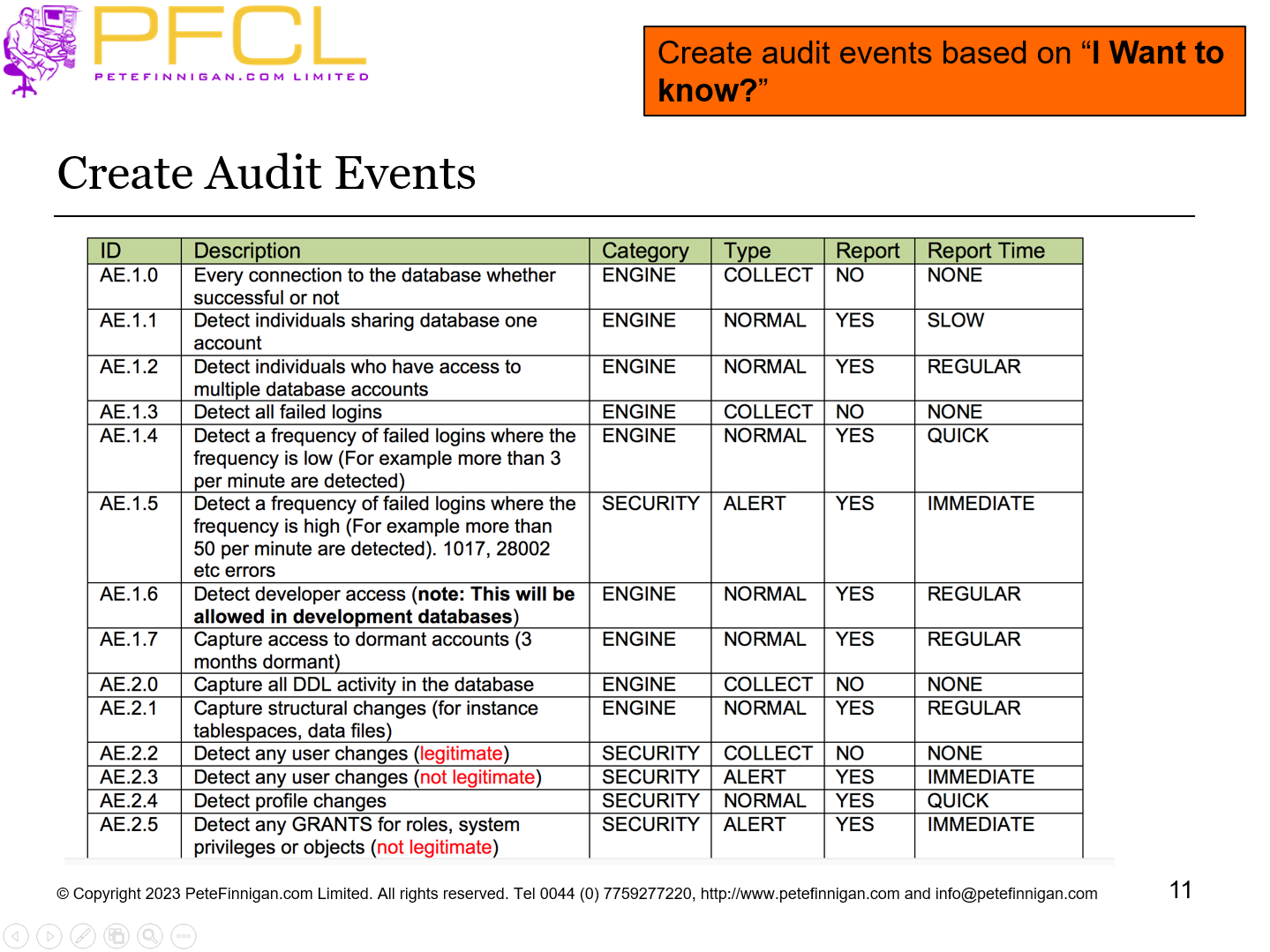
Create audit events based on “I Want to know?”
- Slide 12 - Build On The Audit Events
-
- Work backwards from the events to decide what raw audit to collect
- Then how to work out if event has occurred
- Then how to report
- Then how to alert
- Then how to escalate
- When you have this “table” decide on the technical solution that can be implemented and deployed
- Slide 13 - Audit Trail Toolkit
-
Audit Trail Toolkit
- Slide 14 - The Goal of the Toolkit
-
- As simple as SQL> @atk and a sophisticated audit trail is up and running
- Making it simple for organisations to deploy audit trails simply, with no resources
- No design, implement, test etc as we have done it for you already
- Used in ATC mode – space also is managed in each target database audited
- Simple to configure or not configured at all
- A complete solution to know what is happening at the database engine level for sites with limited resources
- Slide 15 - PFCLATK – “A”udit “T”rail tool”K”it
-
- Toolkit to aid audit trail deployment easily
- Simple pre-configure
- Policy based
- Alert based
- Multiple audit trails sources
- Add in factors (input hints)
- Separated schema design
- Manual 27 pages currently
- Version 2.4.0.0 currently
- Layered audit
- Slide 16 - Elements of Design - Core
-
- The core features of our audit design are
- Policies and events (There are 20 policies and 17 events)
- Polled jobs and reports as checks (There are 7 job intervals)
- Core PL/SQL API Package
- Rules/policy/jobs/payload meta data
- Audit trails specific to PFCLATK
- System Triggers
- DDL triggers
- DML triggers
- PL/SQL based
- Checks can be made via polled jobs to test if the audit is valid
- Raw data is collected, filters are jobs polled via DBMS_SCHEDULER; results added to alerts and alerts generates escalation
Can be deployed to multiple databases and a central database
- Slide 17 - Factors
-
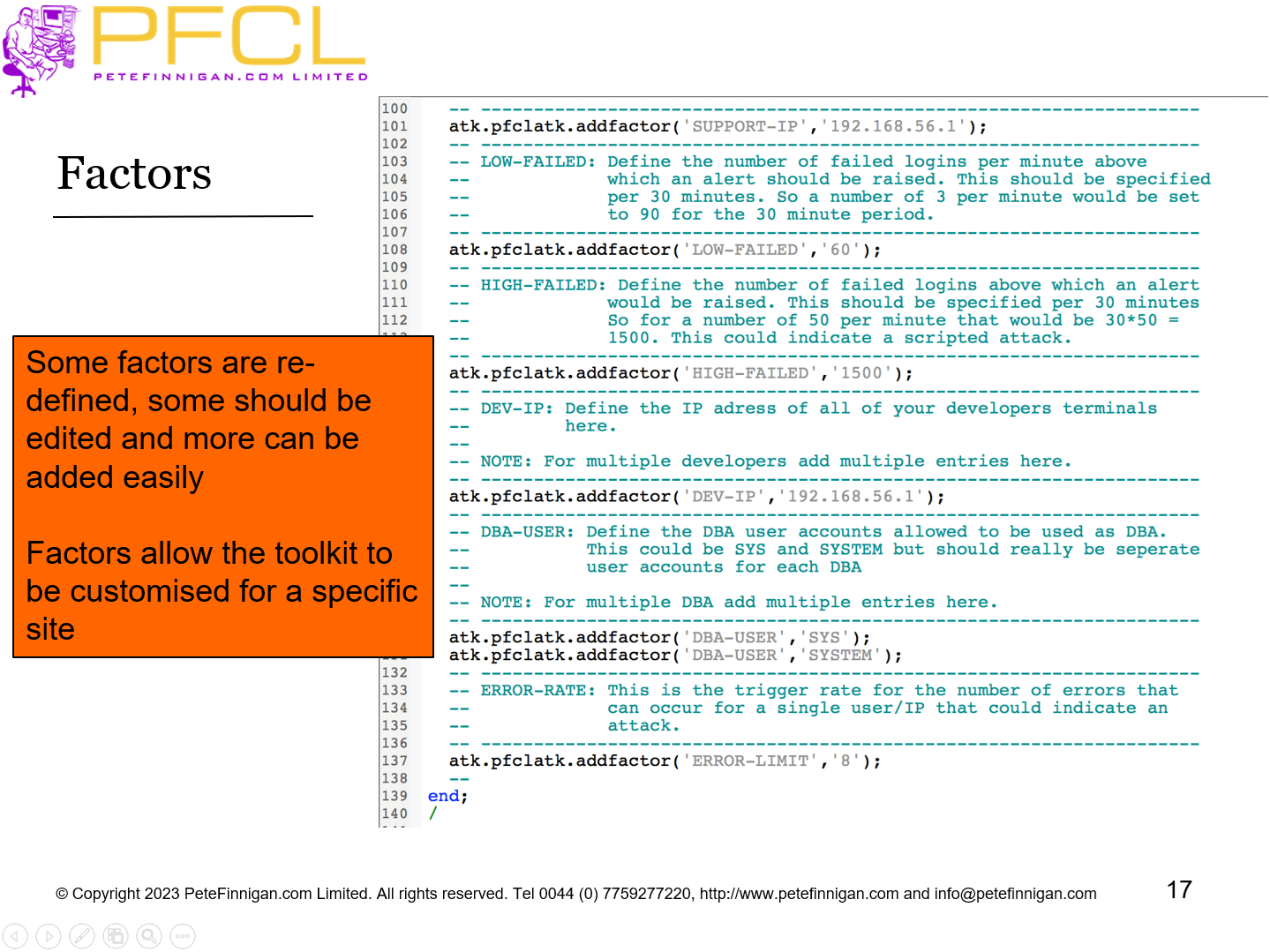
Some factors are re-defined, some should be edited and more can be added easily
Factors allow the toolkit to be customised for a specific site - Slide 18 - Audit Policies
-
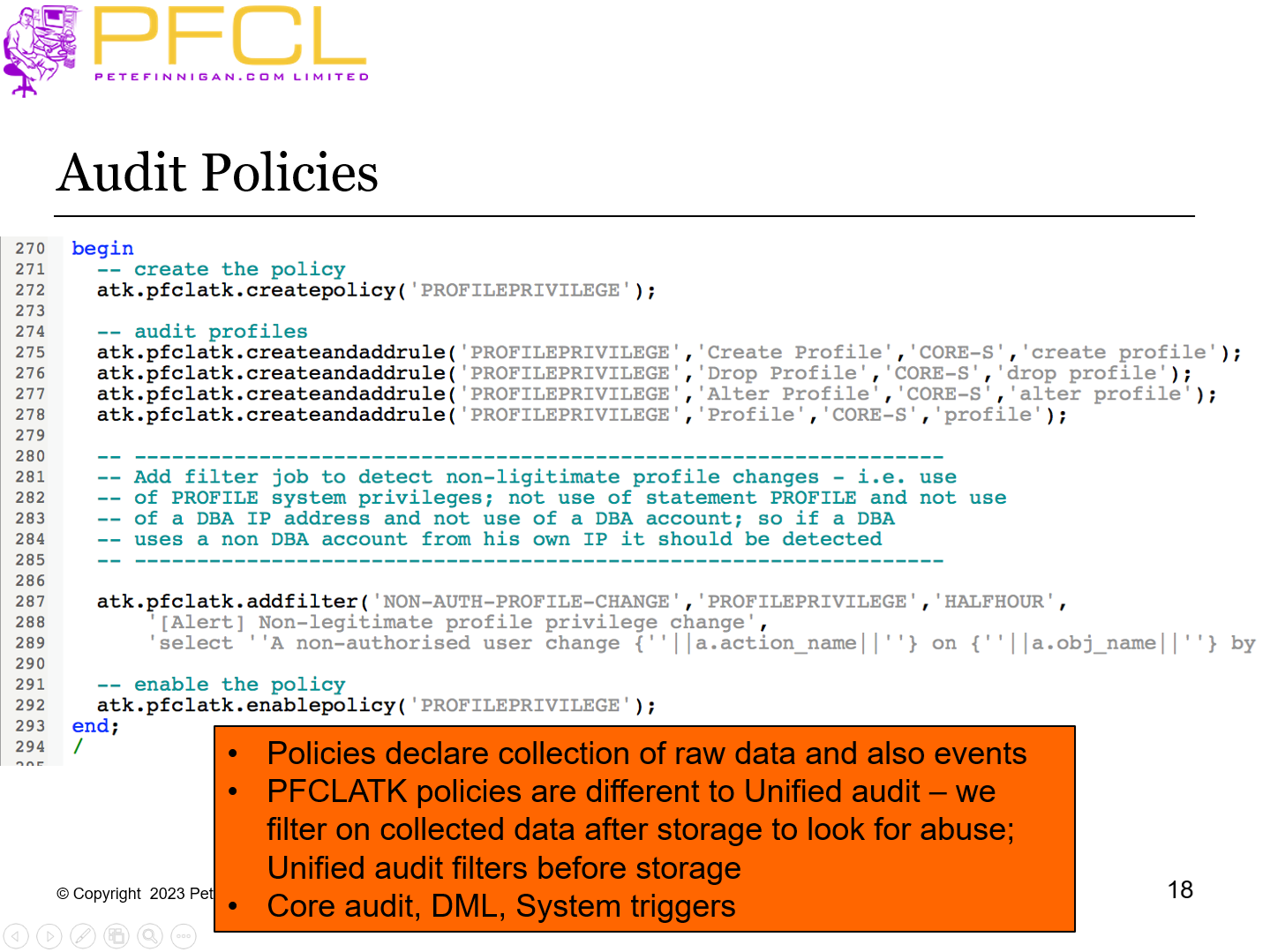
- Policies declare collection of raw data and also events
- PFCLATK policies are different to Unified audit – we filter on collected data after storage to look for abuse; Unified audit filters before storage
- Core audit, DML, System triggers
- Slide 19 - Audit of Audit
-
- A multi-layer approach is needed
- Audit of core trail tables such as AUD$
- Audit of core audit settings such as AUDIT$
- Audit of triggers (Event, DDL and DML)
- Audit of custom logs
- Audit of audit functionality, packages and other objects
- All can be set up as policies in PFCLATK
- Slide 20 - Simple Policy Based Audit Trails
-
Simple Policy Based Audit Trails
- Slide 21 - Policies I Will Implement
-
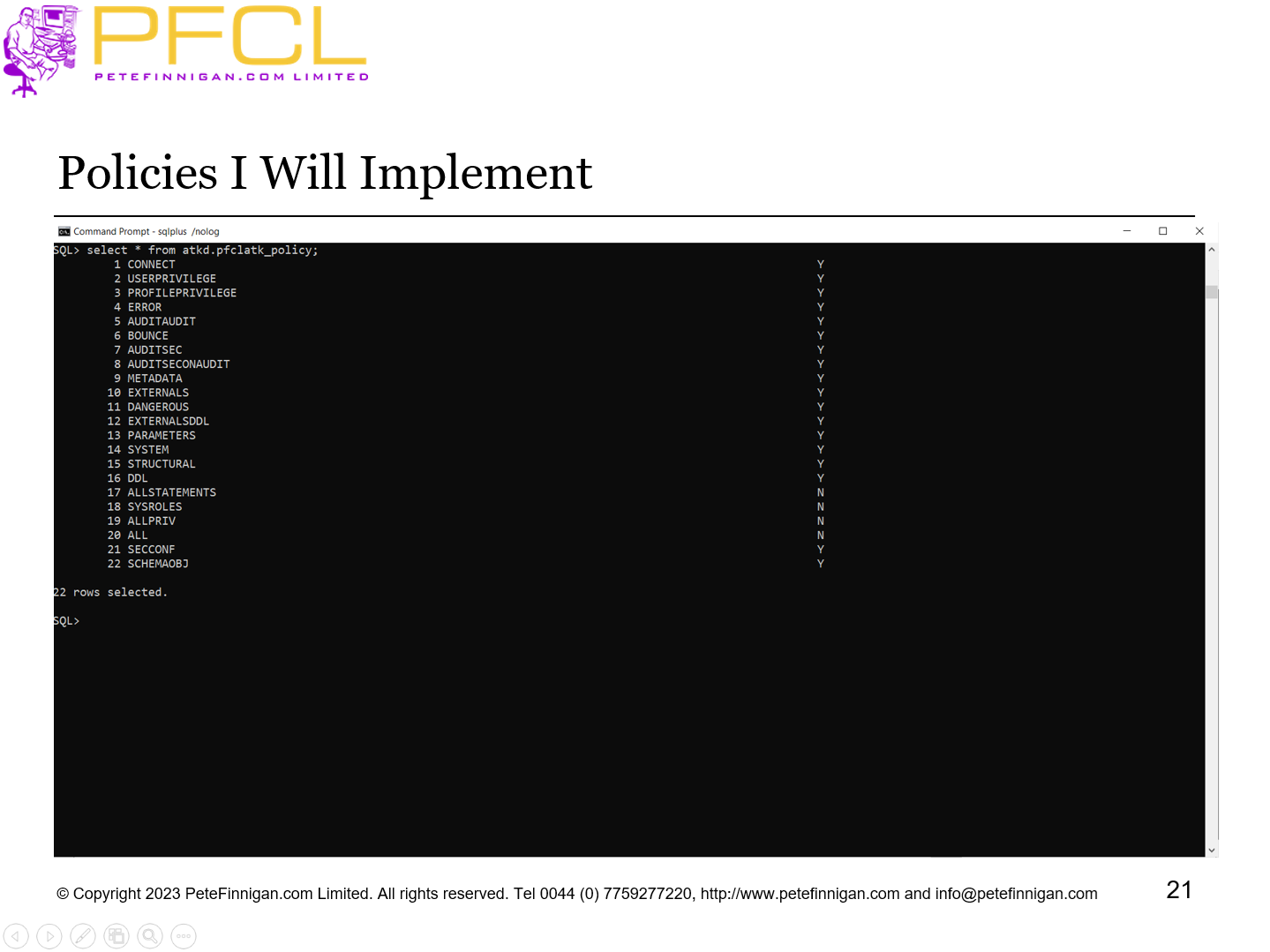
Policies I Will Implement
- Slide 22 - Install the Audit Events and Toolkit
-
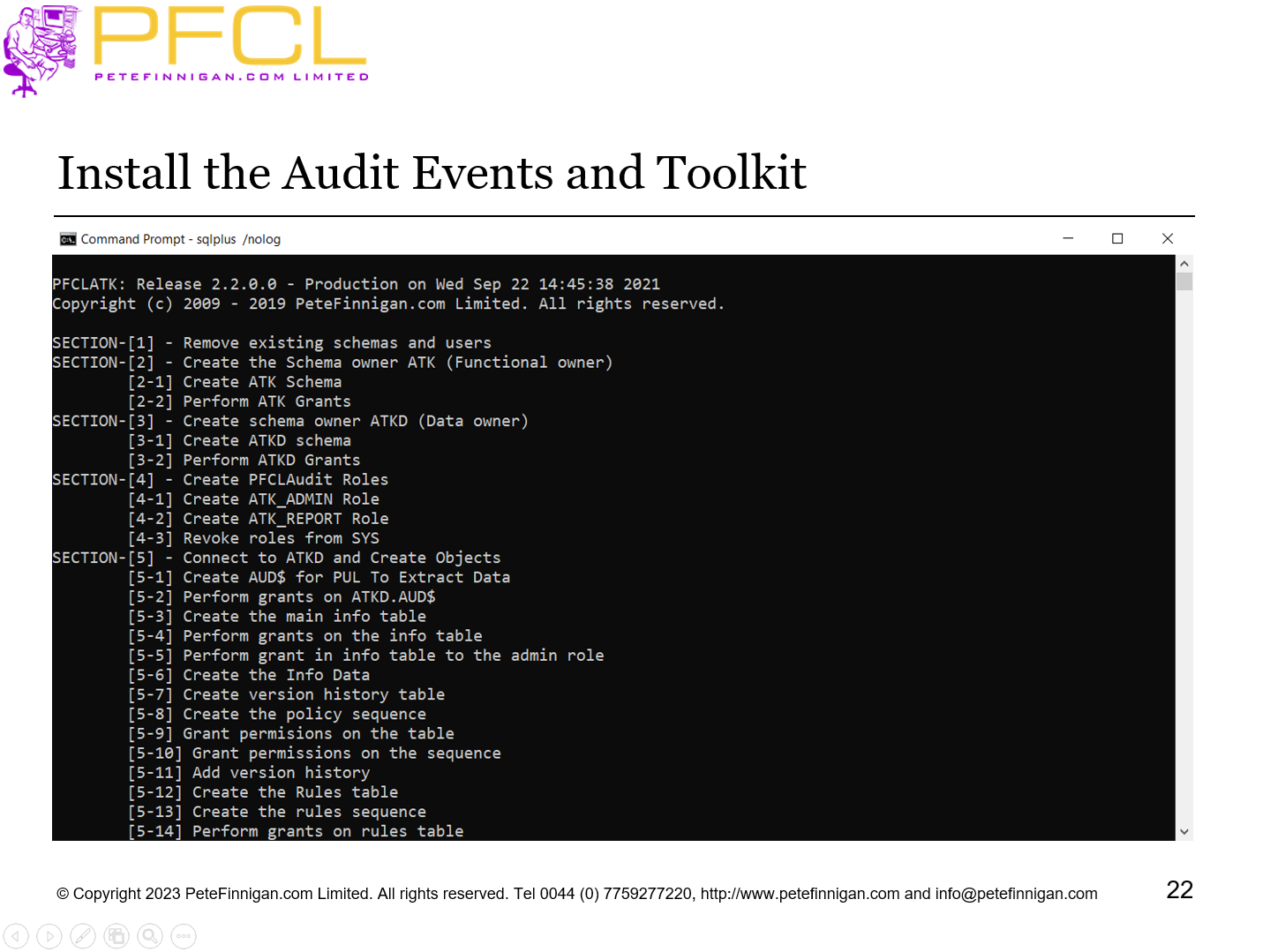
Install the Audit Events and Toolkit
- Slide 23 - Some Audit Results From Hacks
-
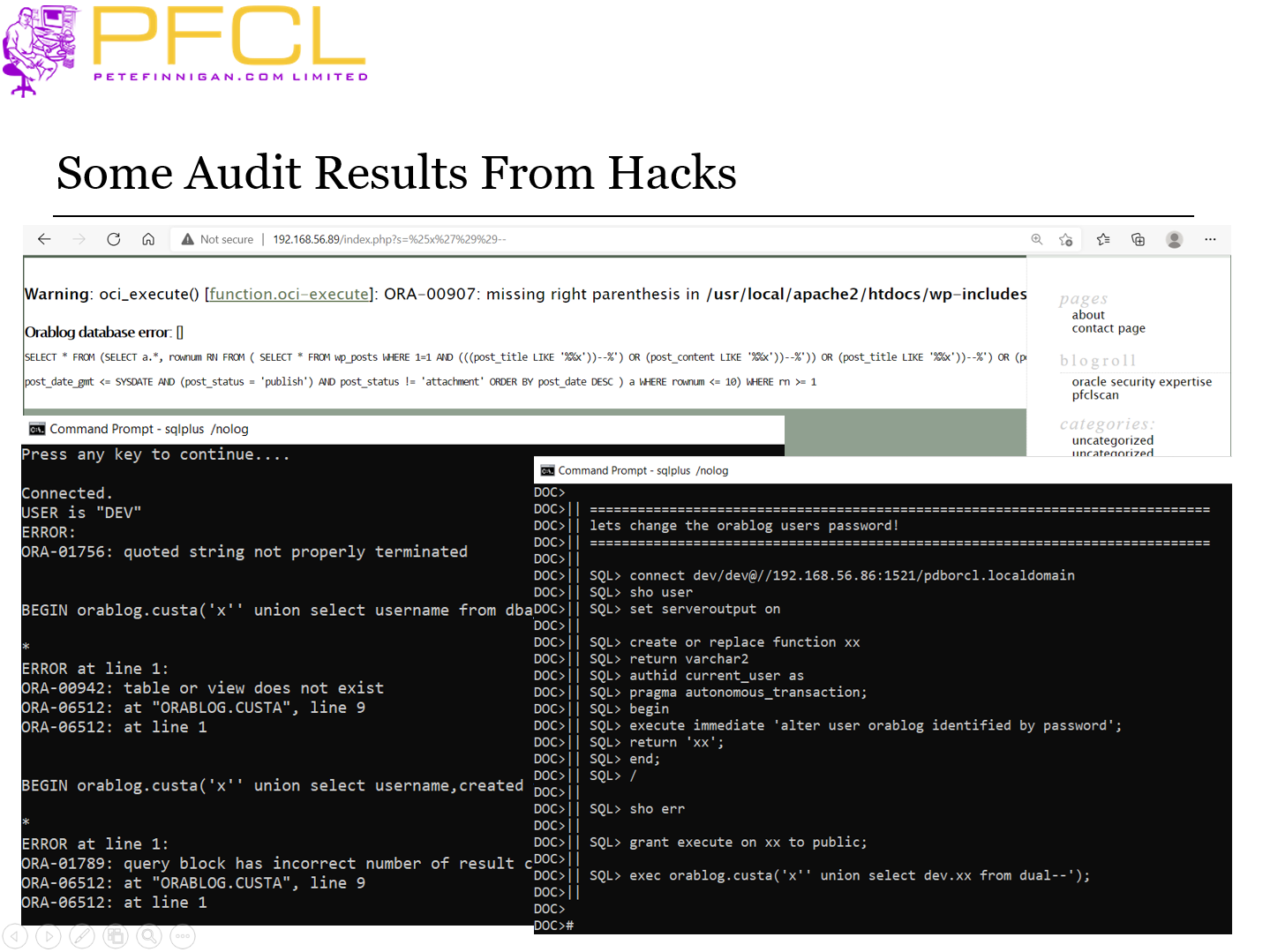
Some Audit Results From Hacks
- Slide 24 - Audit Trail Report
-
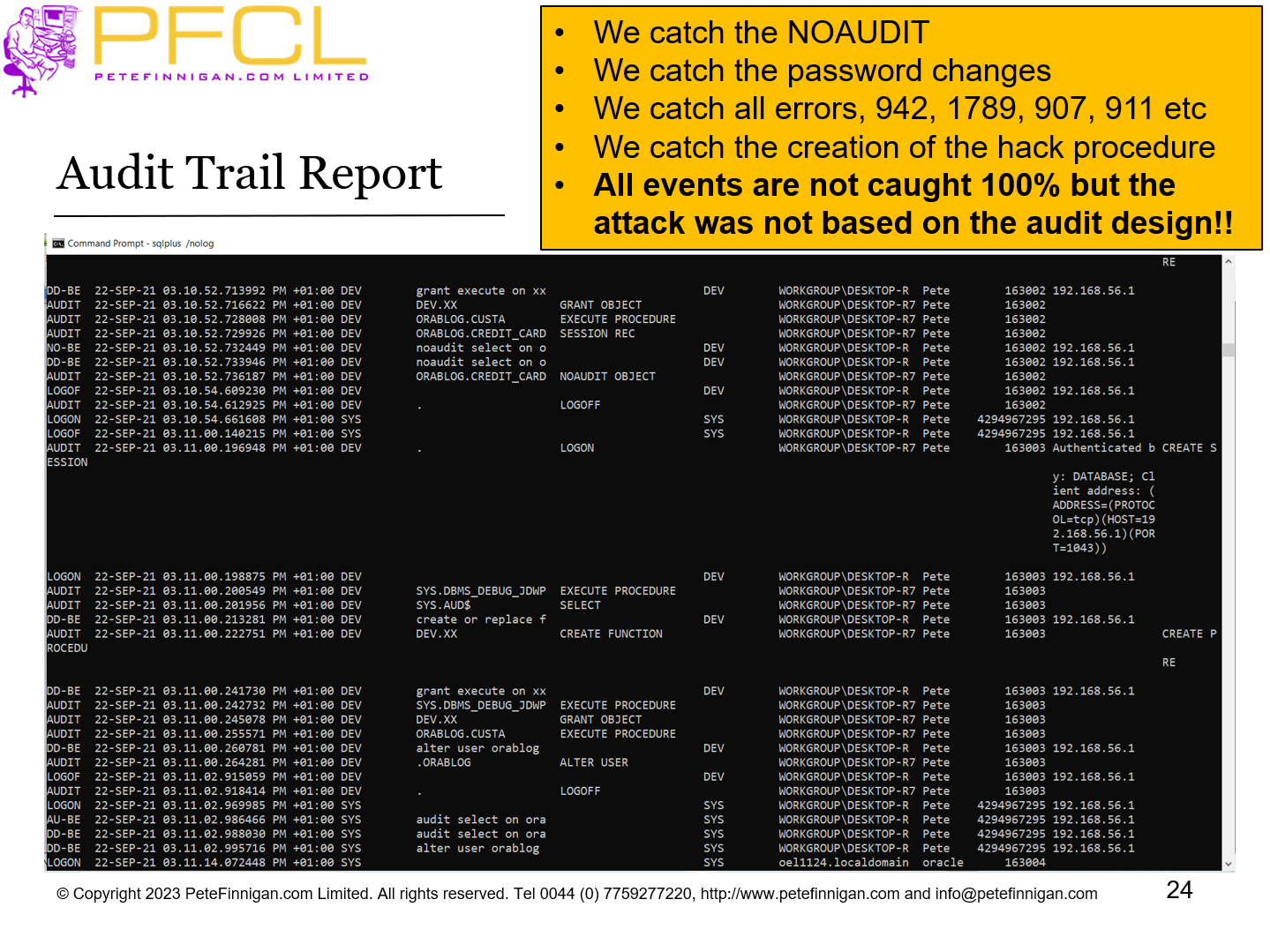
- We catch the NOAUDIT
- We catch the password changes
- We catch all errors, 942, 1789, 907, 911 etc
- We catch the creation of the hack procedure
- All events are not caught 100% but the attack was not based on the audit design!!
- Slide 25 - Adaptive Audit
-
Adaptive Audit
- Slide 26 - Adaptive Audit
-
- Change the audit trail based on security at the time
- Based on a real attack happening – in progress – or a perceived attack happening the audit capture can be increased
- This, as with adaptive security would be reduced after the perceived attack
- Adaptive Audit is useful because in normal circumstances we would not want to collect excessive audit trails but during an attack we may do so.
- For example if the application schema has limited audit normally we increase to audit all access during an attack
- These ideas need to be designed carefully to ensure that the audit does not become a ”Denial Of Service”
- Example
- A schema changes its password from the web server; so audit all actions in the session or audit all actions in the schema by all users
- Slide 27 - What is Conditional Audit?
-
- Audit would be more powerful if conditionally applied
- Oracles Fine Grained Audit (FGA) attests to this
- Oracles Unified Audit from 12c also attests to this but still is underpinned by core audit facilities
- Trigger based security can use some element of conditionality
- When clause can be used to limit the trigger body to certain conditions such as time based, user based privilege based and SYS_CONTEXT() based and more
- OF clause can limit a trigger to certain columns BUT has little value in conditional audit other than protection – see integrity
- A trigger body is PL/SQL so any conditional audit can be programmed in
- Secure contexts can be used to control granularity in triggers, audit functions and more across the database – set up at logon
- Conditional security in core audit is not feasible BUT
- We can process the records records after collection via reports/jobs
- This is in essence what unified audit is doing
- Slide 28 - Adaptive Security
-
Adaptive Security
- Slide 29 - Adaptive Security
-
- Adaptive security is not part of audit trail design but adaptive security could be controlled by audit results and reports
- Create multiple levels of security i.e. defcon5, 4, 3, 2,1
- Adaptive security is where
- Security is changed dynamically based on a real attack happening or perceived real attack happening
- Normally this would be to tighten security to defend the database because of the current attack
- After an attack the reverse could normally occur to remove the additional restrictions
- Examples
- Detect change of a password and lock the user whose password was changed
- Detect change of audit by a schema (user) and kill the user doing it
- These can be implemented in triggers as VP/IPS or specific payloads as jobs
No one is doing this BUT WE COULD
The ultimate – one database is being attacked and it “tells” all others to change audit and security - Slide 30 - Conclusions
-
- Secure the data in your database
- Include an audit trail
- When you are secure
- Think about adaptive audit
- Think about adaptive security
- Slide 31 - Questions
-
Questions
- Slide 32 - Adaptive Security in an Oracle Database
-
Adaptive Security in an Oracle Database