


Auditing The Oracle Database
This is my presentation to the UKOUG last December on Auditing The Oracle Database.
- Slide 1 - Auditing The Oracle Database
-
PFCATK – A Toolkit to Help
- Slide 2 - Legal notice
-
Auditing The Oracle Database
Published by
PeteFinnigan.com Limited
Tower Court
3 Oakdale Road
York
England, YO30 4XL
Copyright © 2025 by PeteFinnigan.com Limited
No part of this publication may be stored in a retrieval system, reproduced or transmitted in any form by any means, electronic, mechanical, photocopying, scanning, recording, or otherwise except as permitted by local statutory law, without the prior written permission of the publisher. In particular this material may not be used to provide training of any type or method. This material may not be translated into any other language or used in any translated form to provide training. Requests for permission should be addressed to the above registered address of PeteFinnigan.com Limited in writing.
Limit of Liability / Disclaimer of warranty. This information contained in this course and this material is distributed on an “as-is” basis without warranty. Whilst every precaution has been taken in the preparation of this material, neither the author nor the publisher shall have any liability to any person or entity with respect to any loss or damage caused or alleged to be caused directly or indirectly by the instructions or guidance contained within this course.
TradeMarks. Many of the designations used by manufacturers and resellers to distinguish their products are claimed as trademarks. Linux is a trademark of Linus Torvalds, Oracle is a trademark of Oracle Corporation. All other trademarks are the property of their respective owners. All other product names or services identified throughout the course material are used in an editorial fashion only and for the benefit of such companies with no intention of infringement of the trademark. No such use, or the use of any trade name, is intended to convey endorsement or other affiliation with this course.
- Slide 3 - Background
-
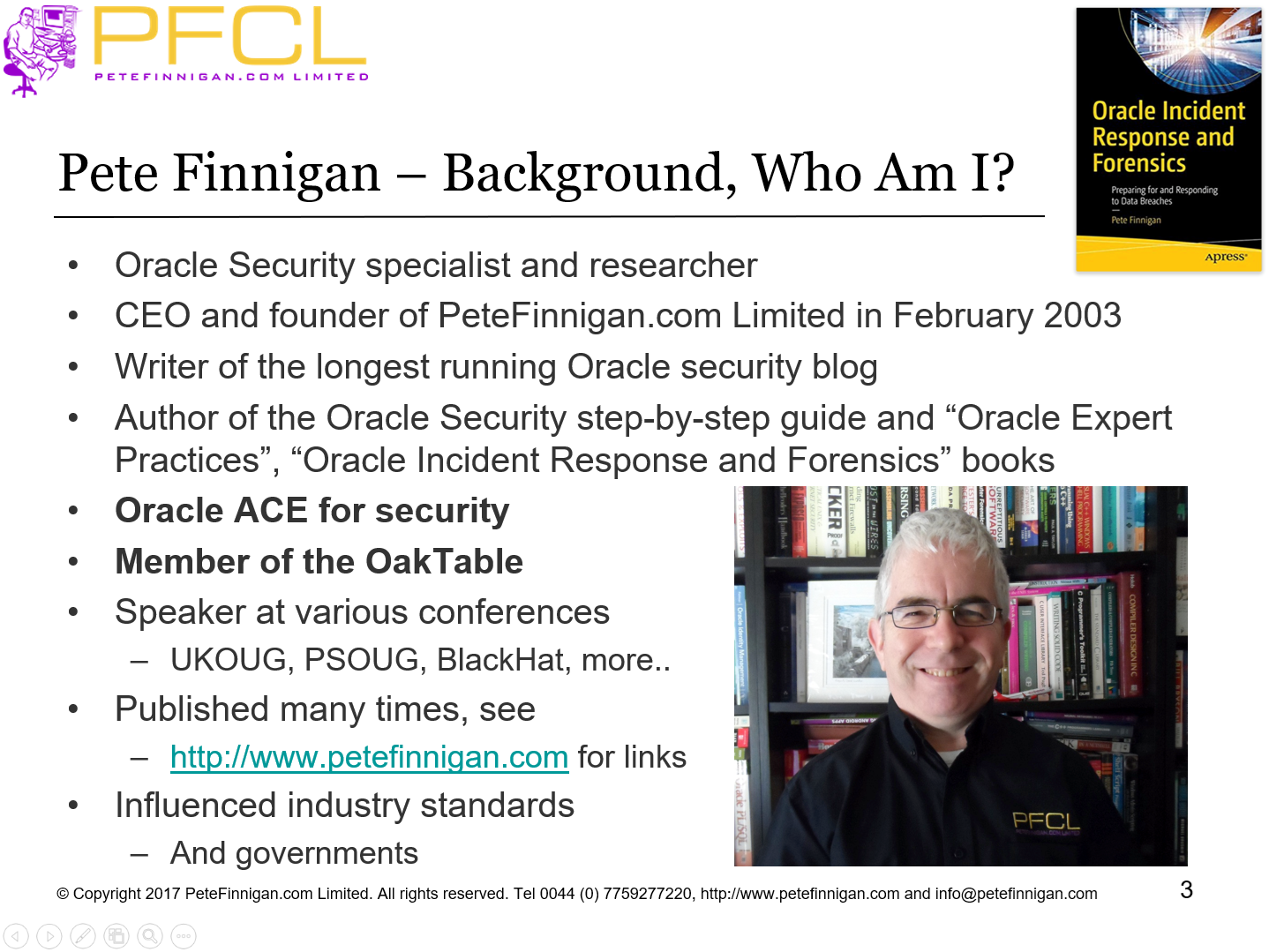
Pete Finnigan – Background, Who Am I?
- Oracle Security specialist and researcher
- CEO and founder of PeteFinnigan.com Limited in February 2003
- Writer of the longest running Oracle security blog
- Author of the Oracle Security step-by-step guide and “Oracle Expert Practices”, “Oracle Incident Response and Forensics” books
- Oracle ACE for security
- Member of the OakTable, SYM 42
- Speaker at various conferences UKOUG, PSOUG, BlackHat, more..
- Published many times, see http://www.petefinnigan.com for links
- Slide 4 - Agenda
-
- Do people use Oracle audit trails?
- A bit of history
- The Focus - The PFCLATK toolkit
- An overview
- Deployment
- Hacking
- Audit results
- Slide 5 - State of the (Audit Trail) Nation
-
- Extensive experience visiting customer sites
- Performing security audits
- Reacting to incidents, breaches or attacks
- I see one common theme
- No audit trails OR
- Very limited audit trails OR
- Of those that do have audit trails very few use them interactively
- Sometimes people collect audit because they have to (regs)
- I have even seen some sites collect audit and delete it (regs)
- How many people here have audit trails enabled in their database to audit the database? – i.e. not apps or data
- Slide 6 - History of the Toolkit and Talks
-
- In 2009 piece of work to help design audit trails
- Site had limited staff, little time to design, deploy, maintain any audit trails
- I came up with some simple ideas, proof of concepts – to package up audit trails for them; inc policy based audit, IPS and simple firewall
- They spent limited time to deploy a useful audit trail
- Similar piece of work in 2011 where limited team needed to deploy audit
- 2012 to 2015 extended the toolkit
- I wrote a presentation back in 2012 and presented it just once at a SIG on practical audit trails where I mentioned this toolkit for the first time
- This then became the basis of a one day class on the same subject
- Reworked that presentation in UKOUG 2015 conference
- Customer in 2016 needed an audit trail to deploy quickly
- Deployed now to customers in UK, Ireland and Germany
- Slide 7 - My Sample Application Architecture
-
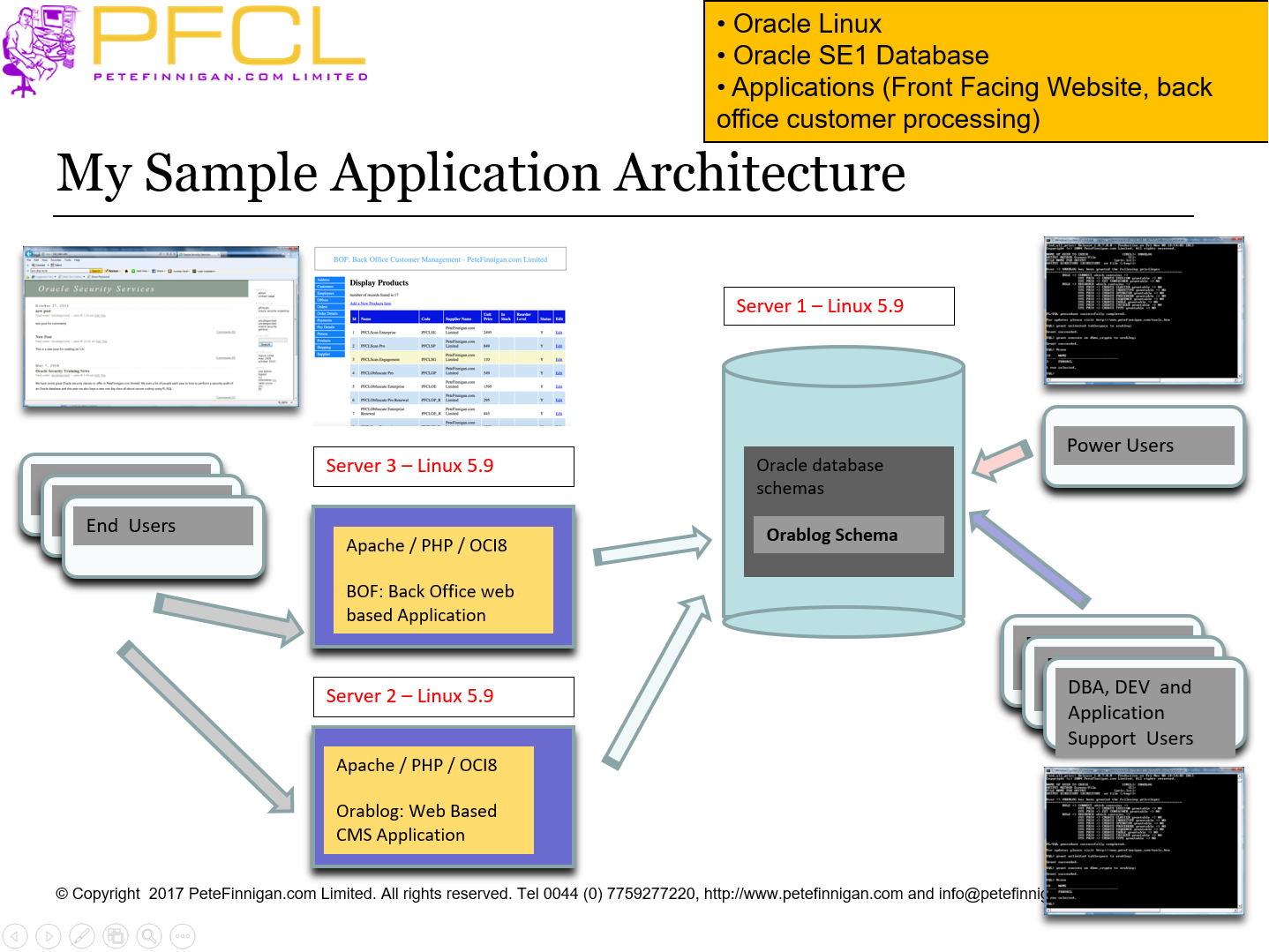
- Oracle Linux
- Oracle SE1 Database
- Applications (Front Facing Website, back office customer processing)
- Slide 8 - Demo Hacking
-
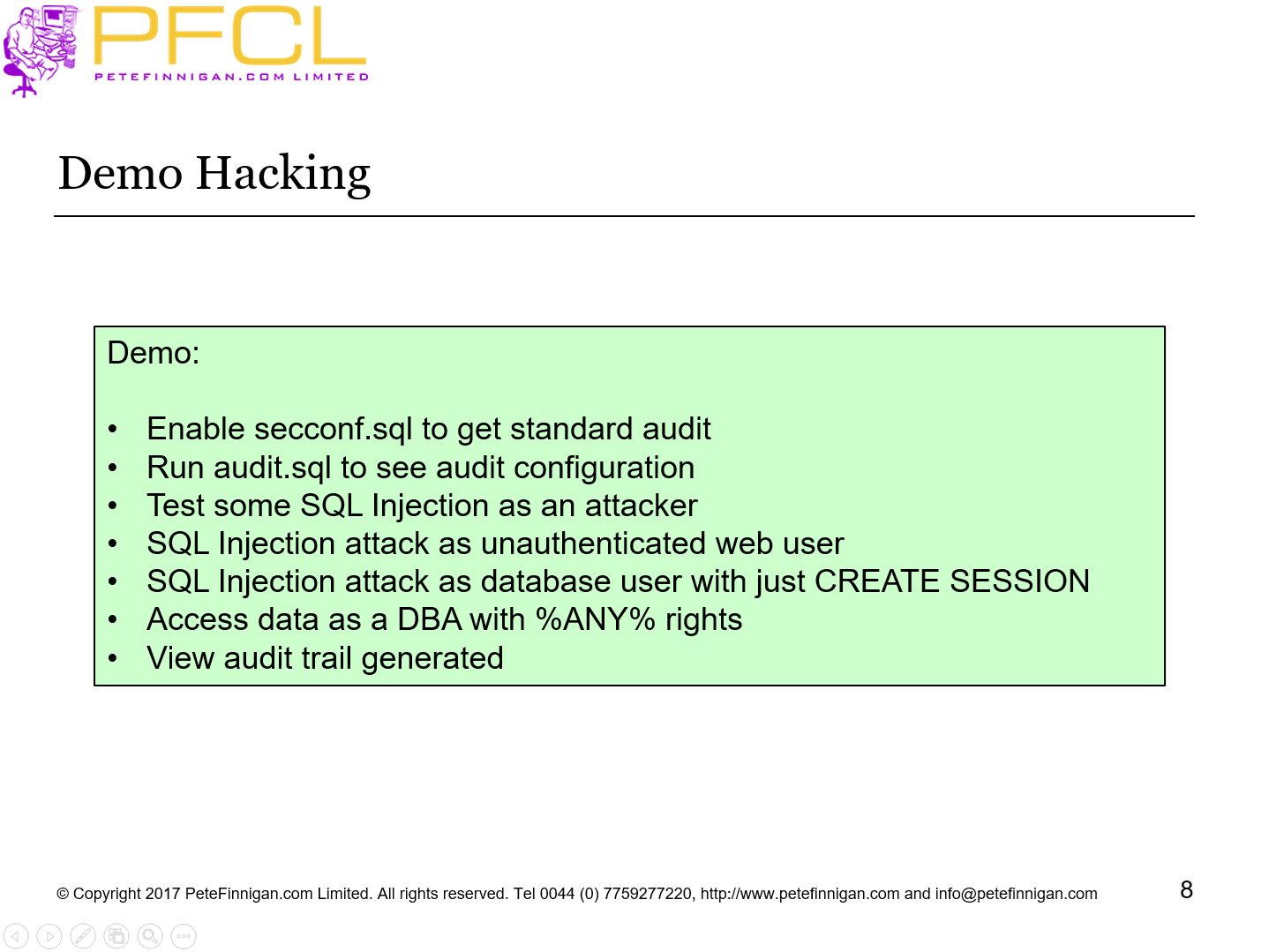
Demo:
- Enable secconf.sql to get standard audit
- Run audit.sql to see audit configuration
- Test some SQL Injection as an attacker
- SQL Injection attack as unauthenticated web user
- SQL Injection attack as database user with just CREATE SESSION
- Access data as a DBA with %ANY% rights
- View audit trail generated
- Slide 9 - The Goal of the Toolkit
-
- As simple as SQL> @atk and a sophisticated audit trail is up and running
- Making it simple for organisations to deploy audit trails simply, with no resources
- No design, implement, test etc as we have done it for you already
- Used in ATC mode – space also is managed in each target database audited
- Simple to configure or not configured at all
- A complete solution to know what is happening at the database engine level for sites with limited resources
- Slide 10 - PFCLATK – “A”udit “T”rail tool”K”it
-
- Toolkit to aid audit trail deployment easily
- Simple pre-configure
- Policy based
- Alert based
- Multiple audit trails sources
- Add in factors (input hints)
- Separated schema design
- Manual 25 pages currently
- Version 1.6.1.0 currently
- Layered audit
- Slide 11 - PFCLATK Block Overview
-
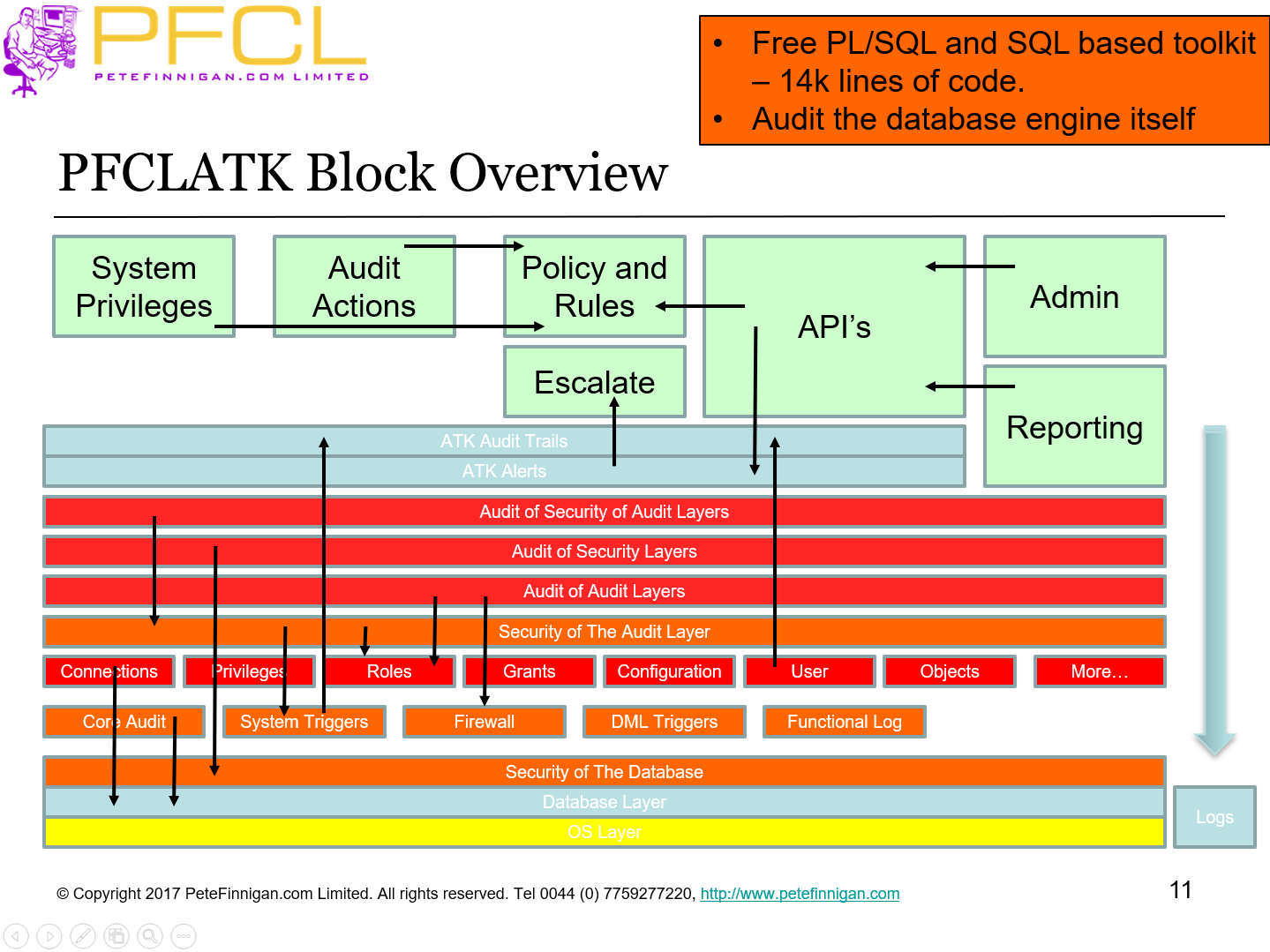
- Free PL/SQL and SQL based toolkit – 14k lines of code.
- Audit the database engine itself
- Slide 12 - PFCLATC – “A”udit “T”oolkit “C”entralised
-
- PFCLATK can be deployed to each “target Oracle Database”
- PFCLATC is an additional layer to add centralisation of those audits automatically
- Simple configuration to link each target with the central storage
- Uses links and a PUL mechanism
- Audit trails are check summed
- Audit trails are PUL’d
- Audit trails purged from the target
- Manage target space needed for audit trails (limited by PUL)
- The toolkit also audits the PFCLATC target (if required)
- Central reporting possible over many databases
- Slide 13 - PFCLATK Architecture
-
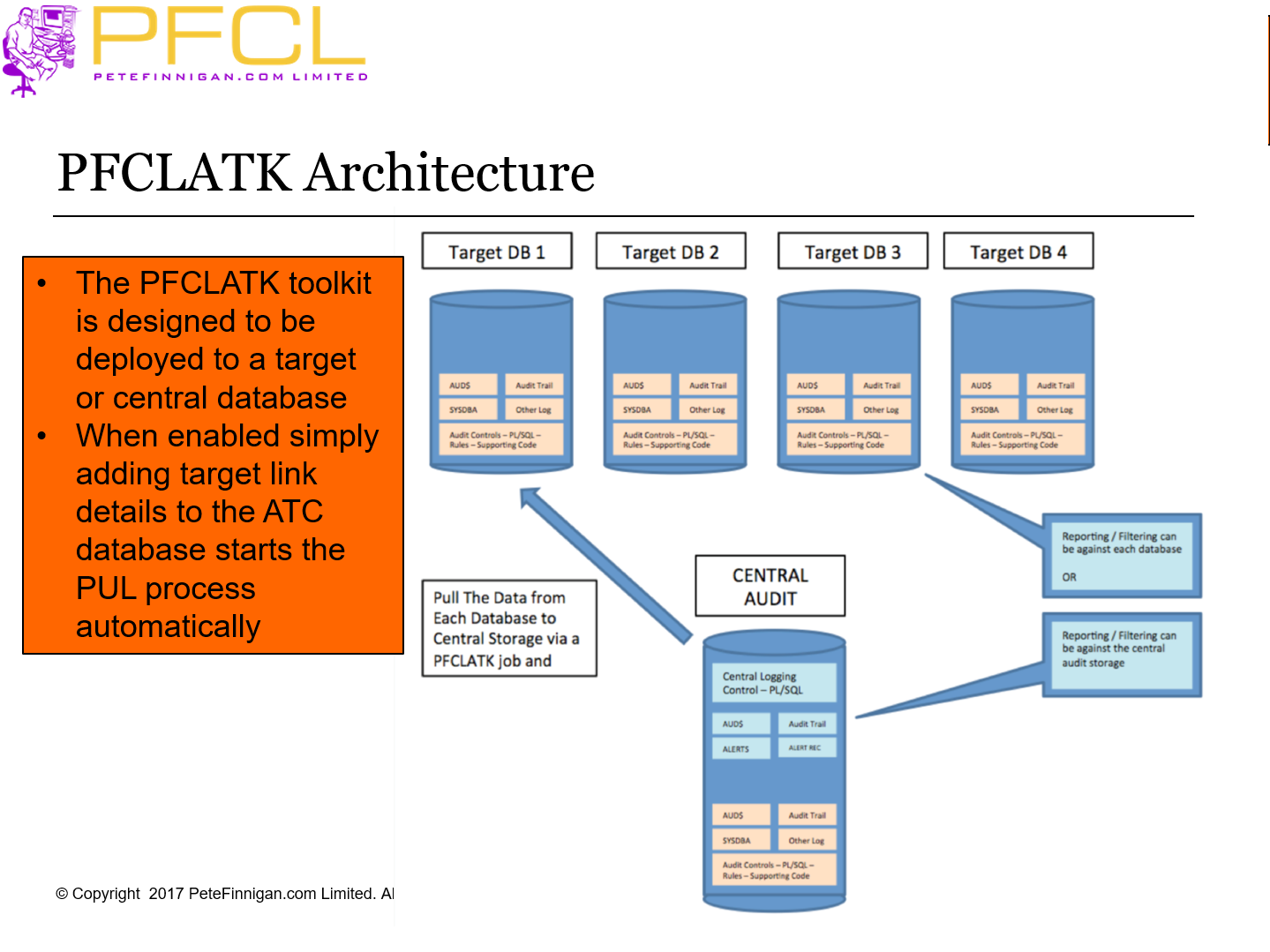
- The PFCLATK toolkit is designed to be deployed to a target or central database
- When enabled simply adding target link details to the ATC database starts the PUL process automatically
- Slide 14 - Database Engine Audit
-
- Sites often have application level audit trails
- In the application layer itself
- Sometime also in the database (RLA in Oracle E-Business Suite for instance)
- Sites sometimes have audit enabled at the operating system level
- Auditing of the database is often
- Application related
- Regulation related
- Audit is needed at the database engine layer to capture abuse against the database itself
- Slide 15 - Alerts
-
- React in real time to attacks
- SQL Injection
- Privilege abuse
- Error conditions
- React in
- Real time where possible
- Semi-real time if not possible
- Other reactions can be slower or not at all
- Alerts are configured in policies along with raw audit collected – post filtering is more powerful than unified audit pre-filtering because we can filter across more domains
- Slide 16 - Separated Schemas and Roles
-
- Schemas
- ATKD – The owner of tables, views, sequences
- ATK – The owner of the main API. Also runs jobs that payloads and filters based on
- Roles
- ATK_ADMIN - Any user granted this role can set up PFCLATK rules, policies, jobs, filters, credentials and factors
- ATK_REPORT – Any user granted this role can view the alerts and alert details and audit trail details
- Slide 17 - Combine All Elements to Create a Design
-
- Create a cohesive design and use all elements we have covered in the diagram
- Work from a design/policy
- Implement core designs to capture actions required
- Then add security on the audit
- Ensure the audit remains enabled or if disabled that action is captured and alerted and escalated
- Solution should ideally be modular for easy implementation
- The design should be simple though and that’s what we have encapsulated in PFCLATK
- Slide 18 - Elements of Design - Core
-
- The core features of our audit design are
- Policies and events (There are 20 policies and 17 events)
- Polled jobs and reports as checks (There are 7 job intervals)
- Core PL/SQL API Package
- Rules/policy/jobs/payload meta data
- Audit trails specific to PFCLATK
- System Triggers
- DDL triggers
- DML triggers
- PL/SQL based
- Checks can be made via polled jobs to test if the audit is valid
- Raw data is collected, filters are jobs polled via DBMS_SCHEDULER; results added to alerts and alerts generates escalation
- Slide 19 - Configuration
-
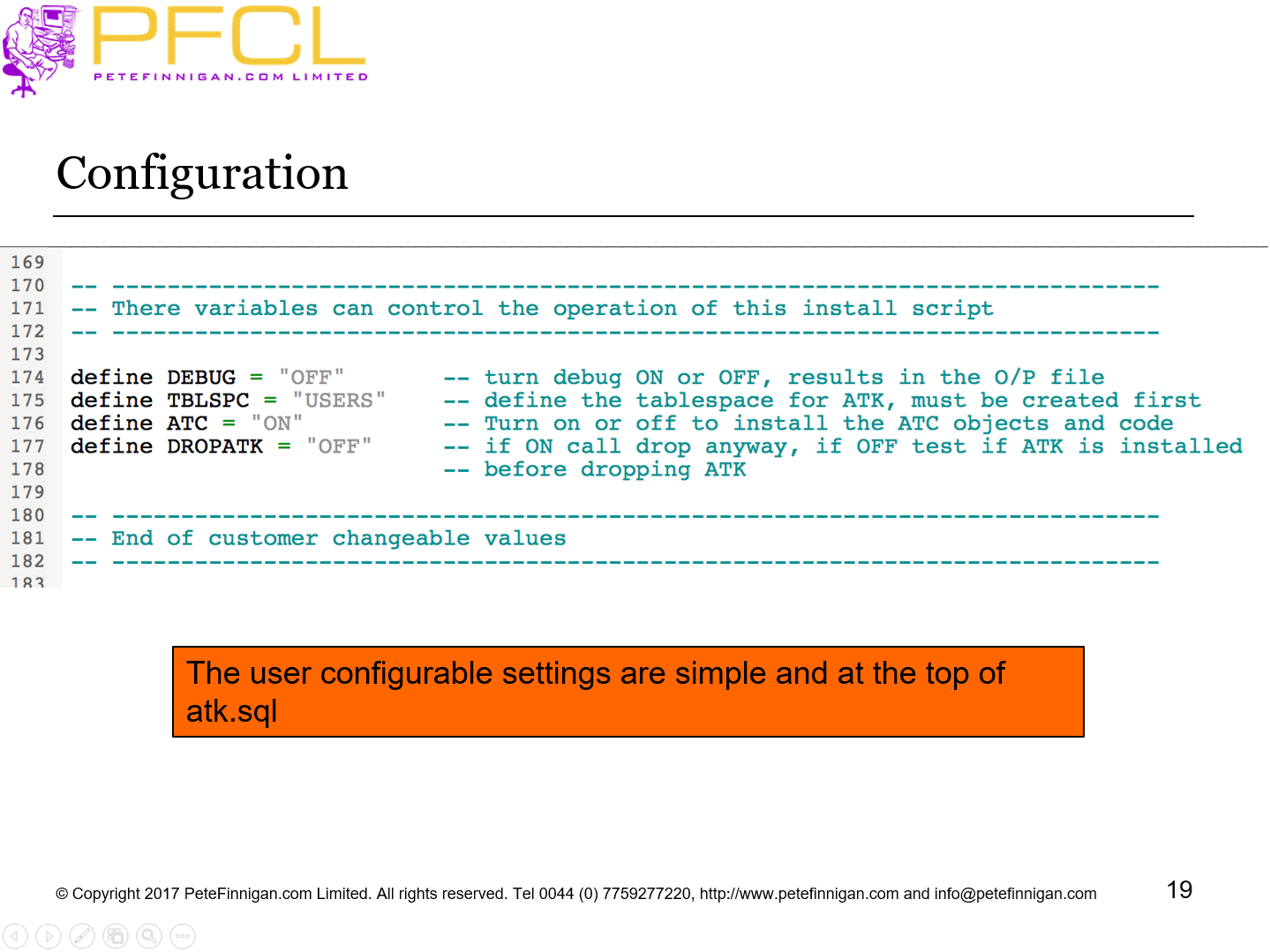
The user configurable settings are simple and at the top of atk.sql
- Slide 20 - Factors
-
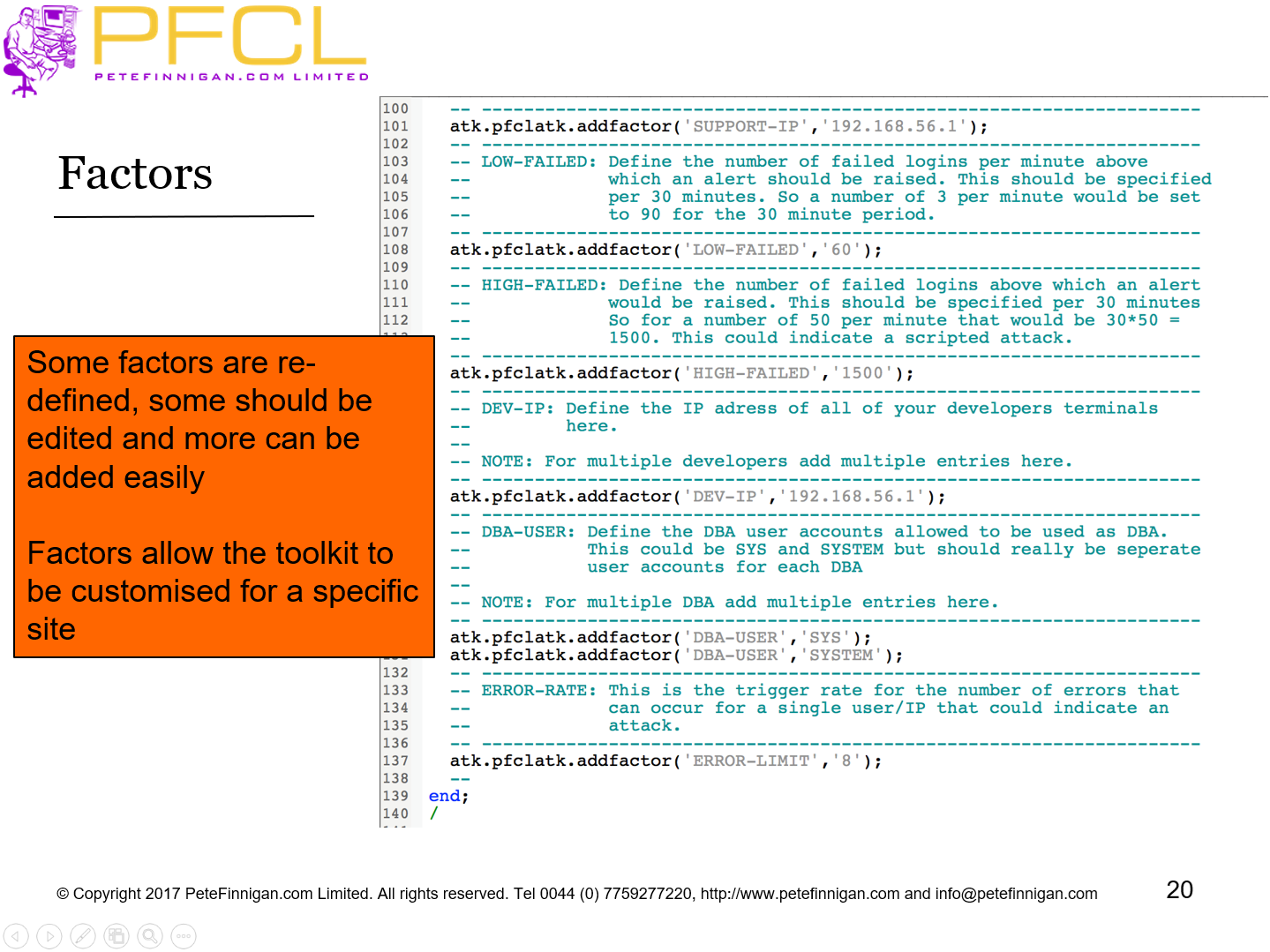
Some factors are re-defined, some should be edited and more can be added easily
Factors allow the toolkit to be customised for a specific site - Slide 21 - Audit Policies
-
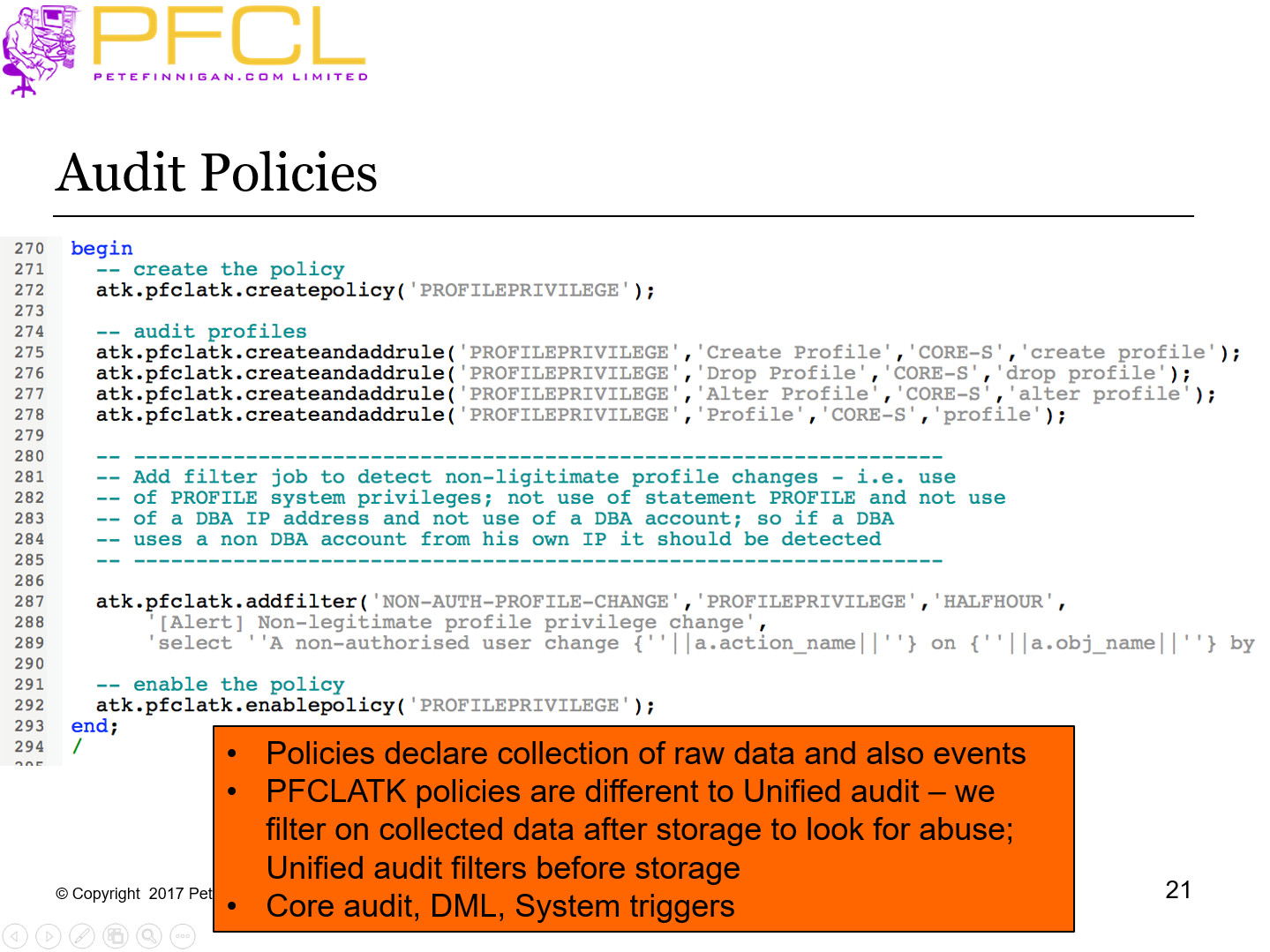
- Policies declare collection of raw data and also events
- PFCLATK policies are different to Unified audit – we filter on collected data after storage to look for abuse; Unified audit filters before storage
- Core audit, DML, System triggers
- Slide 22 - Alert Jobs
-
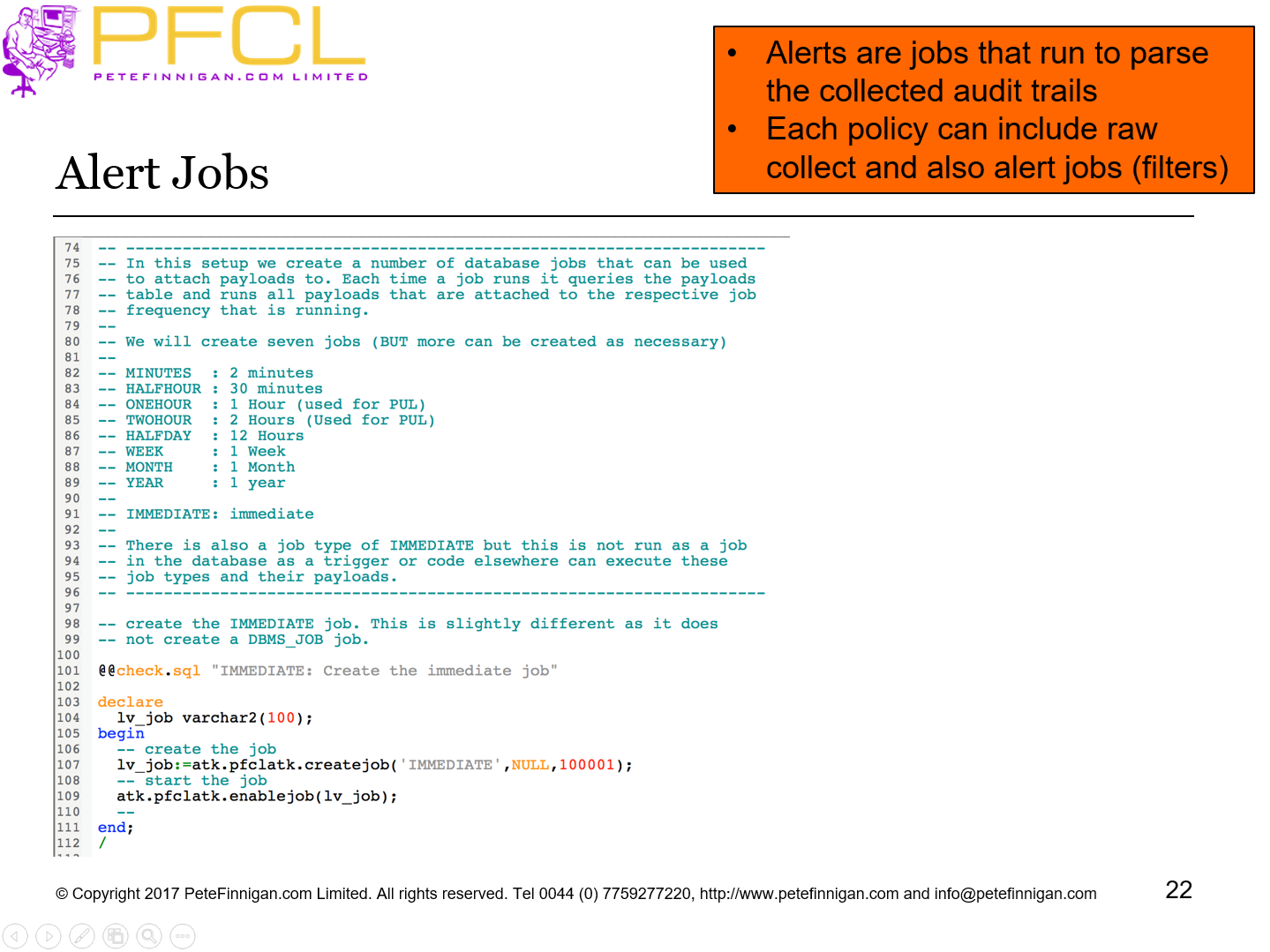
- Alerts are jobs that run to parse the collected audit trails
- Each policy can include raw collect and also alert jobs (filters)
- Slide 23 - Audit of Audit
-
- A multi-layer approach is needed
- Audit of core trail tables such as AUD$
- Audit of core audit settings such as AUDIT$
- Audit of triggers (Event, DDL and DML)
- Audit of custom logs
- Audit of audit functionality, packages and other objects
- All can be set up as policies in PFCLATK
- Slide 24 - Prevent Delete of Audit
-
- There is a danger that someone deletes audit or changes audit or disables triggers
- Because we use multi-layer audit this is harder to achieve
- Also we can be alerted to delete and changes and use tools such as LogMiner to get data back
- The toolkit includes audit of audit, security of audit, audit of security of audit
- Security of the tool, checksums, obfuscate, permissions and more
- Slide 25 - Configure and Deploy
-
- Edit atk.sql
- Edit required settings needed for the toolkit
- Edit conf.sql
- Add connection details
- Demo deployment
- Run atk.sql
Demo: Configure and deploy
- Slide 26 - PFCLATC
-
- If we also would like to set up PFCLATK as a centralised audit then:
- Edit atk.sql configuration section and make the script ATC
- Deploy to a suitable centralised database
- Use the crl.sql script to create a link from the PFCLATC database to each target database
- The “PUL”ling of audit trails will now start from each target to the PFCLATC instance
- The pul reports will show progress (p.sql, p2.sql, p3.sql and p4.sql)
- Slide 27 - Demo Hacking
-
Demo:
- All ATK policies are enabled
- Test some SQL Injection as an attacker
- SQL Injection attack as unauthenticated web user
- SQL Injection attack as database user with just CREATE SESSION
- Access data as a DBA with %ANY% rights
- Slide 28 - Reports
-
- A few sample reports exist that highlight issues
- Audit_report.sql
- Car.sql
- Alerts are viewed via the ATKD.PFCLATK_ALERTS table
- Alert details in ATKD.PFCLATK_ALERT_ROWS
- tr.sql shows high level summary of alerts
Demo: look at the audit trails
- Slide 29 - Extend the Toolkit
-
- Two levels of extension are possible
- 1 – Areas of the database can be audited automatically
- Policies can be created via SQL or PL/SQL for users
- Policies can be created via SQL or PL/SQL for roles
- These tools can be exposed as part of the PFCLATK toolkit
- 2 – New policies and rules can be defined
- Policies can be defined for areas of an application
- Policies can be defined for areas of the core database
- New jobs can be added that generate raw audit trail data
- New jobs can be defined as filters that generate alert records and alerts
- Slide 30 - Issues and Future
-
- Sys audit on some objects cannot be enabled other than as SYSDBA
- Multitennant has similar issues
- Standby databases cause issues with triggers
- Extend to generate 12c unified audit policies
- Enhancements and areas to extend can include
- Parsing of listener log via SQL – PL/SQL
- udit in other areas such as password function
- Read the alert log, trace files
- Add automated policy generation
- Add internal security checks
- Protection layers
- Extend to generate FGA policies
- More to do, clean up the code, refactor the code better
- Reduce privileges needed as much as possible
- Create a separate API needed by report user not the full API as now
- Reduce the noise on the toolkit itself
- Slide 31 - Availability
-
- Get a copy?
- Must be willing to deploy and try it as we would like feedback
- Email pete@petefinnigan.com
- Its not available as a general download
- Is it free?
- The PL/SQL API toolkit is currently free (not sure if it always will be)
- Free does not mean GPL or similar toxic licenses
- We reserve the right to make it commercial
- Most likely we will add an admin dashboard (perhaps as part of PFCLScan, perhaps not) and reports and support will be available
- We also do consultancy to design and deploy audit trails using this toolkit (already)
- Slide 32 - Conclusions
-
- Start to audit the database engine
- Understand what people are doing at the database engine level
- Take advantage of a simple to use idea to enable policies and factors
- Deploy with a simple command
- Close the gap between OS and application audit
- GDPR is coming and you need to detect attacks (successful or not)
- Slide 33 - Auditing The Oracle Database
-
PFCATK – A Toolkit to Help