



Is your PL/SQL secure?
This is my presentation to the UKOUG in December on is your PL/SQL secure?
- Slide 1 - Is Your PL/SQL Secure?
-
- Slide 2 - Legal notice
-
Is Your PL/SQL Secure?
Published by
PeteFinnigan.com Limited
Tower Court
3 Oakdale Road
York
England, YO30 4XL
Copyright © 2025 by PeteFinnigan.com Limited
No part of this publication may be stored in a retrieval system, reproduced or transmitted in any form by any means, electronic, mechanical, photocopying, scanning, recording, or otherwise except as permitted by local statutory law, without the prior written permission of the publisher. In particular this material may not be used to provide training of any type or method. This material may not be translated into any other language or used in any translated form to provide training. Requests for permission should be addressed to the above registered address of PeteFinnigan.com Limited in writing.
Limit of Liability / Disclaimer of warranty. This information contained in this course and this material is distributed on an “as-is” basis without warranty. Whilst every precaution has been taken in the preparation of this material, neither the author nor the publisher shall have any liability to any person or entity with respect to any loss or damage caused or alleged to be caused directly or indirectly by the instructions or guidance contained within this course.
TradeMarks. Many of the designations used by manufacturers and resellers to distinguish their products are claimed as trademarks. Linux is a trademark of Linus Torvalds, Oracle is a trademark of Oracle Corporation. All other trademarks are the property of their respective owners. All other product names or services identified throughout the course material are used in an editorial fashion only and for the benefit of such companies with no intention of infringement of the trademark. No such use, or the use of any trade name, is intended to convey endorsement or other affiliation with this course.
- Slide 3 - Background
-
Pete Finnigan – Background, Who Am I?
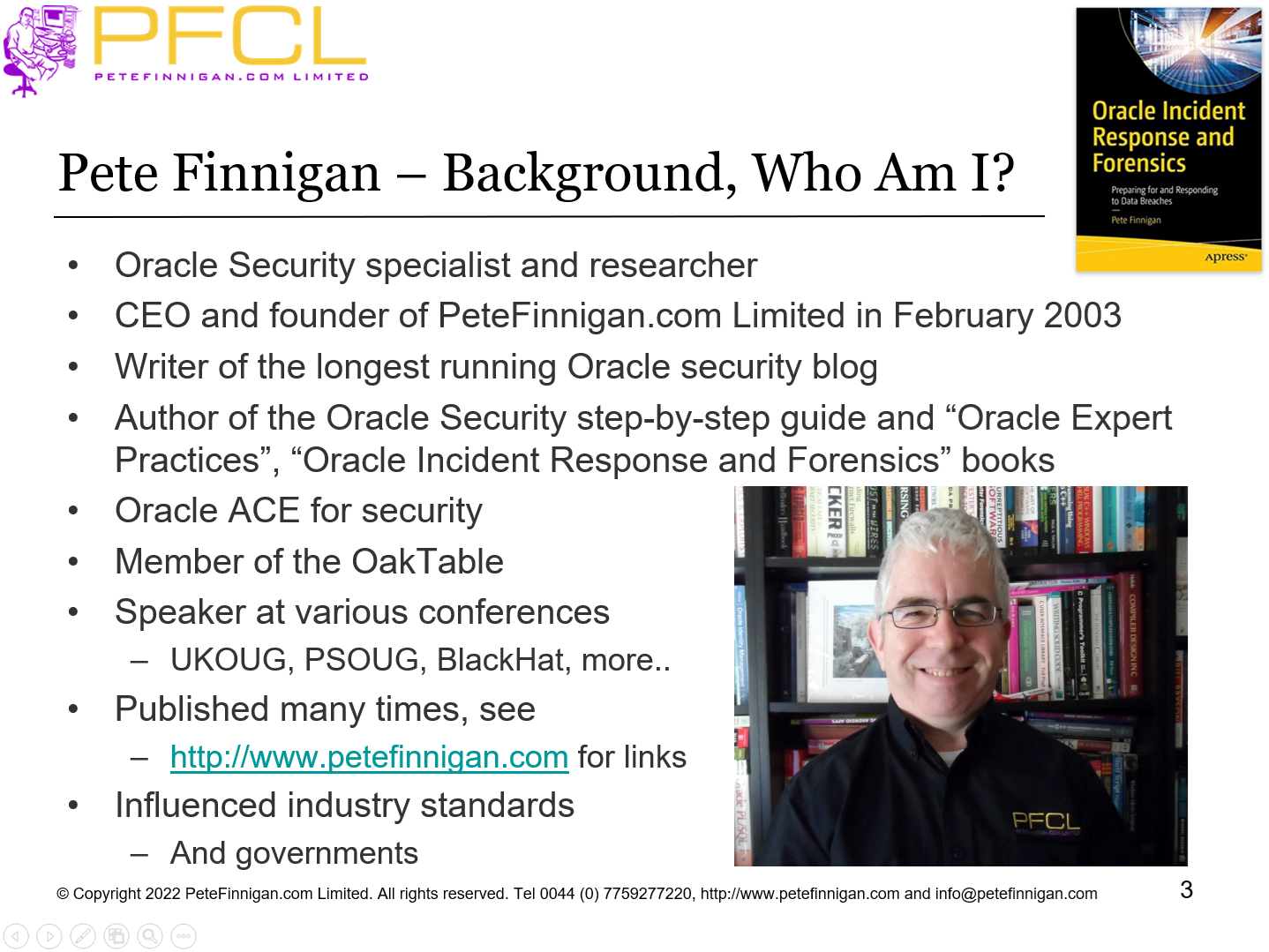
- Oracle Security specialist and researcher
- CEO and founder of PeteFinnigan.com Limited in February 2003
- Writer of the longest running Oracle security blog
- Author of the Oracle Security step-by-step guide and “Oracle Expert Practices”, “Oracle Incident Response and Forensics” books
- Oracle ACE for security
- Member of the OakTable, SYM 42
- Speaker at various conferences UKOUG, PSOUG, BlackHat, more..
- Published many times, see http://www.petefinnigan.com for links
- Slide 4 - Agenda
-
- PL/SQL
- Security of PL/SQL
- Attacks involving PL/SQL
- Securing PL/SQL high level
- Testing PL/SQL
- Fixing your code
- Summing Up
- Slide 5 - PL/SQL
-
PL/SQL
- Slide 6 - Databases Use PL/SQL
-
- We see PL/SQL in most databases
- In your business logic
- Third party applications that use PL/SQL such as EBS
- Commercial tools you use that manage / monitor the database
- Tools your DBAs and Support create that manage / monitor the database
- Slide 7 - Security of PL/SQL
-
Security of PL/SQL
- Slide 8 - Three Security Domains in Secure Code
-
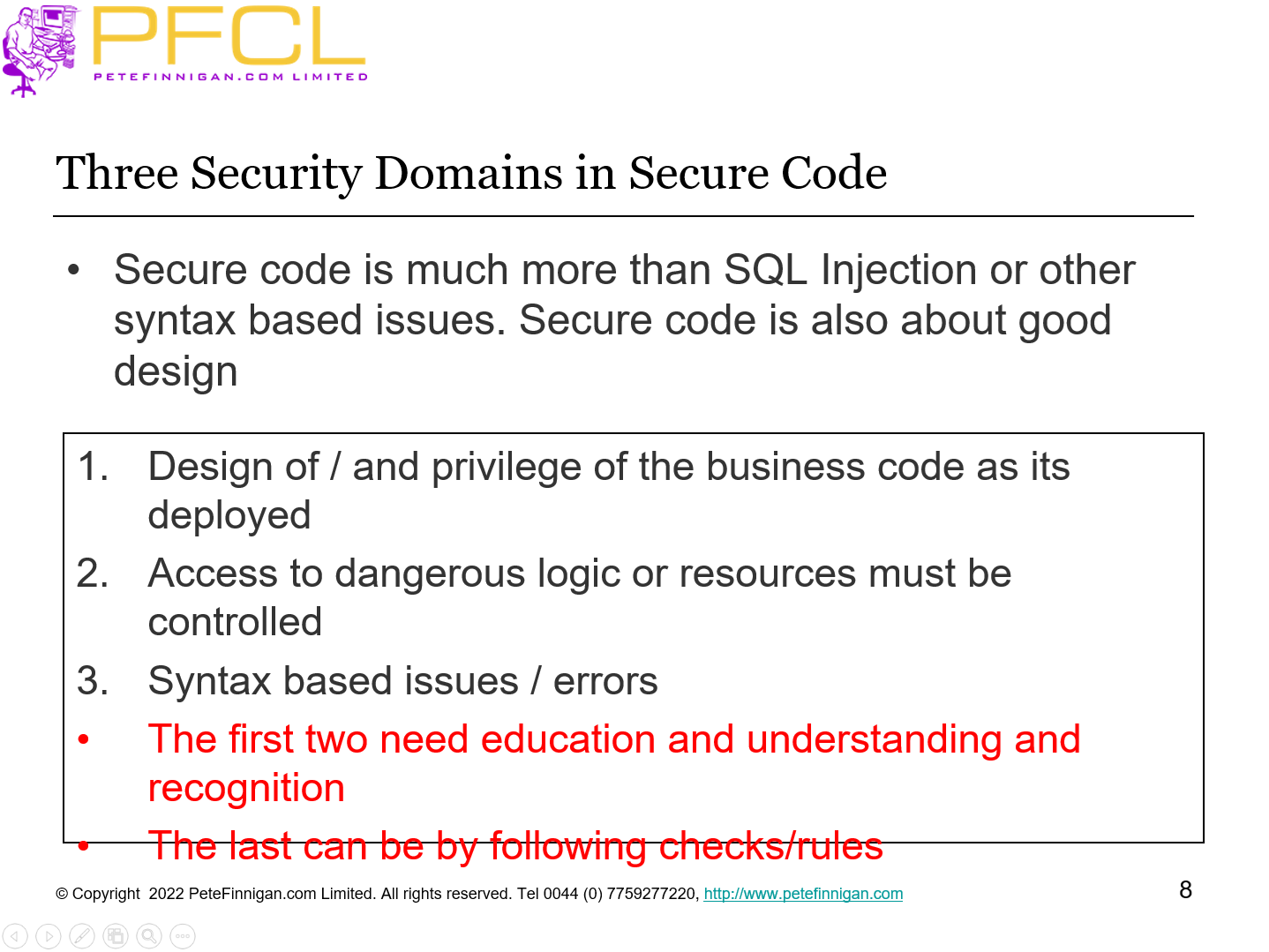
- Secure code is much more than SQL Injection or other syntax based issues. Secure code is also about good design
- Design of / and privilege of the business code as its deployed
- Access to dangerous logic or resources must be controlled
- Syntax based issues / errors
- The first two need education and understanding and recognition
- The last can be by following checks/rules
- Slide 9 - What If Your Database Is absolutely locked Down?
-
- We can completely lock down Oracle to prevent breaches or data loss THEN
- The only possible attacks would be
- Corrupt employees can use apps to access data
- Someone can gain access to the building and access unattended IT
- An attacker can exploit the applications PL/SQL business or security code
- Security of code is not just about syntax
- You must design security
- Slide 10 - Attacks Involving PL/SQL
-
Attacks Involving PL/SQL
- Slide 11 - Simple SQL Injection Example
-
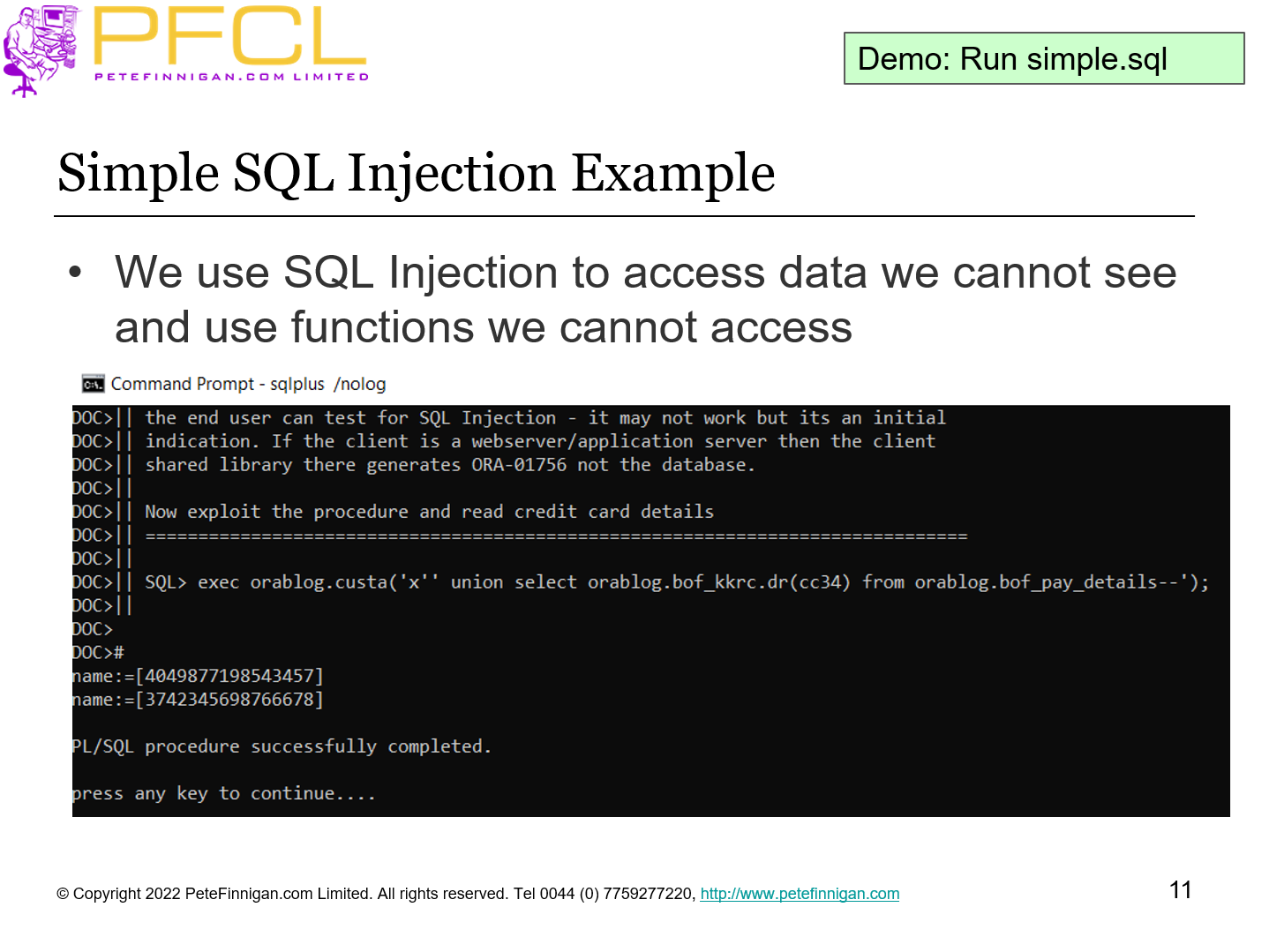
- We use SQL Injection to access data we cannot see and use functions we cannot access
Demo: Run simple.sql
- Slide 12 - Permissions Issue
-
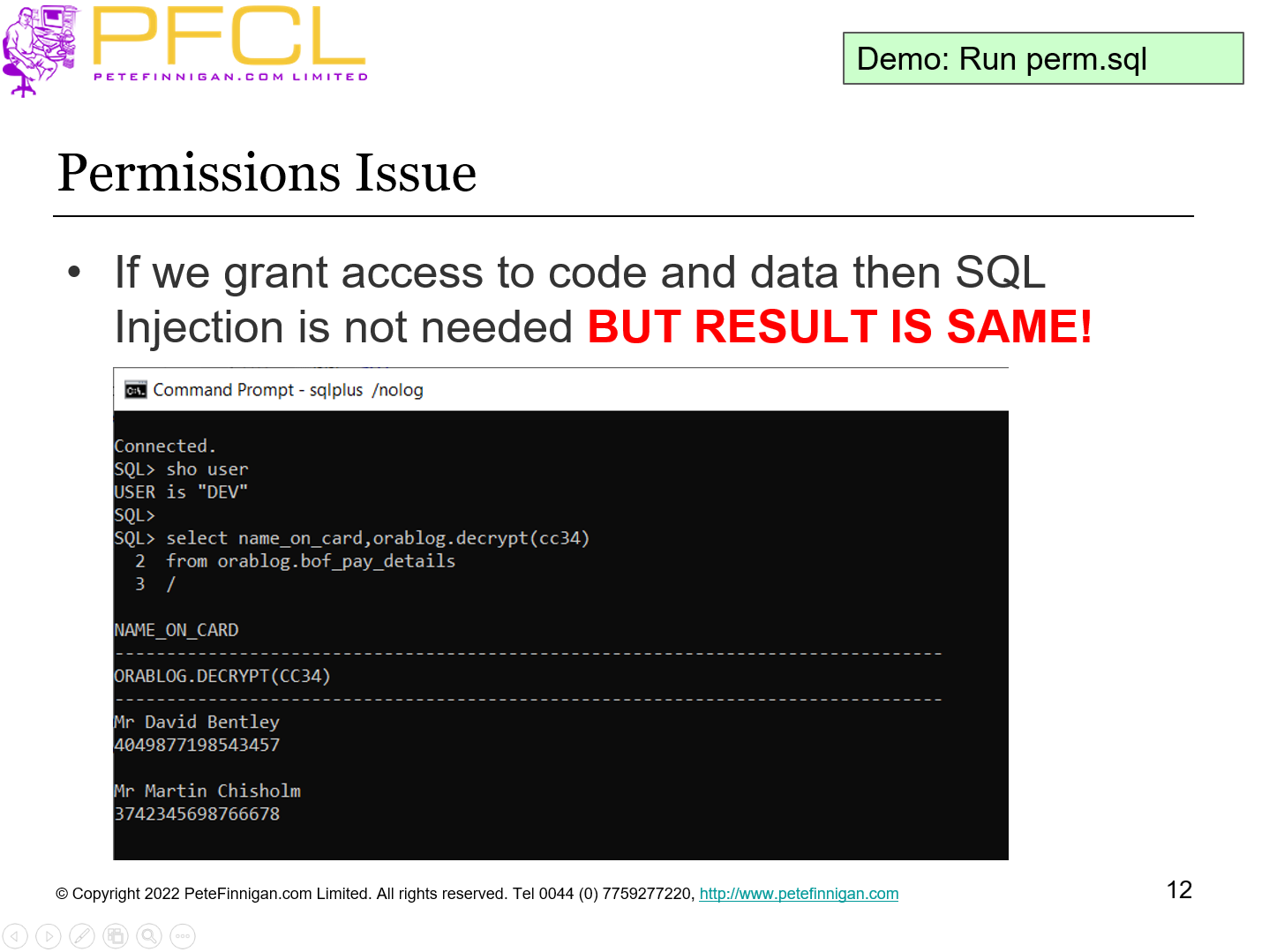
- If we grant access to code and data then SQL Injection is not needed BUT RESULT IS SAME!
Demo: Run perm.sql
- Slide 13 - Expose Internal Secrets (Encryption Key)
-
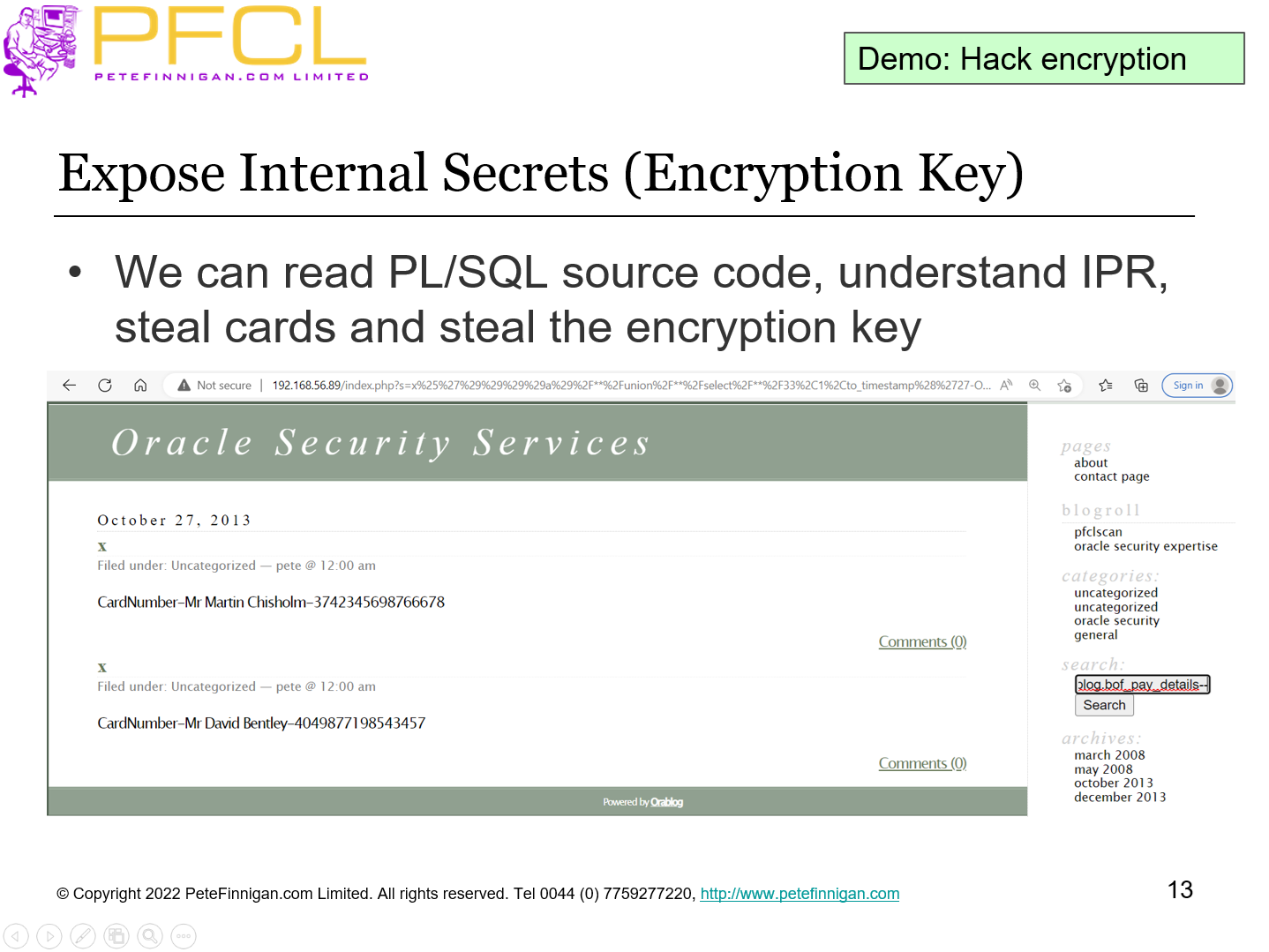
- We can read PL/SQL source code, understand IPR, steal cards and steal the encryption key
Demo: Hack encryption
- Slide 14 - Summary of Hacking
-
- We can steal data not just with SQL injection
- We can simply use a PL/SQL interface that gets the data for us
- We could steal encrypted data and re-implement the PL/SQL “off-line” to steal it
- We could use resources to access data – i.e. use PL/SQL -> Java -> data files
- Slide 15 - Code Areas to Consider
-
- Injection (SQL, PL/SQL, JavaScript, XSS,….)
- Replacement
- Comments that cause issue:
- FUDGE, BODGE, FIXME, ****, ####, TODO, BUG, TICKET…
- Comments that describe security functions and how they work – i.e. encryption key location or password mechanism
- Use of
- Undocumented packages – i.e. %_FFI, KUPP$...
- Deprecated methods and functions, i.e. DBMS_JOB
- Vulnerable functions – i.e. CPU, PSU
- Dangerous, i.e. UTL_MAIL
- Open Interface, i.e. DBMS_DDL
- Magic values, i.e. passwords, keys, IP Address
There are many more areas that we can consider as weaknesses in PL/SQL. Some are highlighted here
- Slide 16 - More Areas to Consider - 2
-
- Values passed to dangerous code, i.e. key passed to DBMS_CRYPTO
- Resources not managed – opened and not closed
- Dependencies – i.e. secure one layer and expose others
- Debug, Trace, Wrapping can be used to inject
- Schemas accessible so bypassing security logic
- Synonyms
- Non direct paths to code
- Multi layer code
- Exceptions, lack of, hiding, never raised, never caught
- Slide 17 - More Areas to Consider - 3
-
- Standalone procedures
- Exceptions – Oracle codes, code and error numbers
- Unused variables, parameters, non-initialised
- Duplication
- Unused or unreachable code
- Ref cursors
- Non-standard concatenation or home grown SQL injection solutions
- Quoted identifiers
- Use of C or Java
- Code size
- Slide 18 - Securing PL/SQL at a High Level
-
Securing PL/SQL at a High Level
- Slide 19 - Secure PL/SQL from Different Vectors
-
- Where
- PL/SQL itself is the attack vector
- Where the attacker gains access due to database security issues
- Design issues (User, Data, Access) allow
- PL/SQL can let you down even if the database is secure
- Success as an attacker gives access to more: IPR, code function…
- An attacker can run code when not intended by apps
- Slide 20 - Testing PL/SQL
-
Testing PL/SQL
- Slide 21 - Automate
-
- Automate testing
- Create a policy / plan
- Create a database security standard
- Create a secure code standard
- Test database security
- Test PL/SQL code security
- Manually do the things that cannot be automated BUT as part of a development and release process
- Slide 22 - Create a Policy
-
- The first step in establishing secure coding practices for PL/SQL is to create a secure coding standards for all PL/SQL development
- What does could it include?
- Industry best practice
- SANS
- OWASP
- PCI
- What format should it take?
- It should be short
- Simple to follow
- Each “rule” should be distinct to avoid interpretation issues
- Define testing against the policy
- This could be manual or automated
- No testing should take place until a standard exists otherwise any testing would be completely random
You cannot secure with random actions, create a plan and work to it
- Slide 23 - Testing PL/SQL Code
-
Three options exist to test your own code but it should be driven by a policy
- Manually review code by eye
- Use a commercial tool to scan PL/SQL code such as Fortify or PFCLCode from PeteFinnigan.com Limited
- Use a free tool to scan PL/SQL code such as VCG or simple SQL and PL/SQL scripts
- Using any tool (free or commercial) out of the box has value
- But: ensure that you test to your own defined standards
- Also be aware that some tools are expensive
- Also be aware that some tools do not find what you need to test for
Analysis involves two levels of issue; static “grep” like for dangerous code or IPR and flow analysis for dynamic SQL or injection
Flow analysis could be by tainting or by processing an AST - Slide 24 - Manual Review
-
- Develop a review cycle that includes security
- Cycle
- Code is written
- Scan / review for security issues
- Function test and integration
- Scan / review again for security issues
- This should fit into the normal development process as additional tasks that check for potential security issues
- Slide 25 - PFCLCode – Commercial Code Scanner
-
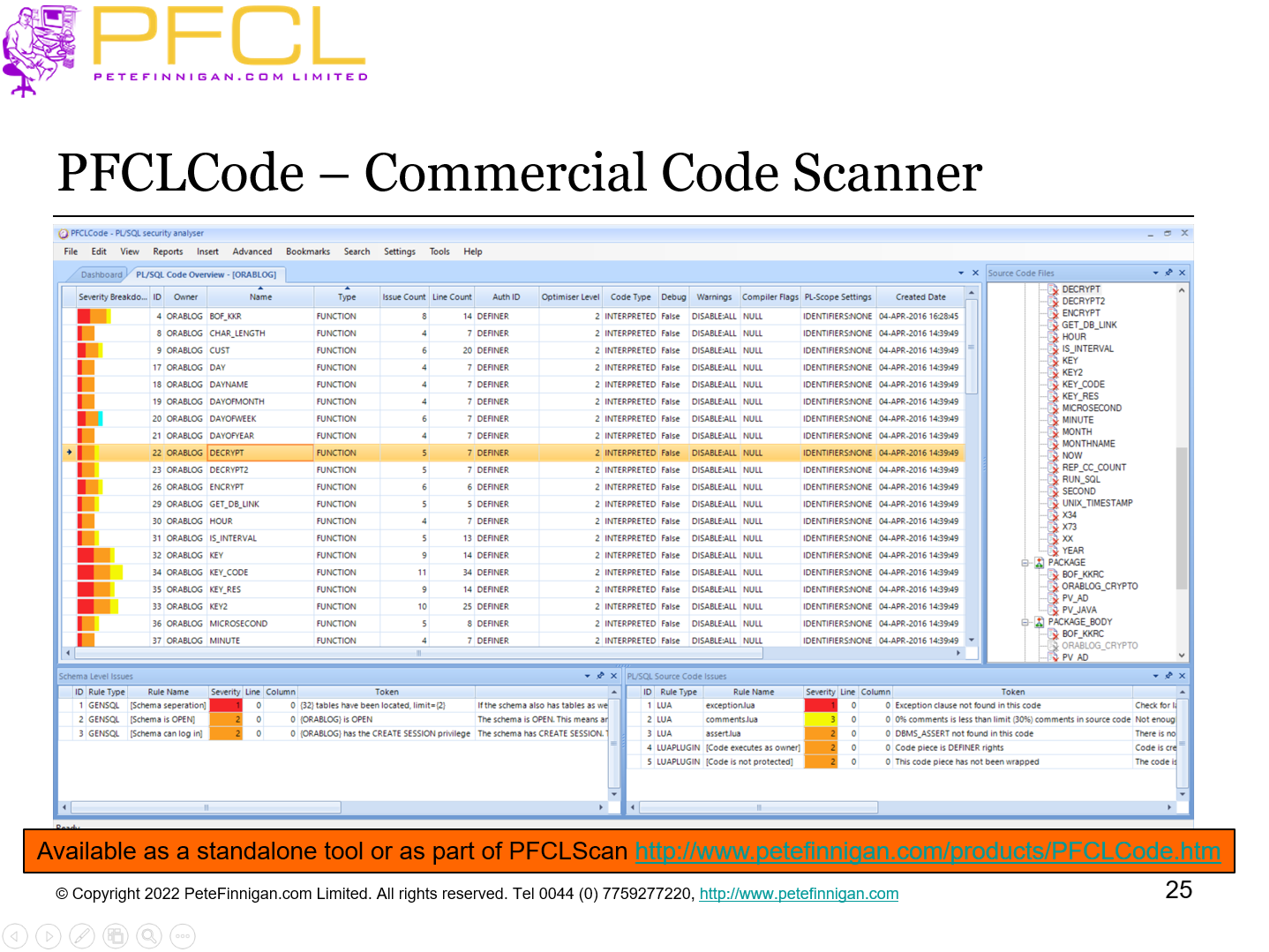
PFCLCode – Commercial Code Scanner
- Slide 26 - Simple Automated Code Analysis
-
- A simple code analysis can be done with queries against the database
- Analyse DBA_ARGUMENTS to locate public interfaces for PL/SQL that can be access by code
- Use script newcodea.sql to locate code that contains dangerous constructs such as DDL, dangerous packages such as DBMS_DDL or dynamic SQL such as EXECUTE IMMEDIATE, DBMS_SQL, DBMS_SYS_SQL and OPEN FOR
- These checks can identify code that could be analysed by hand to assess if issues exist
- The new PL-Scope interface also can provide value to analyse identifiers used in PL/SQL code.
Demo: Run analyse.sql
- Slide 27 - Fixing Your Code
-
Fixing Your Code
- Slide 28 - Security Best Practice in PL/SQL
-
- Design code for security
- Separate logic / function (code) and data into domains
- Design permissions (grants)
- Design for users who access the code
- i.e. we cannot as developers control users as once code is deployed we can have no further say in how its used
- But we can code in logic to prevent bad use
- Use role detection
- Use privilege detection
- Use context based security in our code
- This cannot realistically be done for all code though
- Slide 29 - Security API as a Design Pattern
-
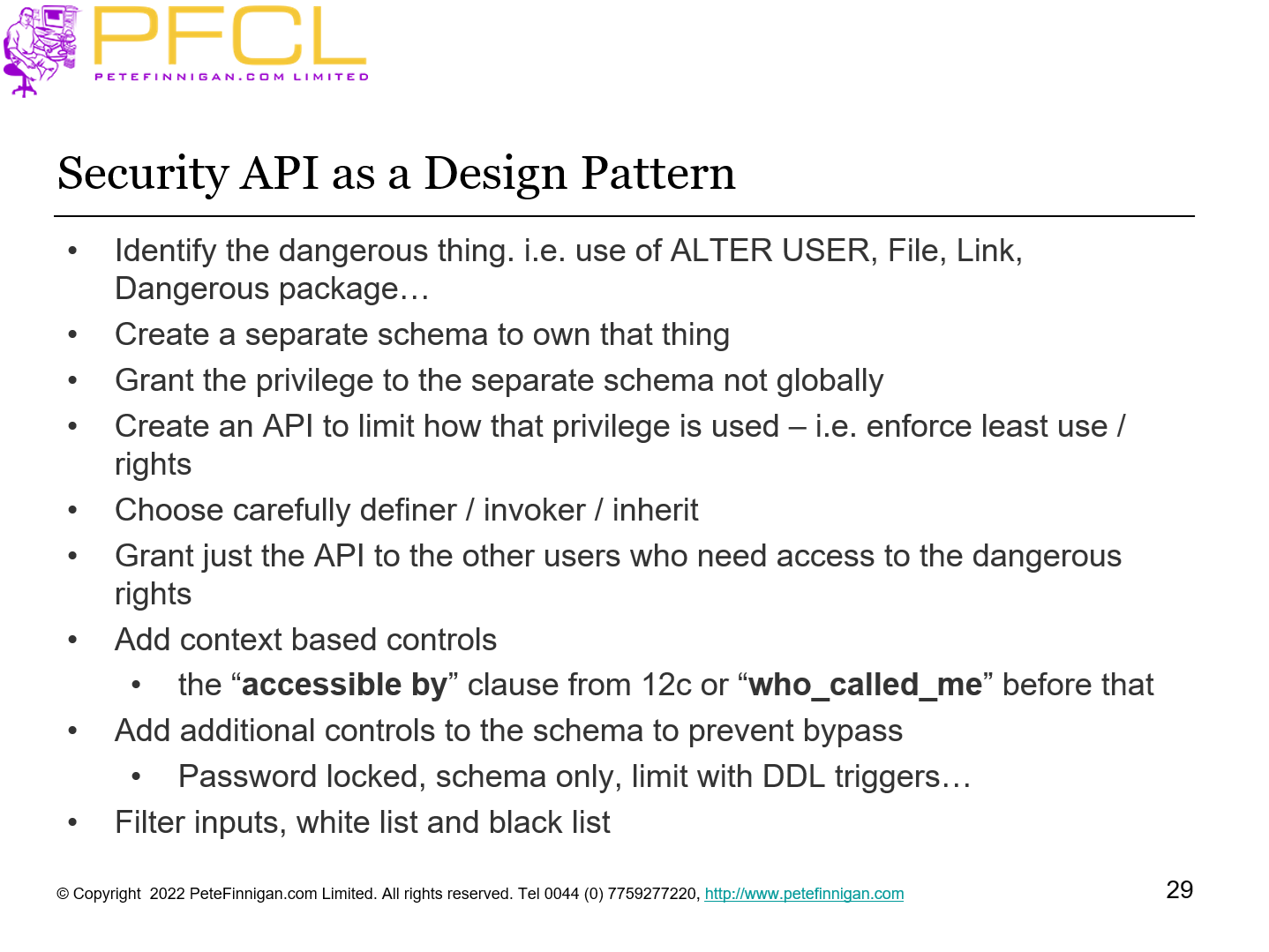
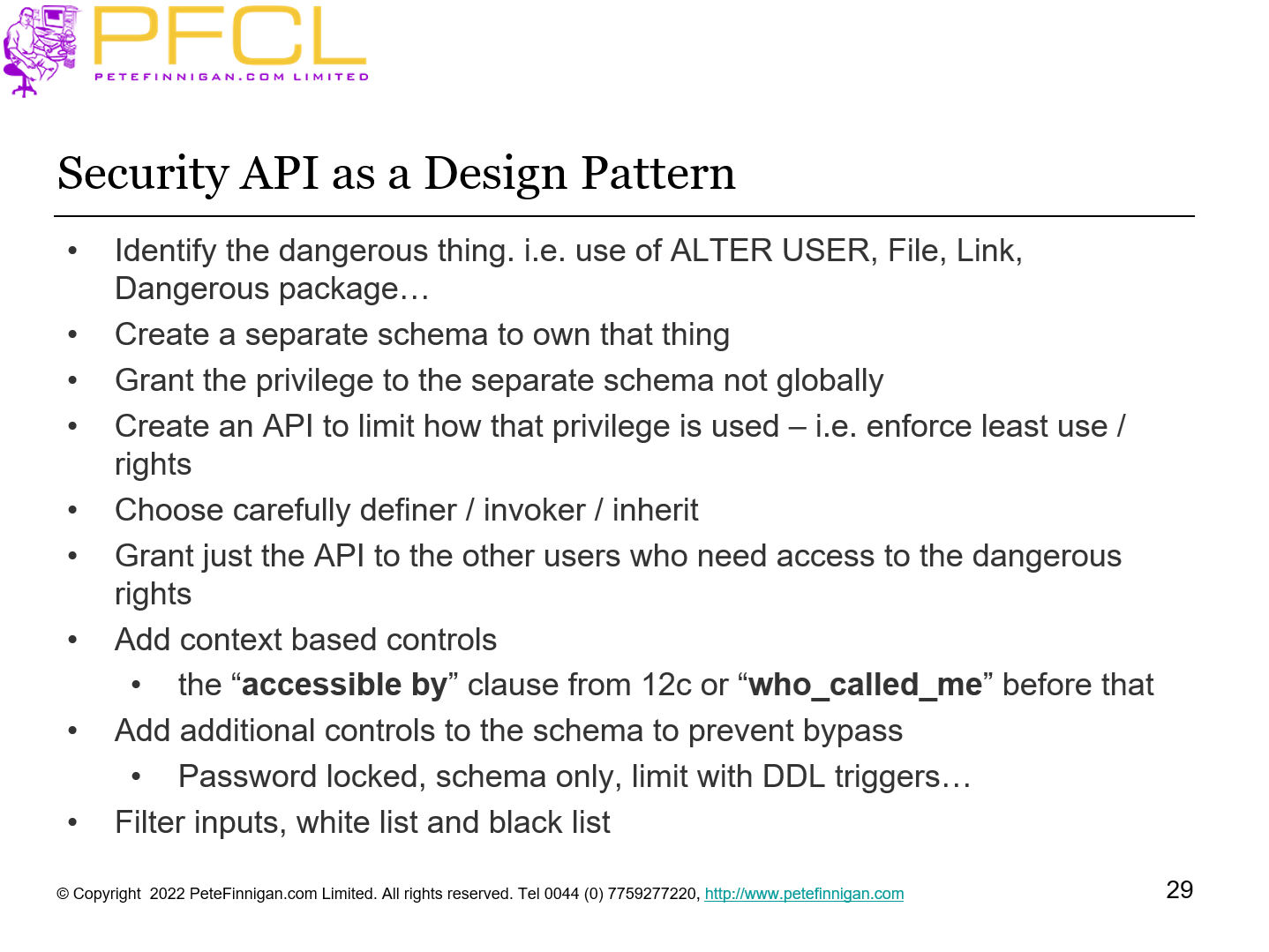
- Identify the dangerous thing. i.e. use of ALTER USER, File, Link, Dangerous package…
- Create a separate schema to own that thing
- Grant the privilege to the separate schema not globally
- Create an API to limit how that privilege is used – i.e. enforce least use / rights
- Choose carefully definer / invoker / inherit
- Grant just the API to the other users who need access to the dangerous rights
- Add context based controls
- the “accessible by” clause from 12c or “who_called_me” before that
- Add additional controls to the schema to prevent bypass
- Password locked, schema only, limit with DDL triggers…
- Filter inputs, white list and black list
- Slide 30 - Obfuscate Code and License Code (Protect IPR)
-
- Obfuscation
- Randomise the code identifiers,
- Remove comments, whitespace etc
- Deeper obfuscations
- License features could have many forms; Types
- Time/ date based
- Place – DBID, DBNAME, Network adaptor, Server, hardware, number of CPU’s...
- Data based – such as SYS create date or DB create date
- Person based
- Context based – where in code,
- Privilege based/enabled
- i.e. Run on Tuesday between 6 and 8 pm when user is “FRED” and role “BLOB” is enabled and DB is PROD and ....
- Slide 31 - Example Fix: Basic Security Filtering
-
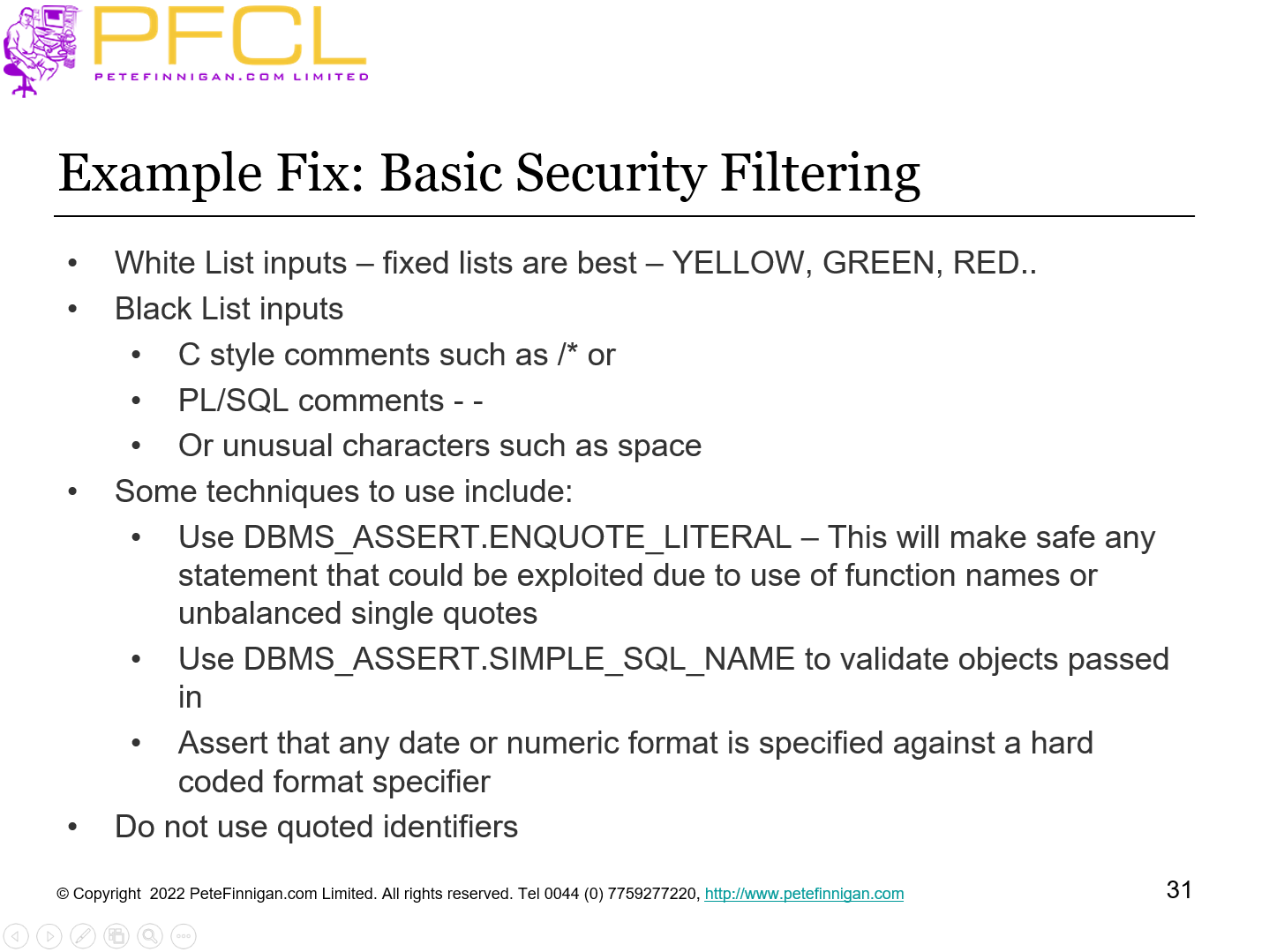
- White List inputs – fixed lists are best – YELLOW, GREEN, RED..
- Black List inputs
- C style comments such as /* or
- PL/SQL comments - -
- Or unusual characters such as space
- Some techniques to use include:
- Use DBMS_ASSERT.ENQUOTE_LITERAL – This will make safe any statement that could be exploited due to use of function names or unbalanced single quotes
- Use DBMS_ASSERT.SIMPLE_SQL_NAME to validate objects passed in
- Assert that any date or numeric format is specified against a hard coded format specifier
- Do not use quoted identifiers
- Slide 32 - Example Fix: Static Concatenation
-
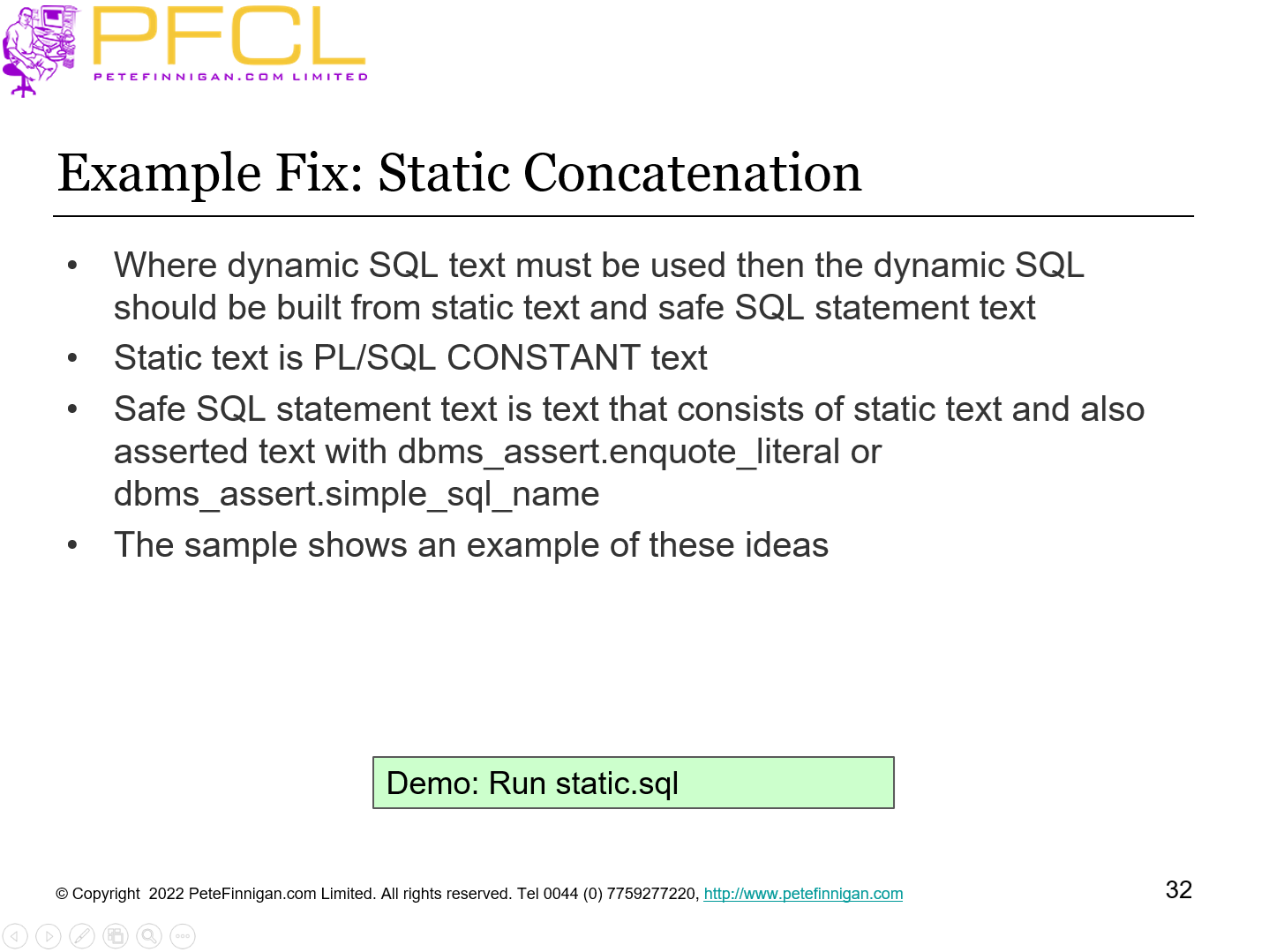
- Where dynamic SQL text must be used then the dynamic SQL should be built from static text and safe SQL statement text
- Static text is PL/SQL CONSTANT text
- Safe SQL statement text is text that consists of static text and also asserted text with dbms_assert.enquote_literal or dbms_assert.simple_sql_name
- The sample shows an example of these ideas
Demo: Run static.sql
- Slide 33 - Example Fix: Bind Variables
-
- Where dynamic SQL or PL/SQL does not involve objects then bind variables should instead be used as this effectively prevents injection
- The sample shows a solution to simple.sql using bind variables.
- NOTE: The overall solutions are multi-faceted
- We should use bind variables or explicit cursors
- We should use static template text
- We should assert input from attack
- We should filter and test input to be from a narrow range
Demo: Run bind.sql
- Slide 34 - Summing Up
-
Summing Up
- Slide 35 - Conclusions
-
- Focus first on architecture
- Separate dangerous code from normal logic
- Avoid loss of data via permissions issues
- Code securely (Injection, use, many more)
- Scan code for simple things and perform code review
- Create a policy
- Educate staff
- Slide 36 - Questions
-
Questions
- Slide 37 - Is Your PL/SQL Secure?
-
Is Your PL/SQL Secure?