


Oracle Database Vault in Real Life
This is my presentation to the UKOUG last December on Oracle Database Vault in Real Life
- Slide 1 - Oracle Database Vault in Real Life
-
- Slide 2 - Legal notice
-
Oracle Database Vault in Real Life
Published by
PeteFinnigan.com Limited
Tower Court
3 Oakdale Road
York
England, YO30 4XL
Copyright © 2025 by PeteFinnigan.com Limited
No part of this publication may be stored in a retrieval system, reproduced or transmitted in any form by any means, electronic, mechanical, photocopying, scanning, recording, or otherwise except as permitted by local statutory law, without the prior written permission of the publisher. In particular this material may not be used to provide training of any type or method. This material may not be translated into any other language or used in any translated form to provide training. Requests for permission should be addressed to the above registered address of PeteFinnigan.com Limited in writing.
Limit of Liability / Disclaimer of warranty. This information contained in this course and this material is distributed on an “as-is” basis without warranty. Whilst every precaution has been taken in the preparation of this material, neither the author nor the publisher shall have any liability to any person or entity with respect to any loss or damage caused or alleged to be caused directly or indirectly by the instructions or guidance contained within this course.
TradeMarks. Many of the designations used by manufacturers and resellers to distinguish their products are claimed as trademarks. Linux is a trademark of Linus Torvalds, Oracle is a trademark of Oracle Corporation. All other trademarks are the property of their respective owners. All other product names or services identified throughout the course material are used in an editorial fashion only and for the benefit of such companies with no intention of infringement of the trademark. No such use, or the use of any trade name, is intended to convey endorsement or other affiliation with this course.
- Slide 3 - Background
-
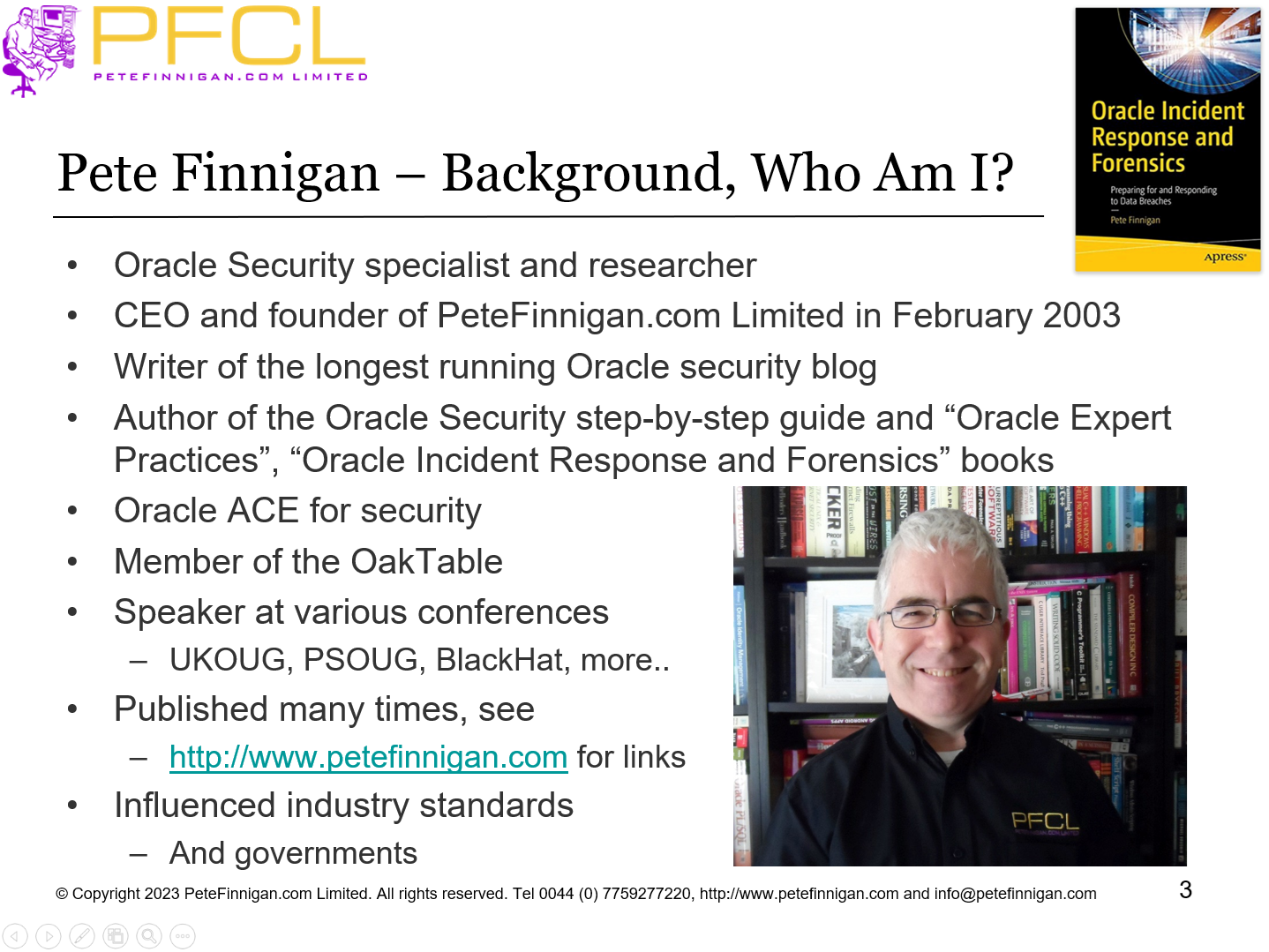
Pete Finnigan – Background, Who Am I?
- Oracle Security specialist and researcher
- CEO and founder of PeteFinnigan.com Limited in February 2003
- Writer of the longest running Oracle security blog
- Author of the Oracle Security step-by-step guide and “Oracle Expert Practices”, “Oracle Incident Response and Forensics” books
- Oracle ACE for security
- Member of the OakTable, SYM 42
- Speaker at various conferences UKOUG, PSOUG, BlackHat, more..
- Published many times, see http://www.petefinnigan.com for links
- Slide 4 - Agenda
-
- Securing Oracle
- Three elements to secure
- Do you want to go further?
- Do it the hard way
- Use Database Vault to add better security
- Report and verify
- Slide 5 - Securing Oracle
-
Securing Oracle
- Slide 6 - Secure Data
-
- The focus for us is to secure data and not “Oracle Security”
- We must use features of Oracle to secure our data BUT simply following a check list
- Securing to a list does not work as we must secure based on OUR data and OUR use of that data
- We will keep this talk fairly high level
- Slide 7 - Three Elements to Secure
-
Three Elements to Secure
- Slide 8 - Compartmentalise Data Security?
-
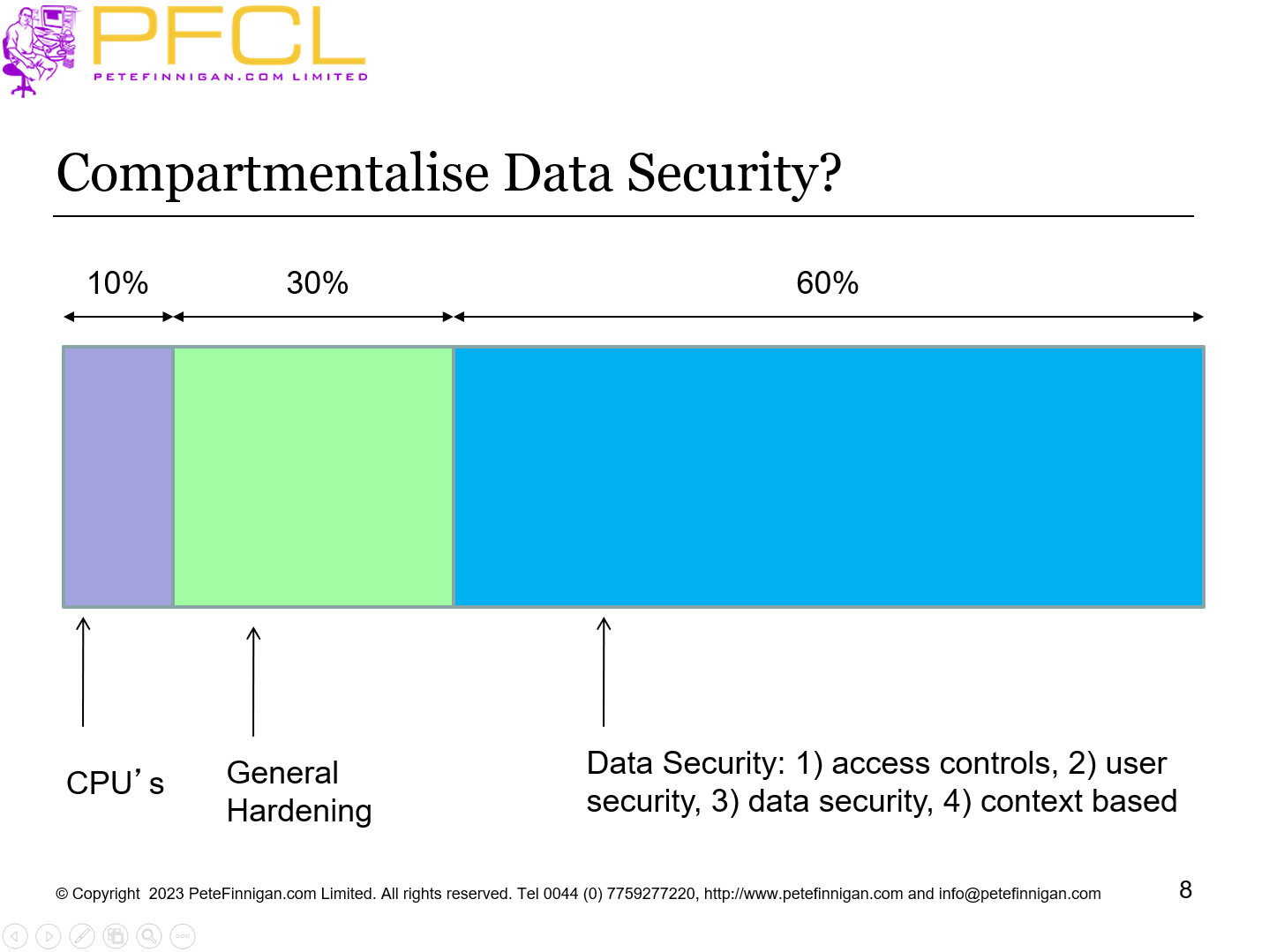
Compartmentalise Data Security?
- Slide 9 - Splitting Up Data Security in Oracle
-
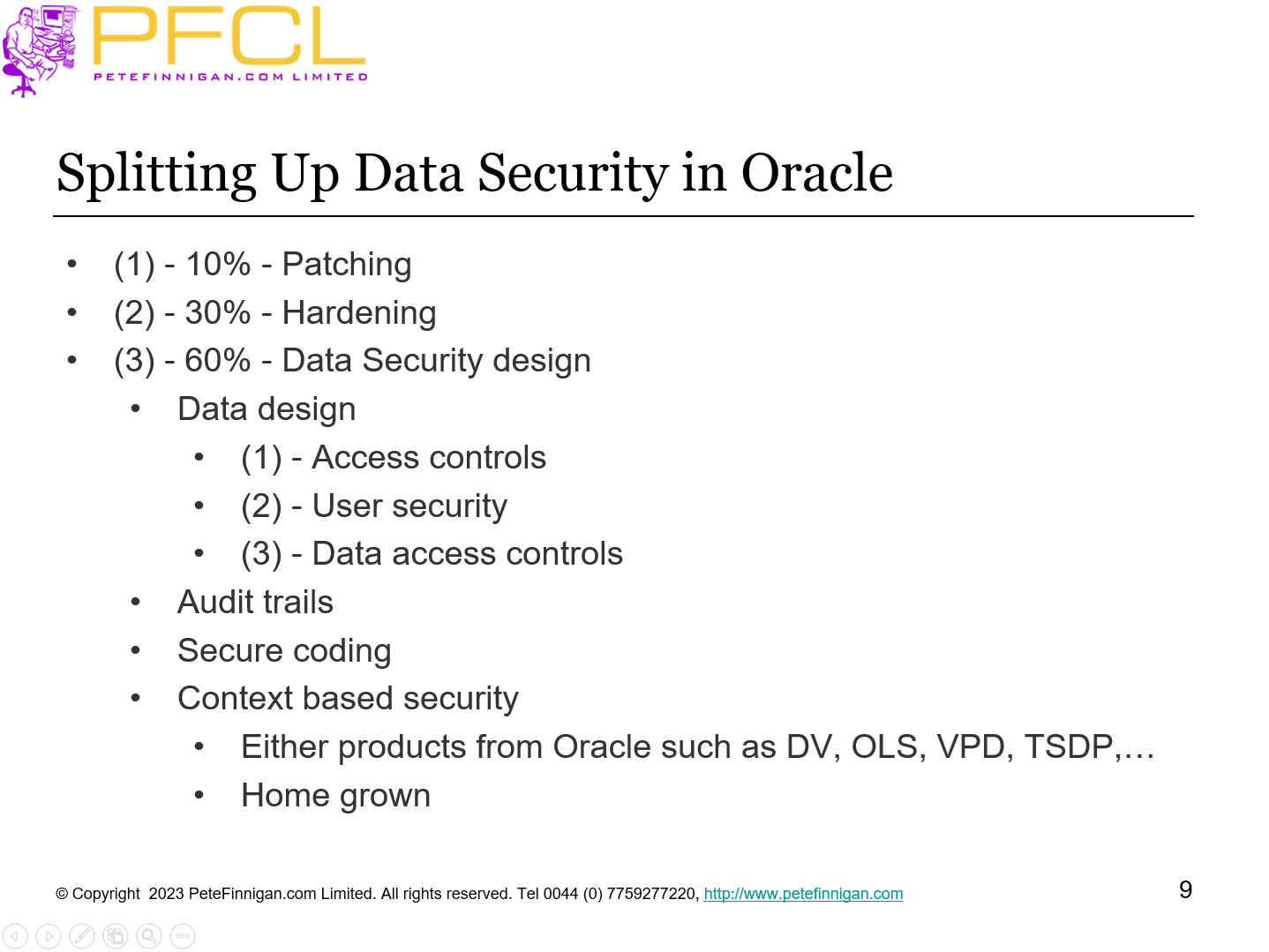
- (1) - 10% - Patching
- (2) - 30% - Hardening
- (3) - 60% - Data Security design
- Data design
- (1) - Access controls
- (2) - User security
- (3) - Data access controls
- Audit trails
- Secure coding
- Context based security
- Either products from Oracle such as DV, OLS, VPD, TSDP,…
- Home grown
- Slide 10 - Context Based Security
-
- Enhance other layers of security
- Allows detailed level security
- Allow pete to access credit cards from JDE and only from the office and on a PC in the accounts department
- How?
- Limit the database user, limit the application, limit the location, Limit by machine domain, limit by application roles of context / info / etc,
- Slide 11 - Do you Want to go Further?
-
Do you Want to go Further?
- Slide 12 - We Want to Achieve Better Security
-
- We must use context
- That context must be secure and trusted
- Can do some things with VPD, …
- Can do by hand with
- PL/SQL code, triggers, secure application roles, views and more
- Why is this an issue to do by hand?
- Lots of code, Design the framework yourself
- Can be bypassed as Oracle is complex
- Slide 13 - Do it the Hard Way
-
Do it the Hard Way
- Slide 14 - Context: View Based Security
-
- We can create VIEW BASED security to limit access to read data
- A PL/SQL function allows tests to be made to check whether access is allowed or not
- We could also check in this PL/SQL whether the privilege used is SELECT ANY by checking the users actual rights
- This can block some ANY privileges
- BUT system ANY for select can access the base table. Solution:
- Revoke system ANY except for sys
- Block SYSDBA access – The first versions of DV did this
- Slide 15 - Context: DML Based Security
-
- We can apply the same “Realm” type ideas to block DML with triggers
- This cannot be overridden as this is added to the base table and this is not view based
- Again we could check for System ANY in the PL/SQL code by looking at the callers rights
- We can also make a mandatory realm – in part at least with context based code
- Slide 16 - Command Rule: Block SQL*Plus - Webserver
-
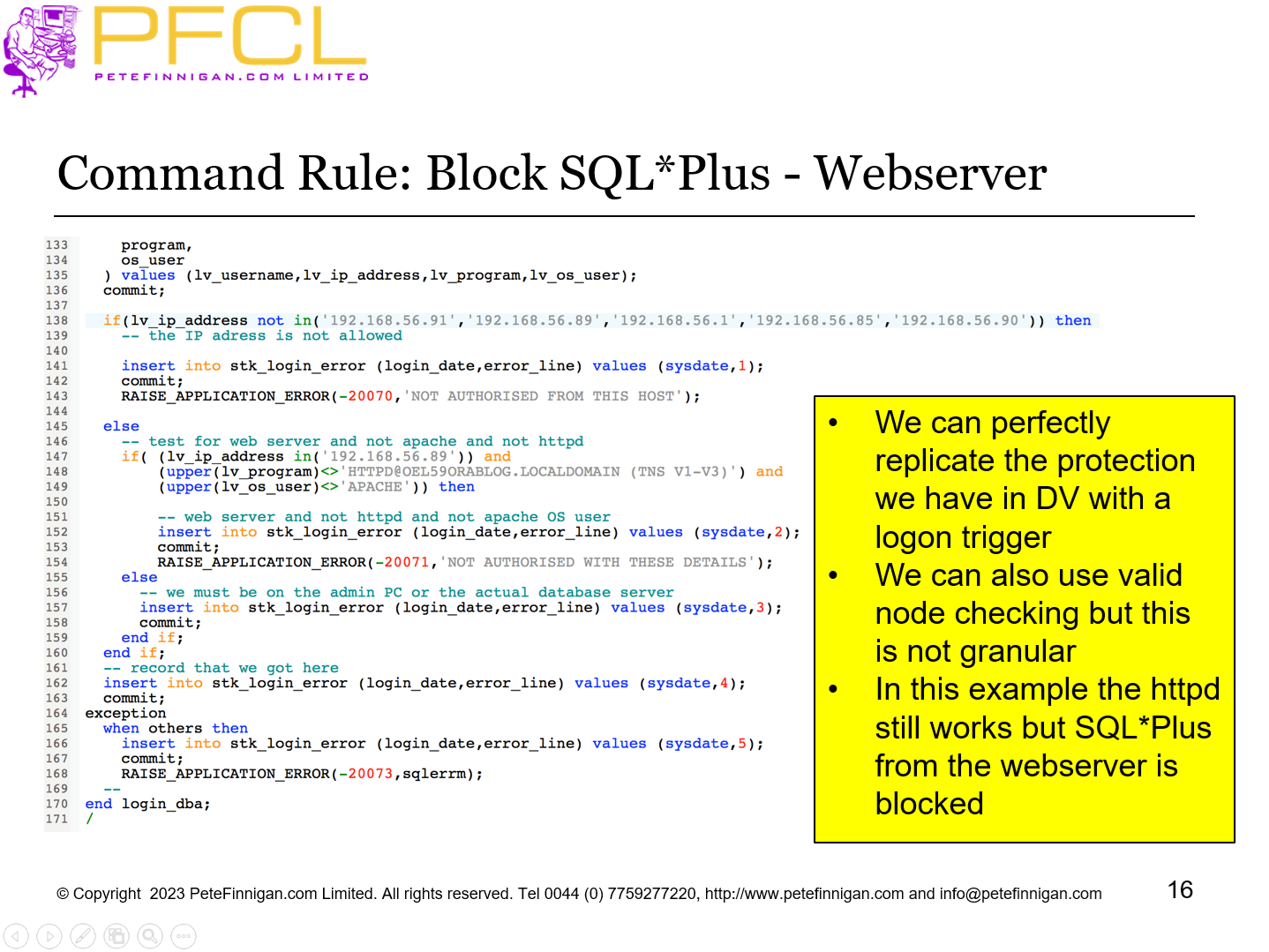
- We can perfectly replicate the protection we have in DV with a logon trigger
- We can also use valid node checking but this is not granular
- In this example the httpd still works but SQL*Plus from the webserver is blocked
- Slide 17 - Use Database Vault to Add Better Security
-
Use Database Vault to Add Better Security
- Slide 18 - What Is Database Vault?
-
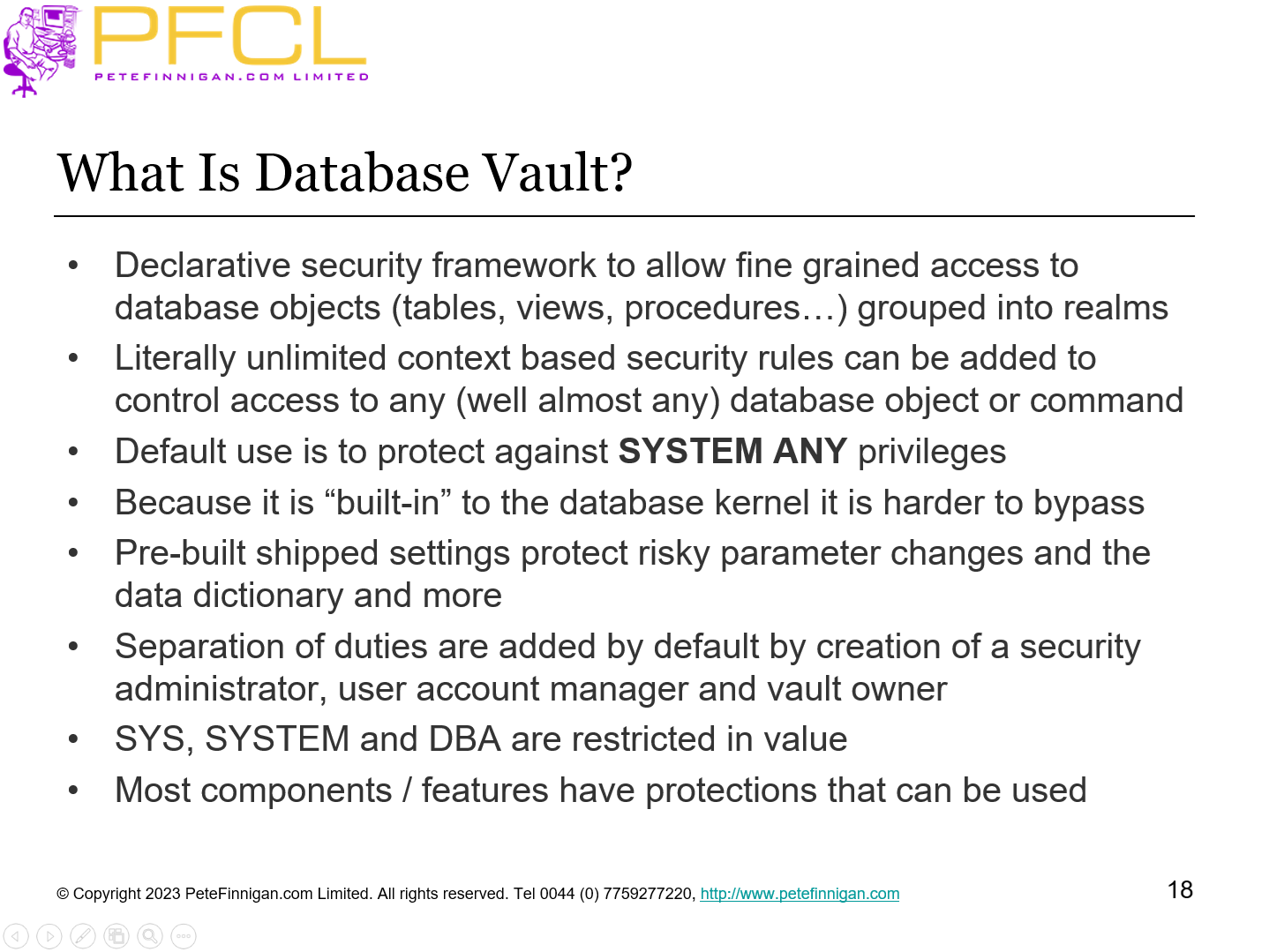
- Declarative security framework to allow fine grained access to database objects (tables, views, procedures…) grouped into realms
- Literally unlimited context based security rules can be added to control access to any (well almost any) database object or command
- Default use is to protect against SYSTEM ANY privileges
- Because it is “built-in” to the database kernel it is harder to bypass
- Pre-built shipped settings protect risky parameter changes and the data dictionary and more
- Separation of duties are added by default by creation of a security administrator, user account manager and vault owner
- SYS, SYSTEM and DBA are restricted in value
- Most components / features have protections that can be used
- Slide 19 - The Main DV Components
-
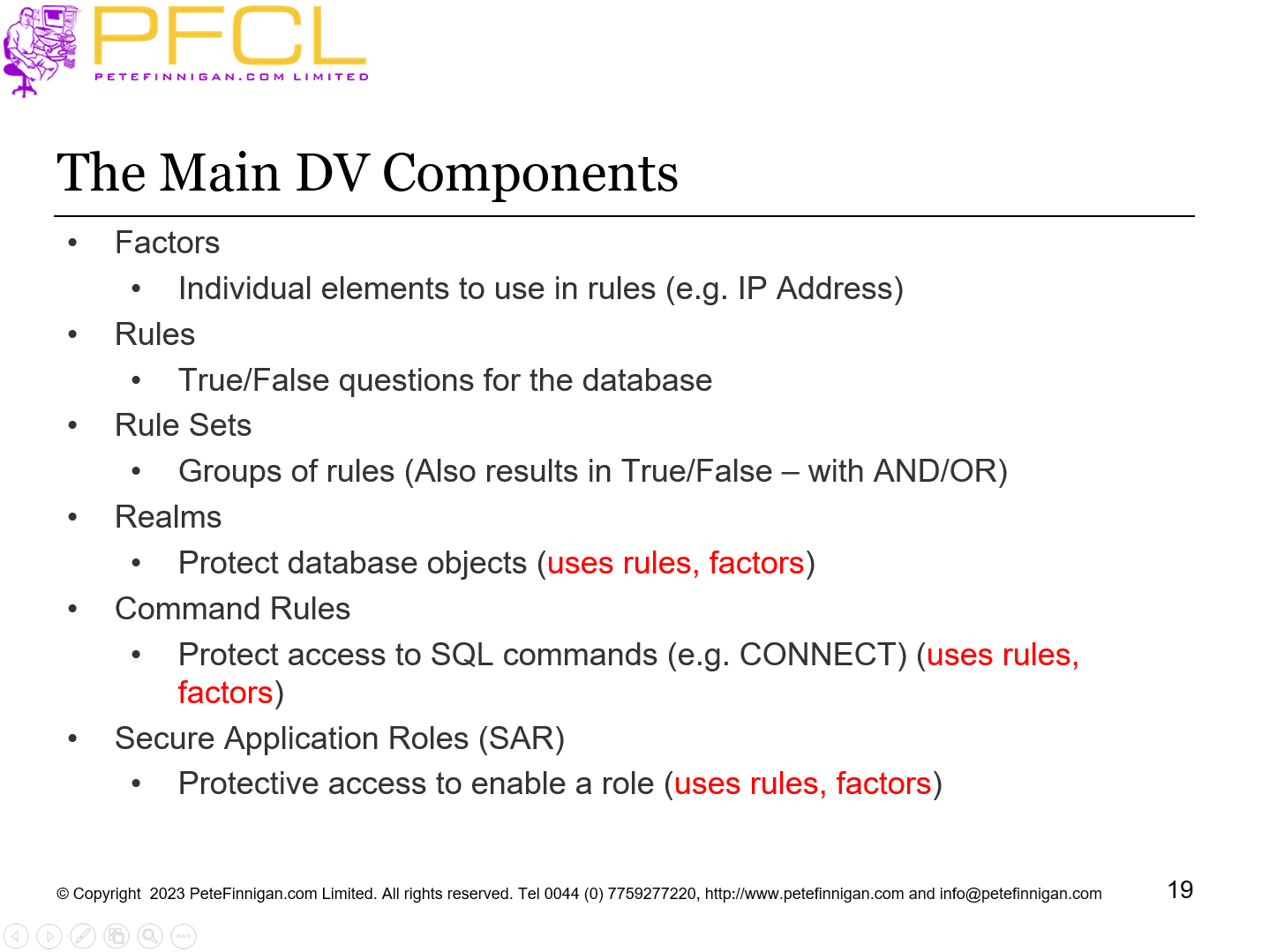
- Factors
- Individual elements to use in rules (e.g. IP Address)
- Rules
- True/False questions for the database
- Rule Sets
- Groups of rules (Also results in True/False – with AND/OR)
- Realms
- Protect database objects (uses rules, factors)
- Command Rules
- Protect access to SQL commands (e.g. CONNECT) (uses rules, factors)
- Secure Application Roles (SAR)
- Protective access to enable a role (uses rules, factors)
- Slide 20 - Hacking The Sample Database Before DV
-
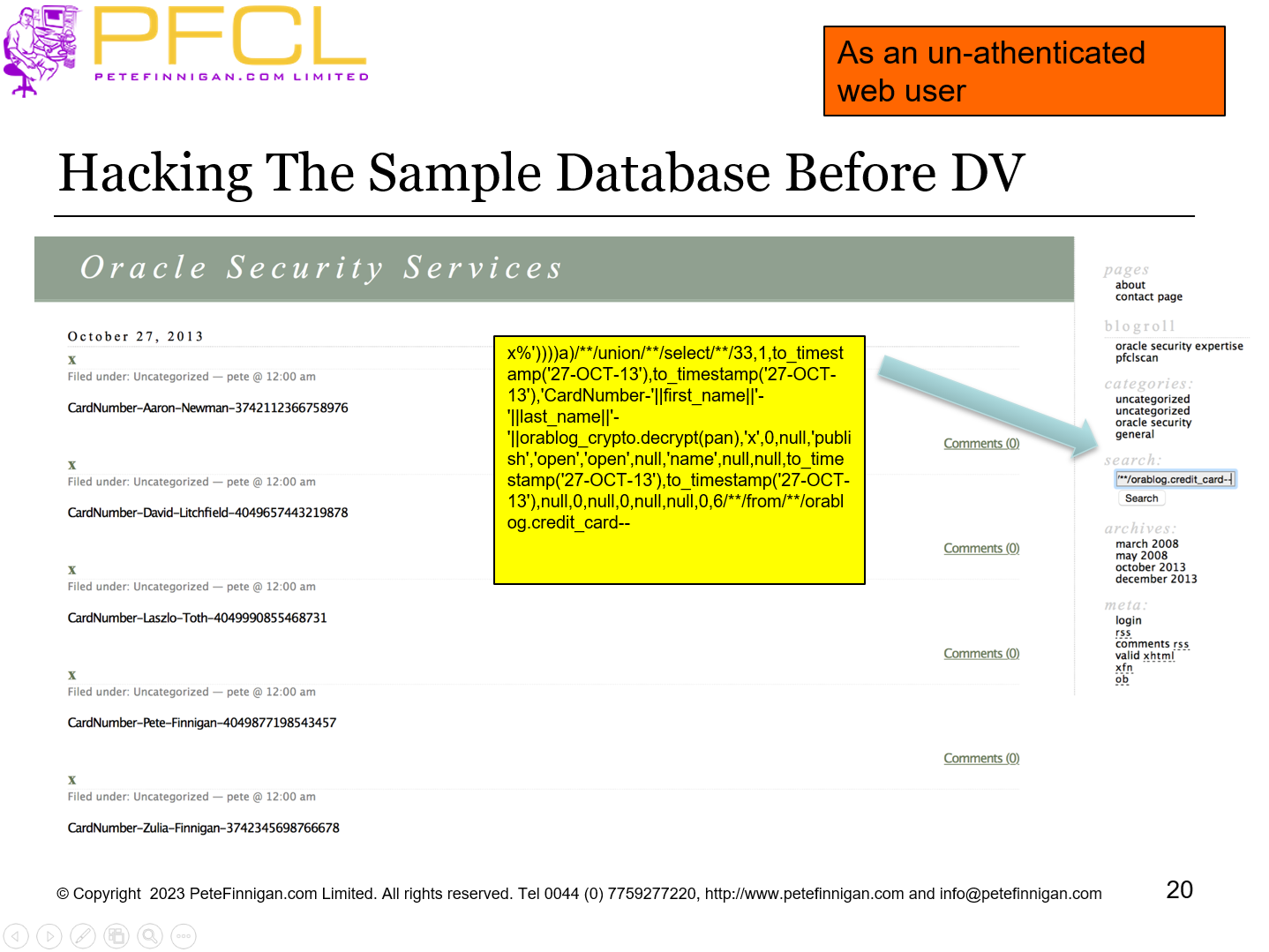
As an un-athenticated web user
- Slide 21 - Hacking The Sample Database After DV OOTB
-
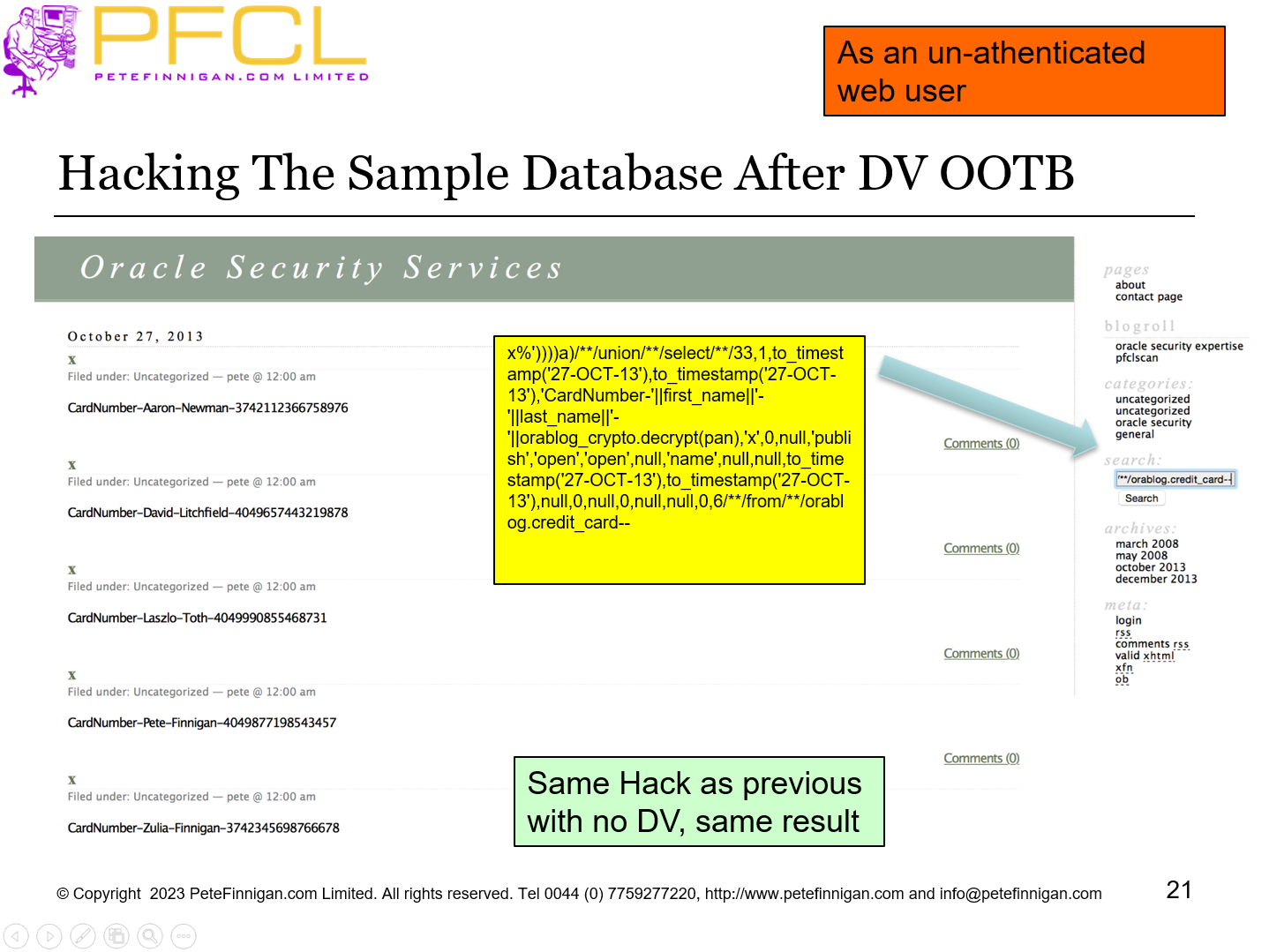
As an un-athenticated web user
Same Hack as previous with no DV, same result
- Slide 22 - DV Add A Realm – Hack Again
-
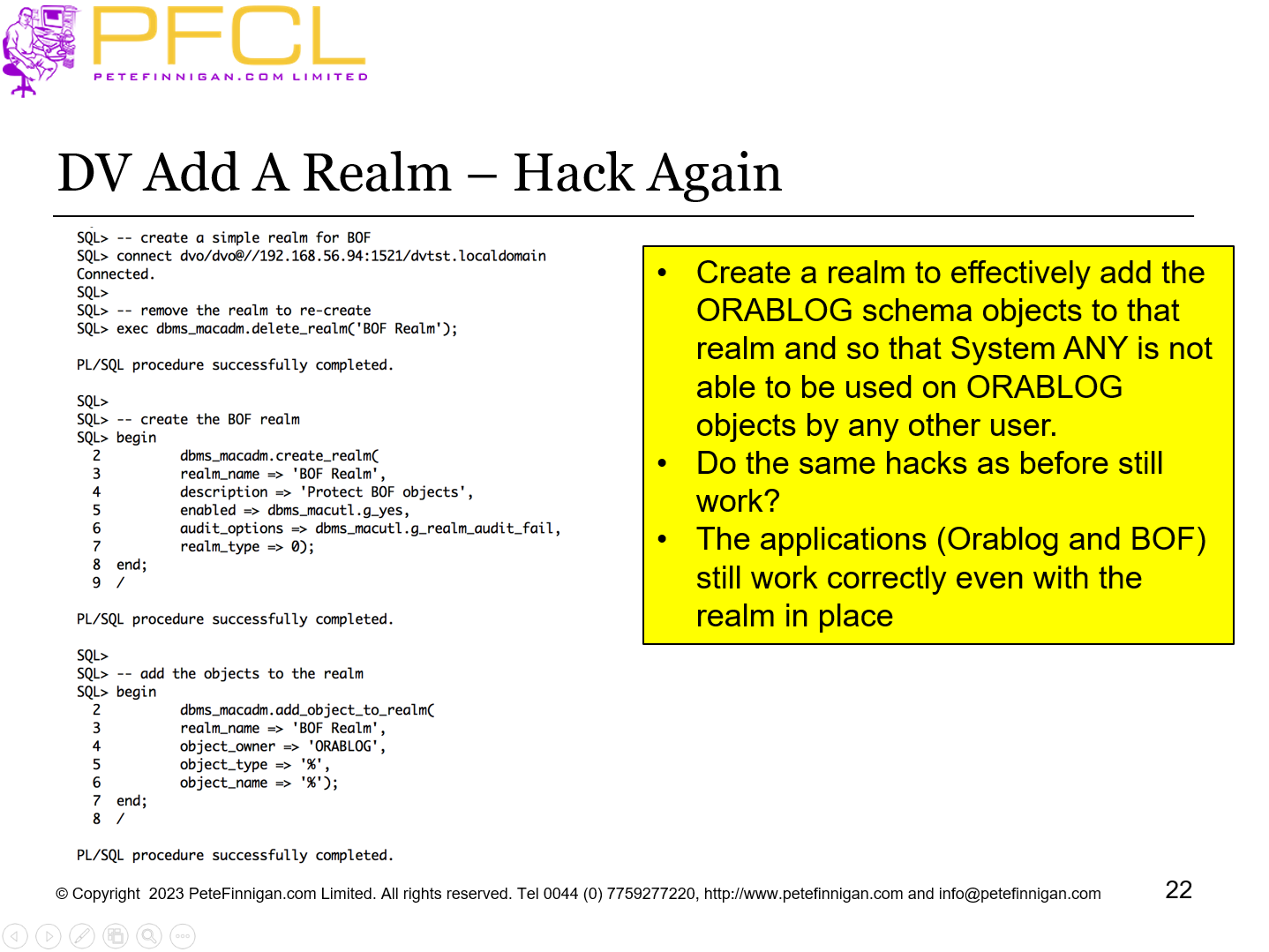
- Create a realm to effectively add the ORABLOG schema objects to that realm and so that System ANY is not able to be used on ORABLOG objects by any other user.
- Do the same hacks as before still work?
- The applications (Orablog and BOF) still work correctly even with the realm in place
- Slide 23 - Hacking The Sample Database With Realm
-
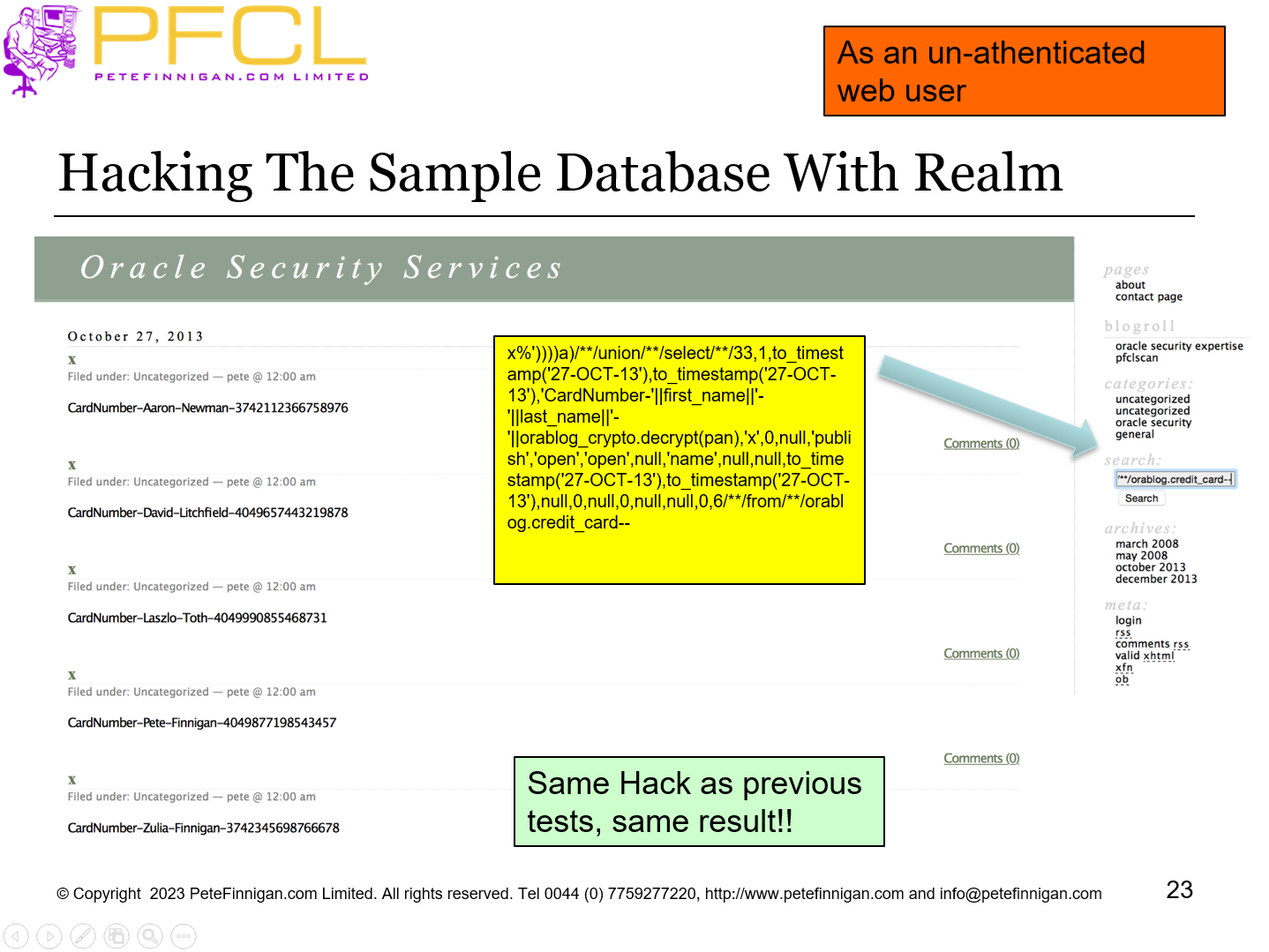
As an un-athenticated web user
Same Hack as previous tests, same result!!
- Slide 24 - Add Mandatory Realm – Hack Again
-
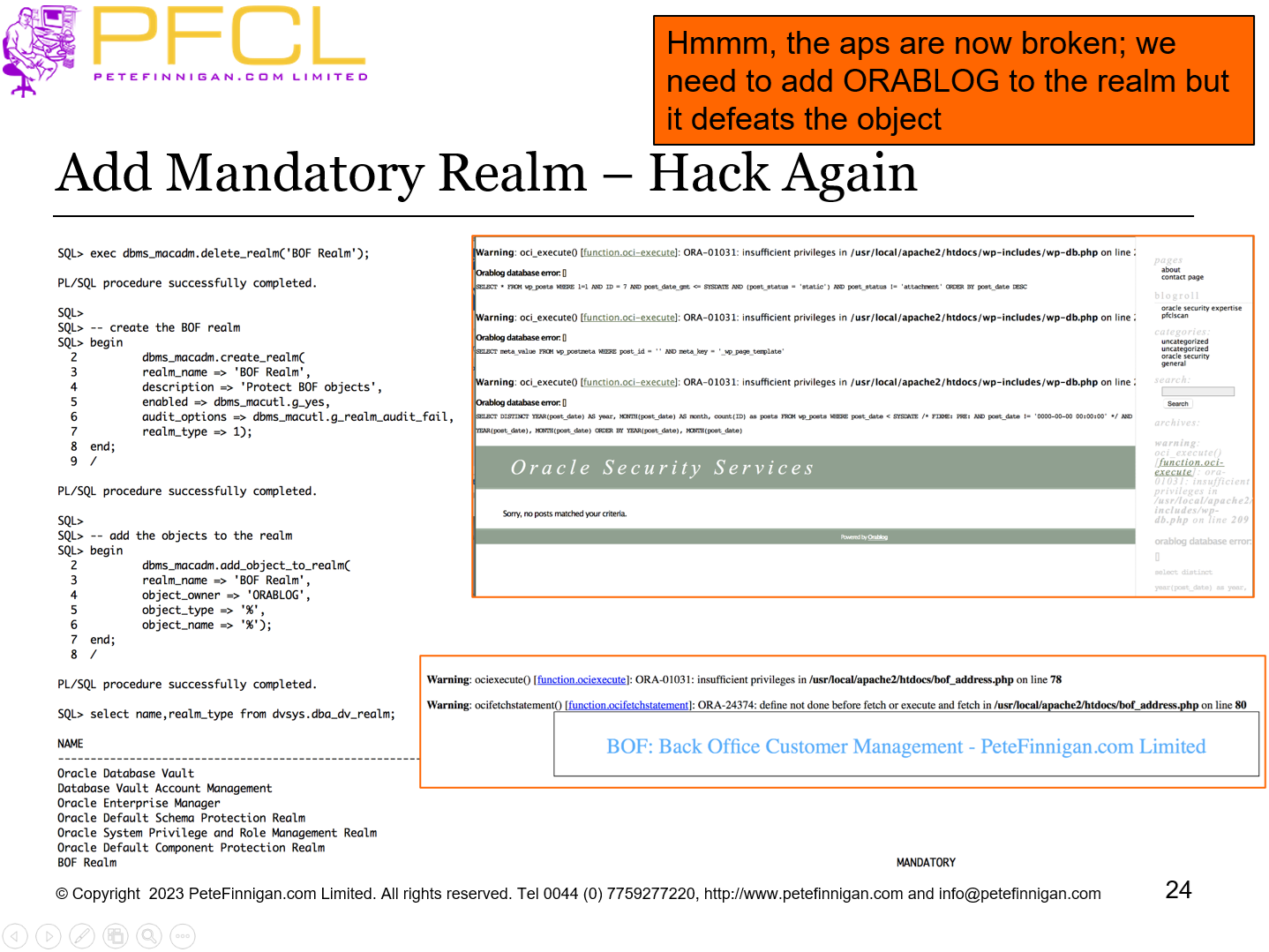
Hmmm, the aps are now broken; we need to add ORABLOG to the realm but it defeats the object
- Slide 25 - Add Mandatory Realm – Fix The Realm Auth
-
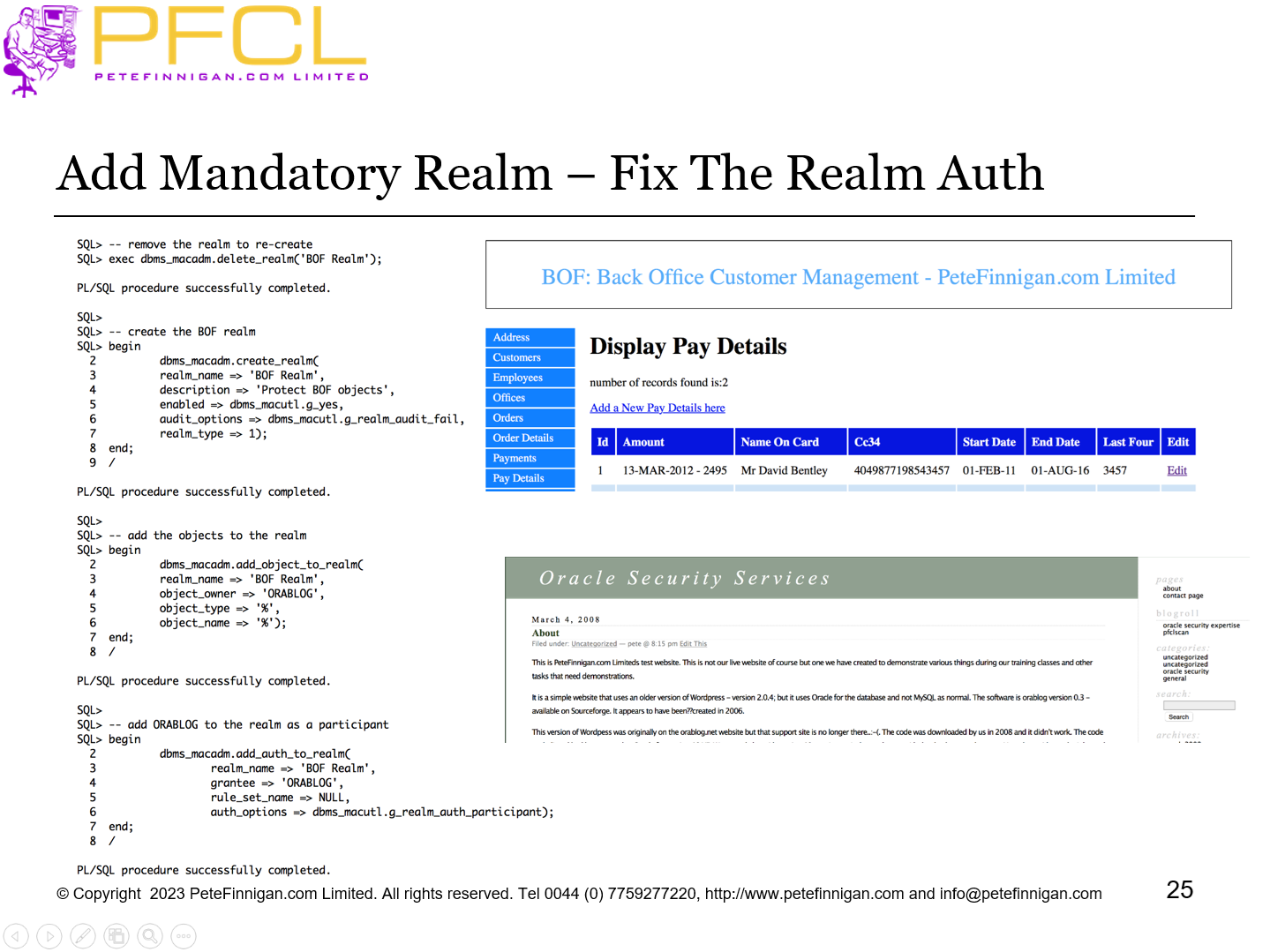
Add Mandatory Realm – Fix The Realm Auth
- Slide 26 - Hacking The Sample Database With Mandatory Realm
-
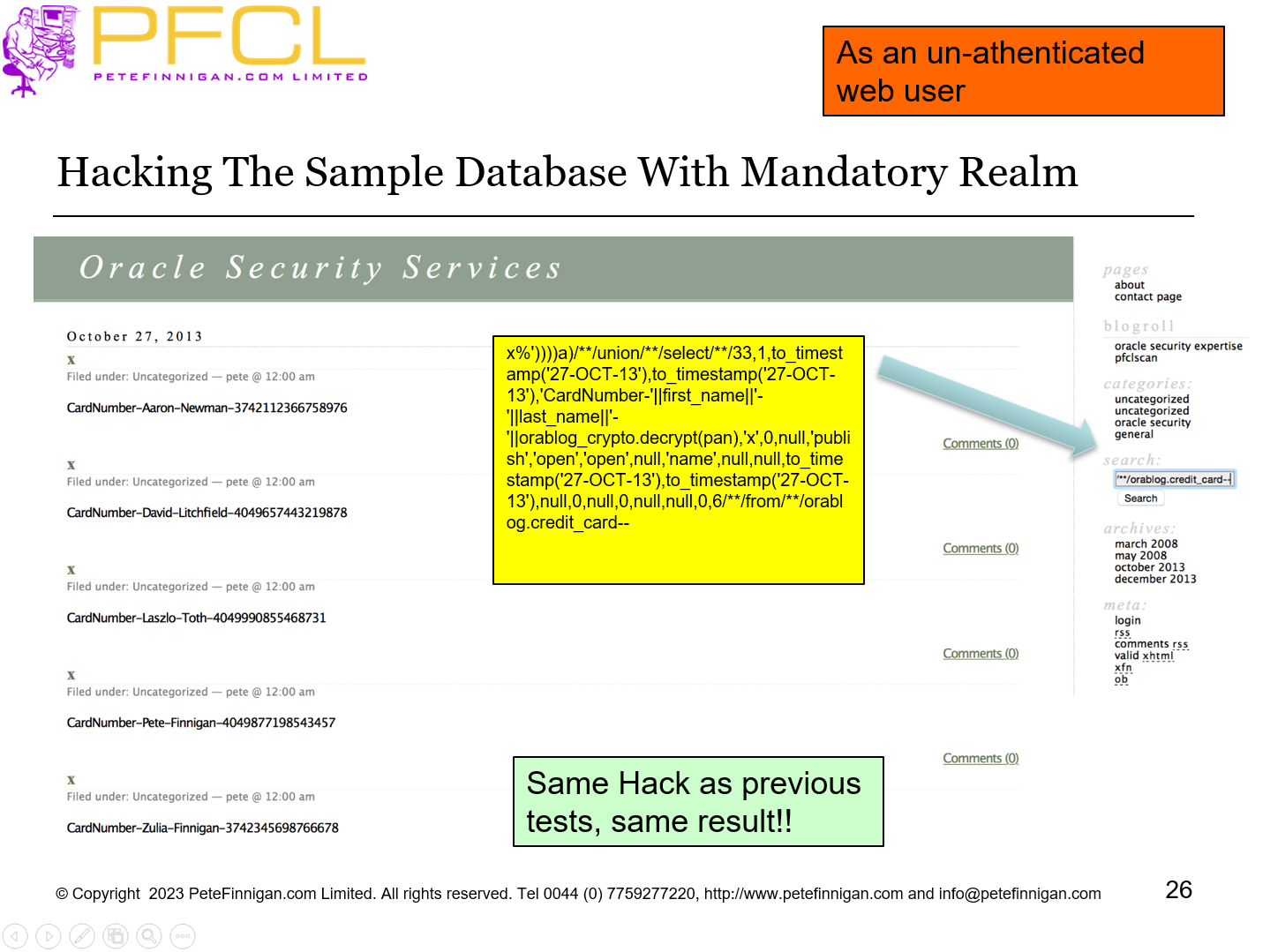
As an un-athenticated web user
Same Hack as previous tests, same result!!
- Slide 27 - DV Command Rule – Create the Rules
-
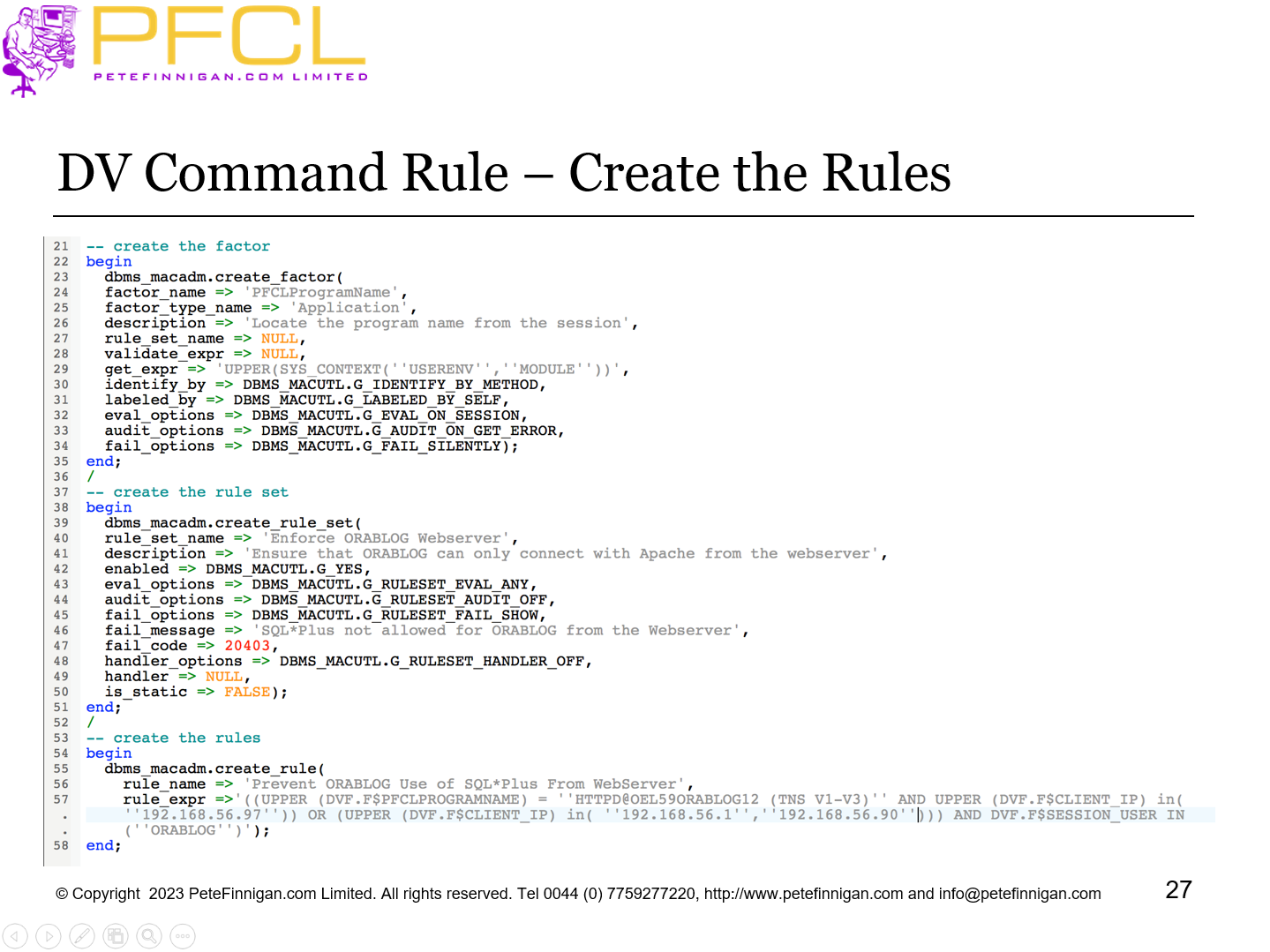
DV Command Rule – Create the Rules
- Slide 28 - DV Command Rule – Code Continued
-
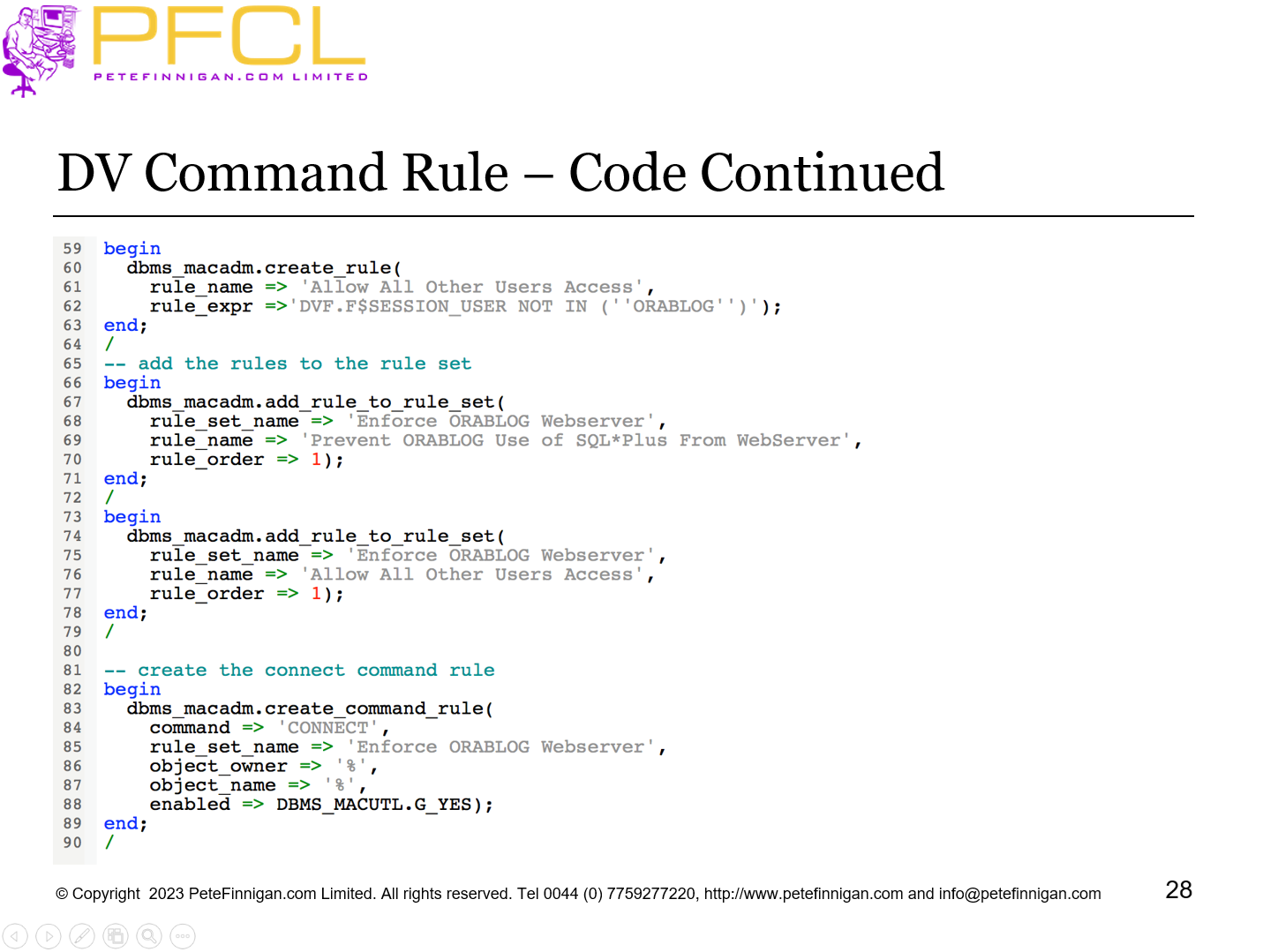
DV Command Rule – Code Continued
- Slide 29 - DV Command Rule - Results
-
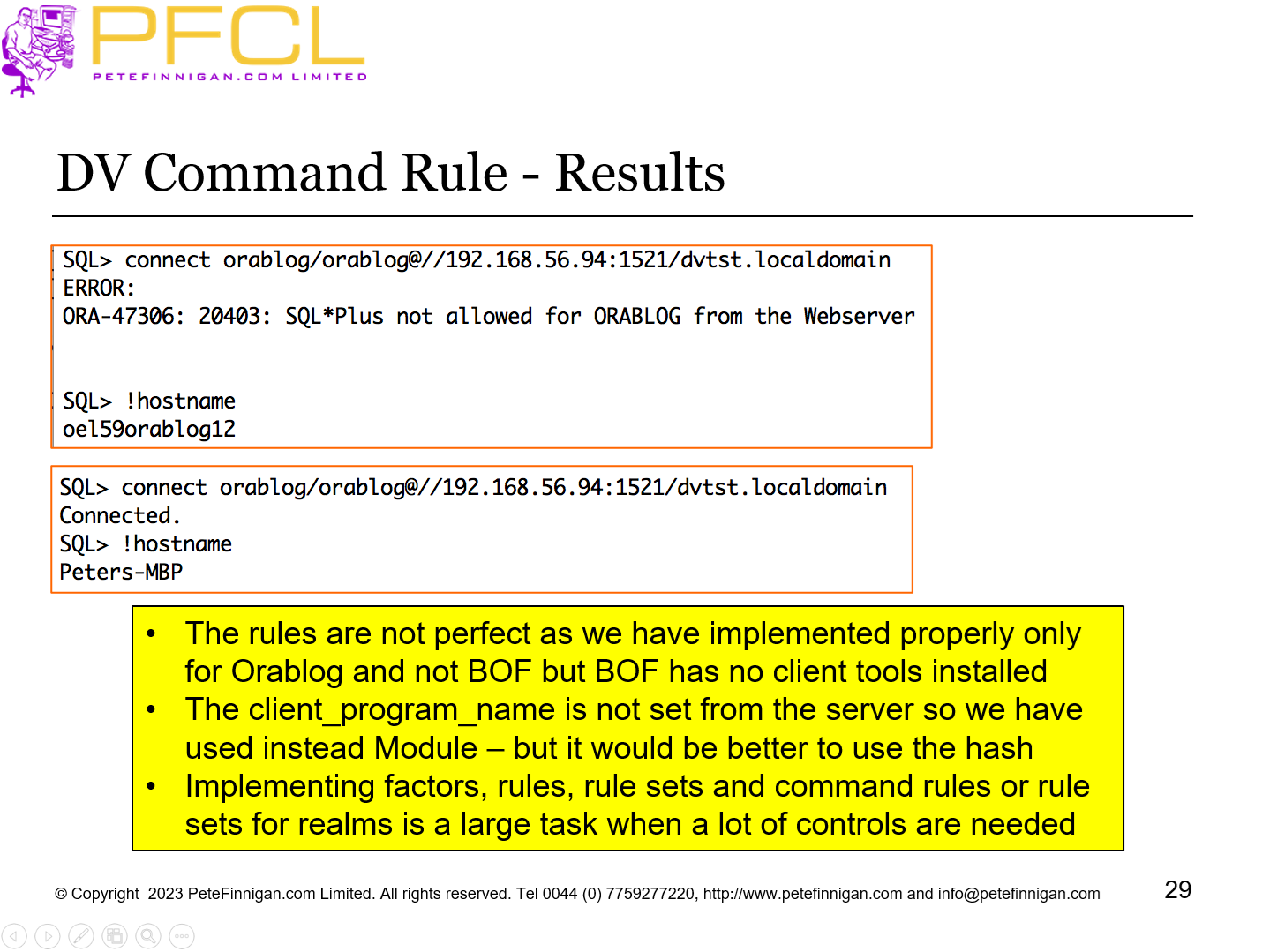
- The rules are not perfect as we have implemented properly only for Orablog and not BOF but BOF has no client tools installed
- The client_program_name is not set from the server so we have used instead Module – but it would be better to use the hash
- Implementing factors, rules, rule sets and command rules or rule sets for realms is a large task when a lot of controls are needed
- Slide 30 - Do Not Use DV
-
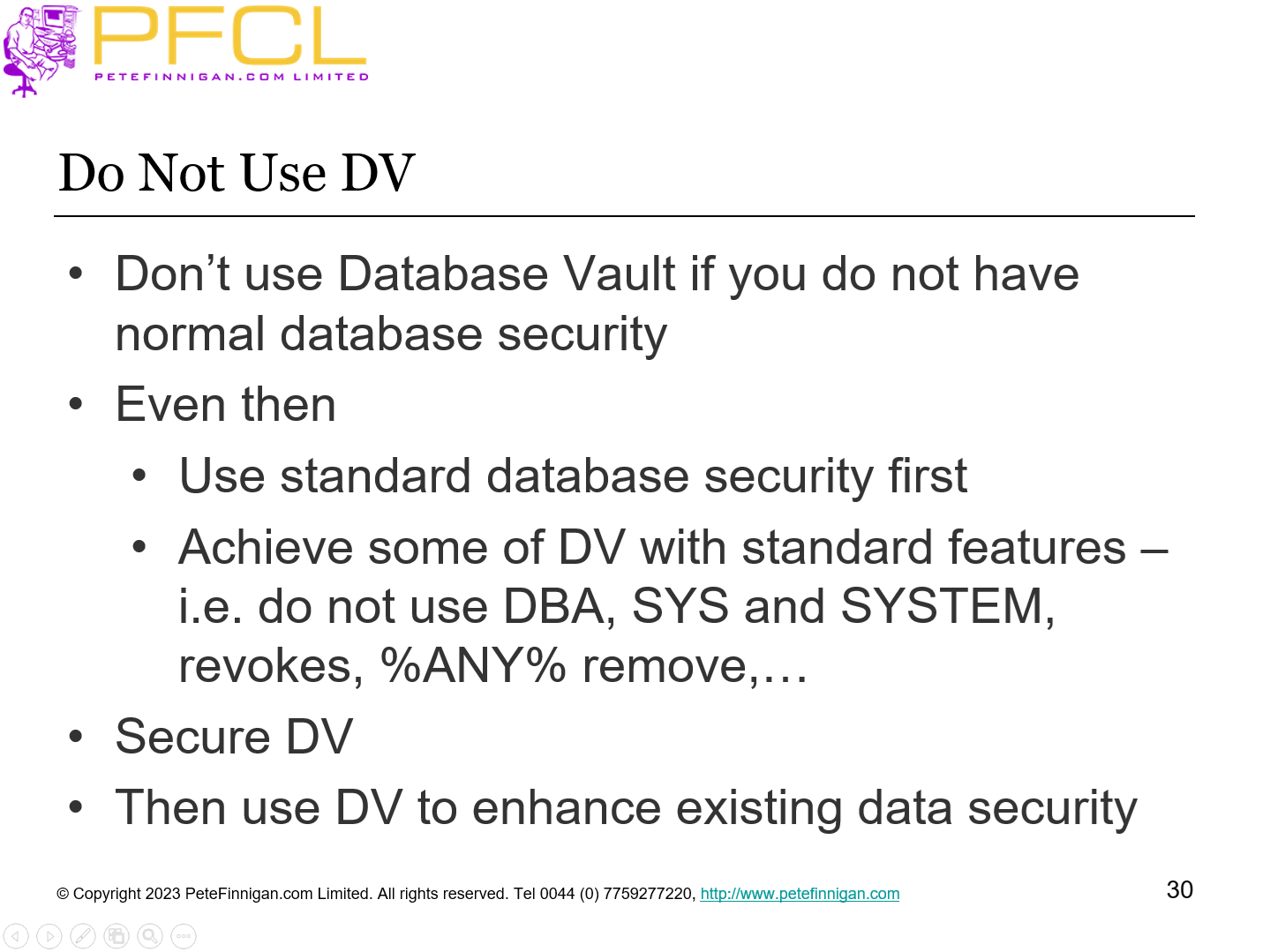
- Don’t use Database Vault if you do not have normal database security
- Even then
- Use standard database security first
- Achieve some of DV with standard features – i.e. do not use DBA, SYS and SYSTEM, revokes, %ANY% remove,…
- Secure DV
- Then use DV to enhance existing data security
- Slide 31 - TDE Would Benefit from Database Vault
-
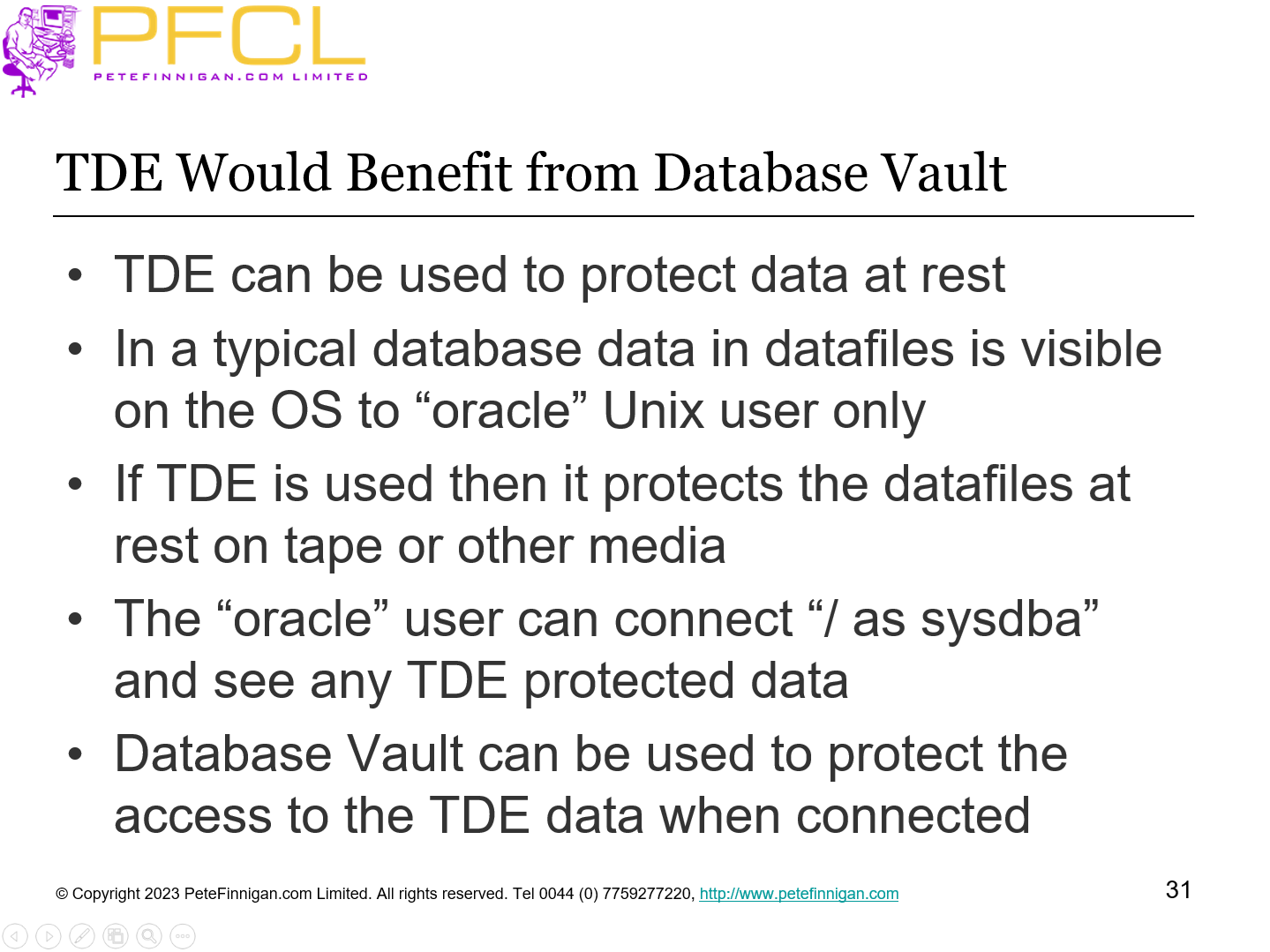
- TDE can be used to protect data at rest
- In a typical database data in datafiles is visible on the OS to “oracle” Unix user only
- If TDE is used then it protects the datafiles at rest on tape or other media
- The “oracle” user can connect “/ as sysdba” and see any TDE protected data
- Database Vault can be used to protect the access to the TDE data when connected
- Slide 32 - Choose the Correct DV Solution
-
- Keep the Database Vault set up as simple as possible
- Use simple rules / rule sets that can be verified
- Use designs not random code
- Use the right solution; command rule, SAR, Realm based on the requirement
- Enrich realms with command rules
- Slide 33 - Do Not Mix
-
- If an object must appear in multiple realms
- use one realm and more complex rules
- Or multiple realms and simpler rules
- Don’t cross over in rules
- Layer command rules on realms if necessary
- Design and create simple rules and rule sets
- Design necessary factors and ensure they are secure
- Slide 34 - Report and Verify
-
Report and Verify
- Slide 35 - Check The DV Security
-
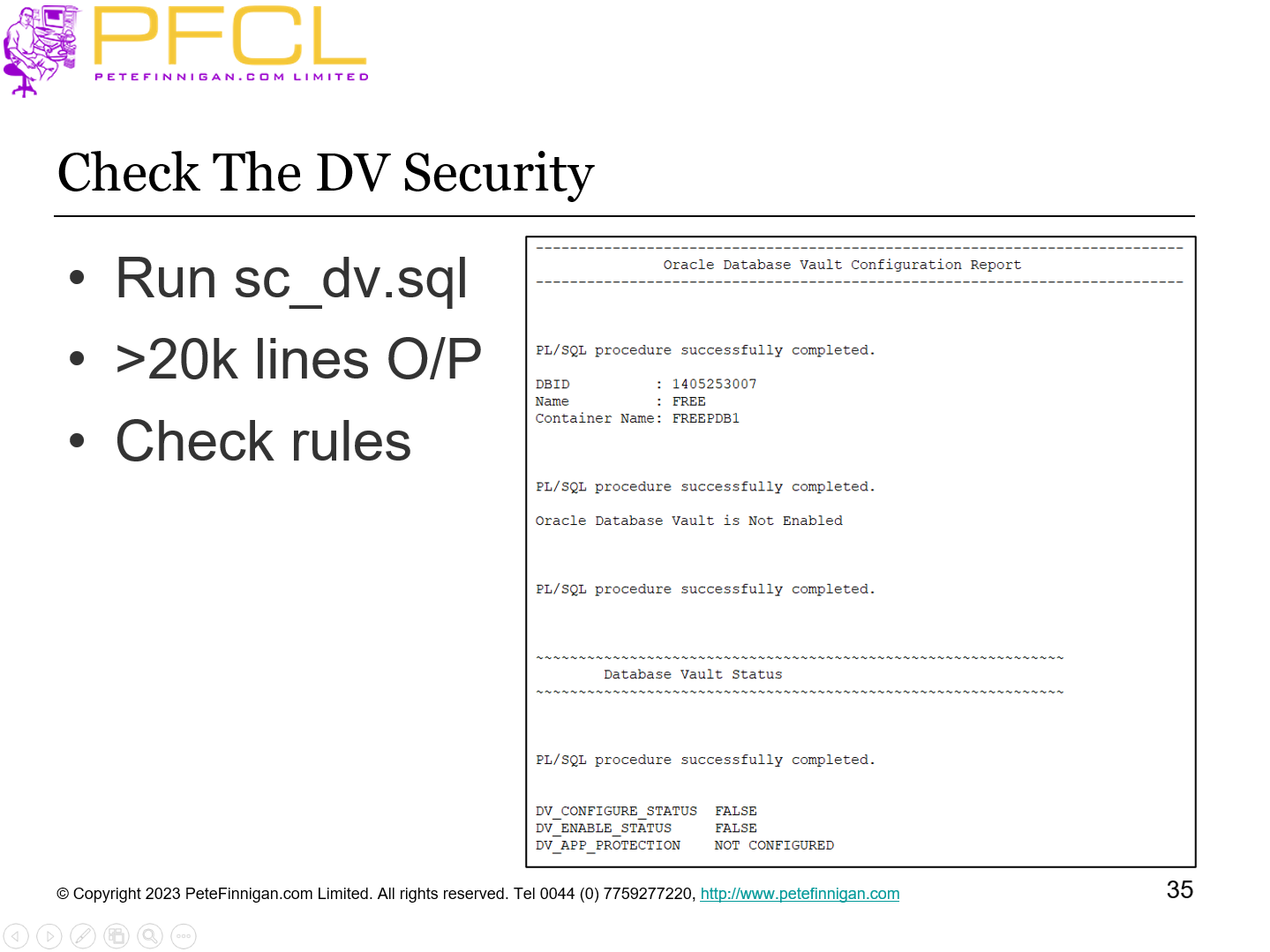
- Run sc_dv.sql
- >20k lines O/P
- Check rules
- Slide 36 - Conclusions
-
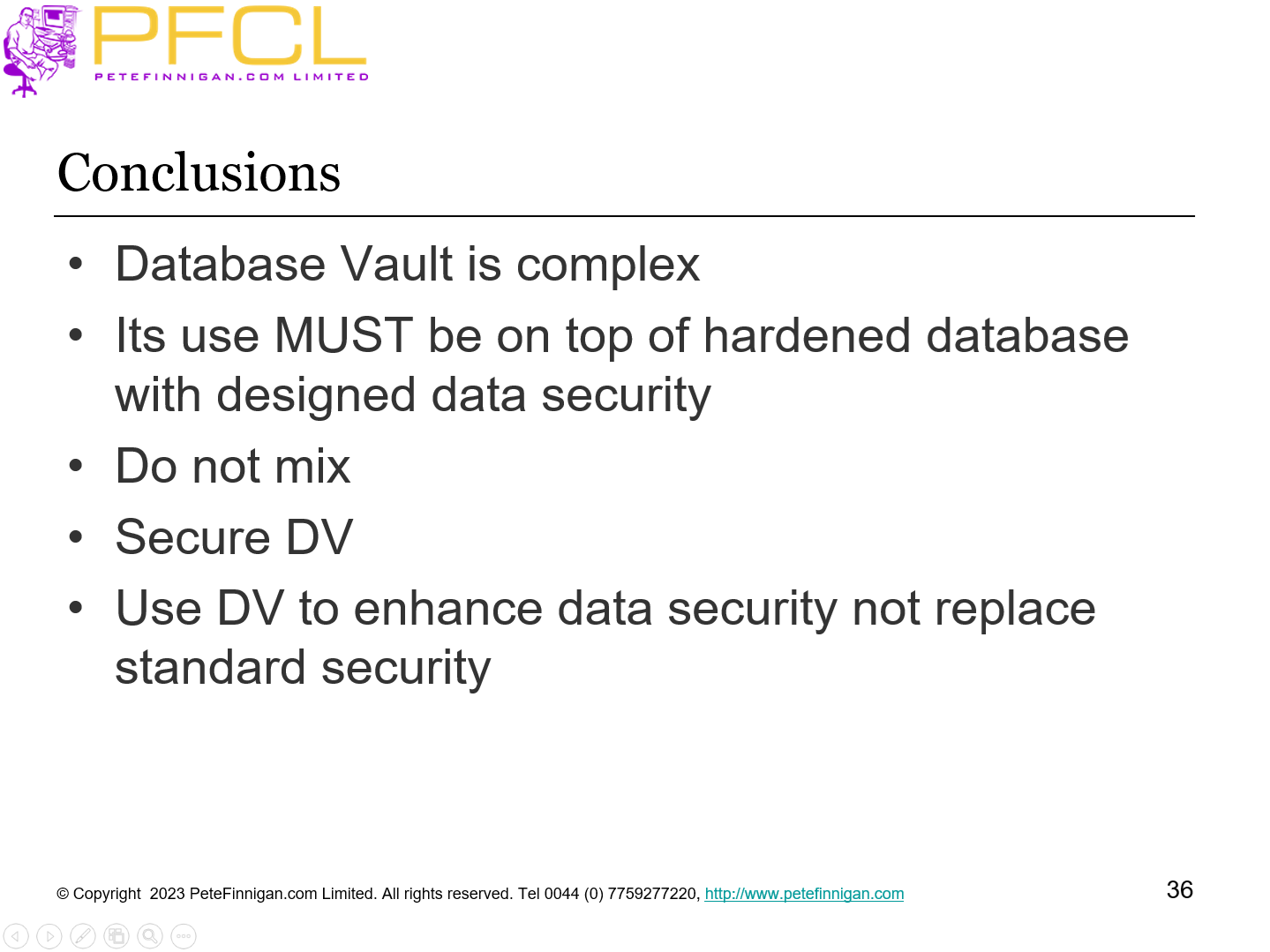
- Database Vault is complex
- Its use MUST be on top of hardened database with designed data security
- Do not mix
- Secure DV
- Use DV to enhance data security not replace standard security
- Slide 37 - Questions
-
Questions
- Slide 38 - Oracle Database Vault in Real Life
-
Oracle Database Vault in Real Life