



User Least Privilege
This is my presentation to the UKOUG last December on User Least Privilege.
- Slide 1 - User Least Privilege
-
UKOUG – Liverpool 2018
- Slide 2 - Legal notice
-
User Least Privilege
Published by
PeteFinnigan.com Limited
Tower Court
3 Oakdale Road
York
England, YO30 4XL
Copyright © 2025 by PeteFinnigan.com Limited
No part of this publication may be stored in a retrieval system, reproduced or transmitted in any form by any means, electronic, mechanical, photocopying, scanning, recording, or otherwise except as permitted by local statutory law, without the prior written permission of the publisher. In particular this material may not be used to provide training of any type or method. This material may not be translated into any other language or used in any translated form to provide training. Requests for permission should be addressed to the above registered address of PeteFinnigan.com Limited in writing.
Limit of Liability / Disclaimer of warranty. This information contained in this course and this material is distributed on an “as-is” basis without warranty. Whilst every precaution has been taken in the preparation of this material, neither the author nor the publisher shall have any liability to any person or entity with respect to any loss or damage caused or alleged to be caused directly or indirectly by the instructions or guidance contained within this course.
TradeMarks. Many of the designations used by manufacturers and resellers to distinguish their products are claimed as trademarks. Linux is a trademark of Linus Torvalds, Oracle is a trademark of Oracle Corporation. All other trademarks are the property of their respective owners. All other product names or services identified throughout the course material are used in an editorial fashion only and for the benefit of such companies with no intention of infringement of the trademark. No such use, or the use of any trade name, is intended to convey endorsement or other affiliation with this course.
- Slide 3 - Background
-
Pete Finnigan – Background, Who Am I?
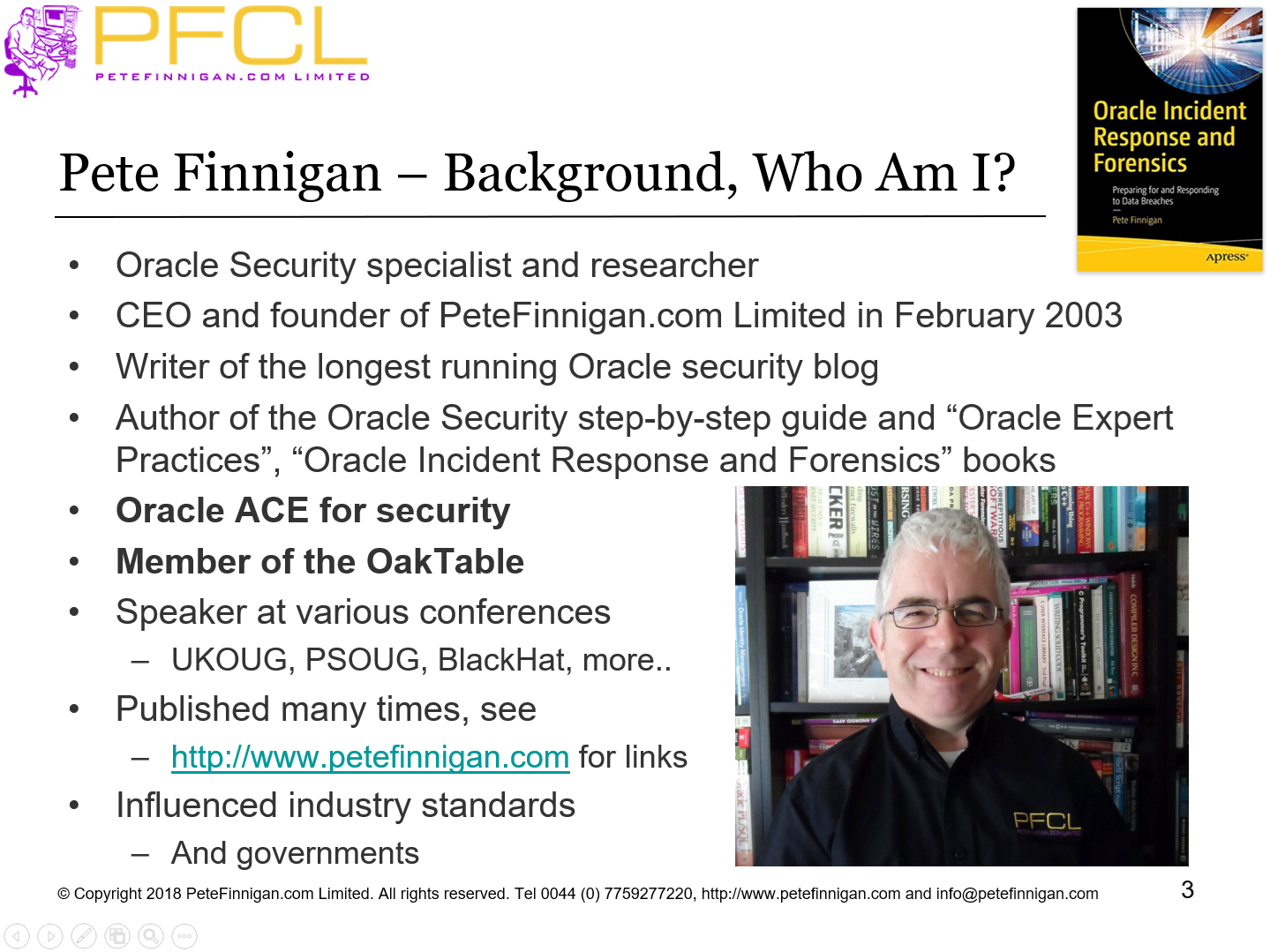
- Oracle Security specialist and researcher
- CEO and founder of PeteFinnigan.com Limited in February 2003
- Writer of the longest running Oracle security blog
- Author of the Oracle Security step-by-step guide and “Oracle Expert Practices”, “Oracle Incident Response and Forensics” books
- Oracle ACE for security
- Member of the OakTable, SYM 42
- Speaker at various conferences UKOUG, PSOUG, BlackHat, more..
- Published many times, see http://www.petefinnigan.com for links
- Slide 4 - Agenda
-
- Securing Oracle
- Where does least privilege fit
- Live demo of reducing the grants of a sample database user
- Where next
- Slide 5 - Compartmentalise Data Security?
-
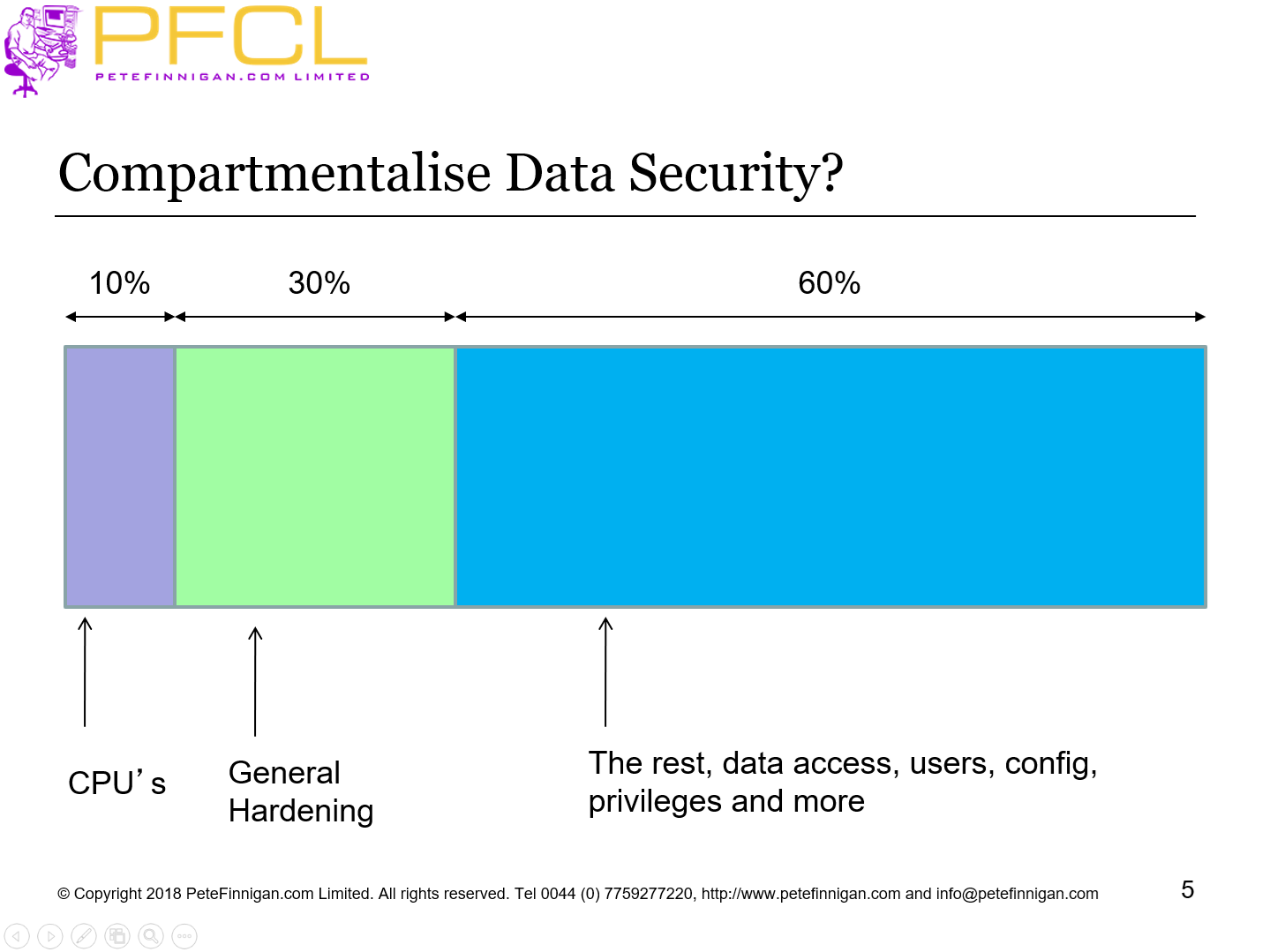
Compartmentalise Data Security?
- Slide 6 - The Areas to Secure Data in Oracle Database
-
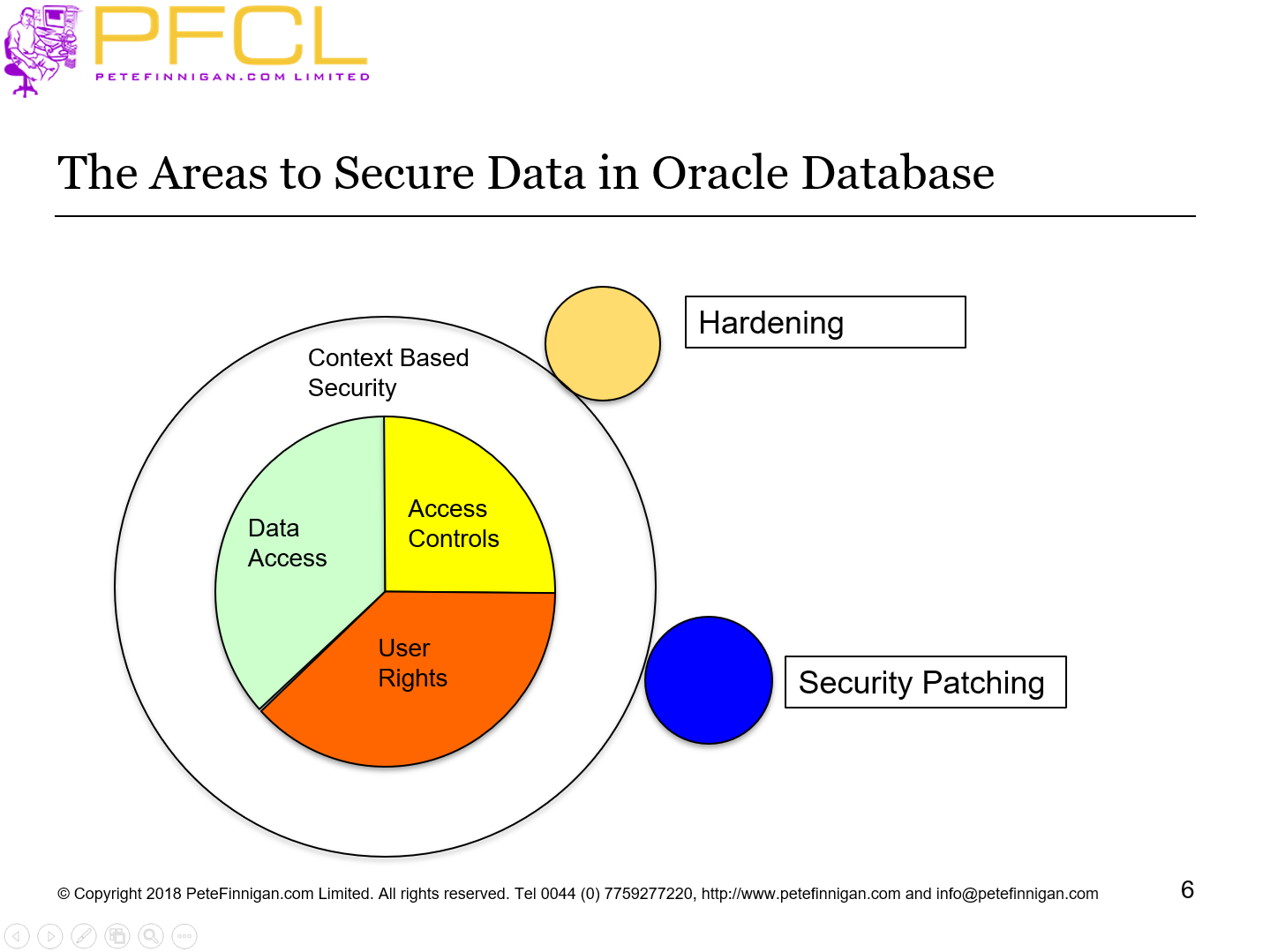
The Areas to Secure Data in Oracle Database
- Slide 7 - Least Privileges
-
- For every database user (or schema) they MUST have just the correct rights to allow them to do their job properly and no more
- This is hard to achieve in new databases
- Even harder in existing databases
- There is always a fear that something will break
- My experience of performing security audits is the opposite usually exists
- Most customers end up with MOST PRIVILEGE not LEAST PRIVILEGE
- Slide 8 - Actors and Processes
-
- To assess security of data in an Oracle database we must know who the “actors” are – not Johnny Depp but
- Direct access persons –
- job roles that are allowed to connect to the database and why
- Individuals who are allowed to connect and why – when its not a clear job role
- Processes –
- Feeds and extracts
- Business tasks –
- Reporting
- Unless we know about who connects and why we cannot secure the Oracle database
- Slide 9 - Data Architecture
-
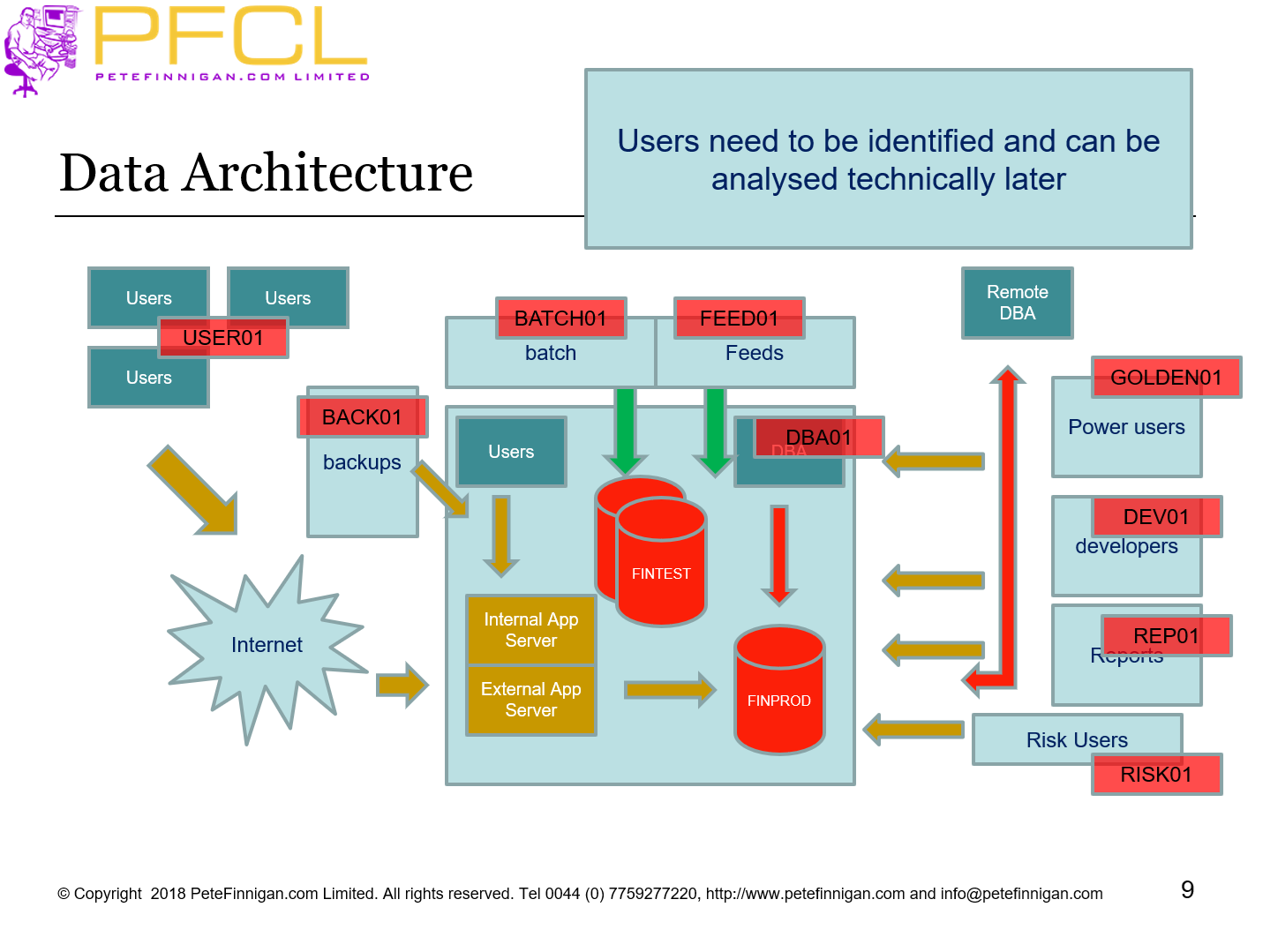
Users need to be identified and can be analysed technically later
- Slide 10 - Gather All Users/Roles Privileges
-
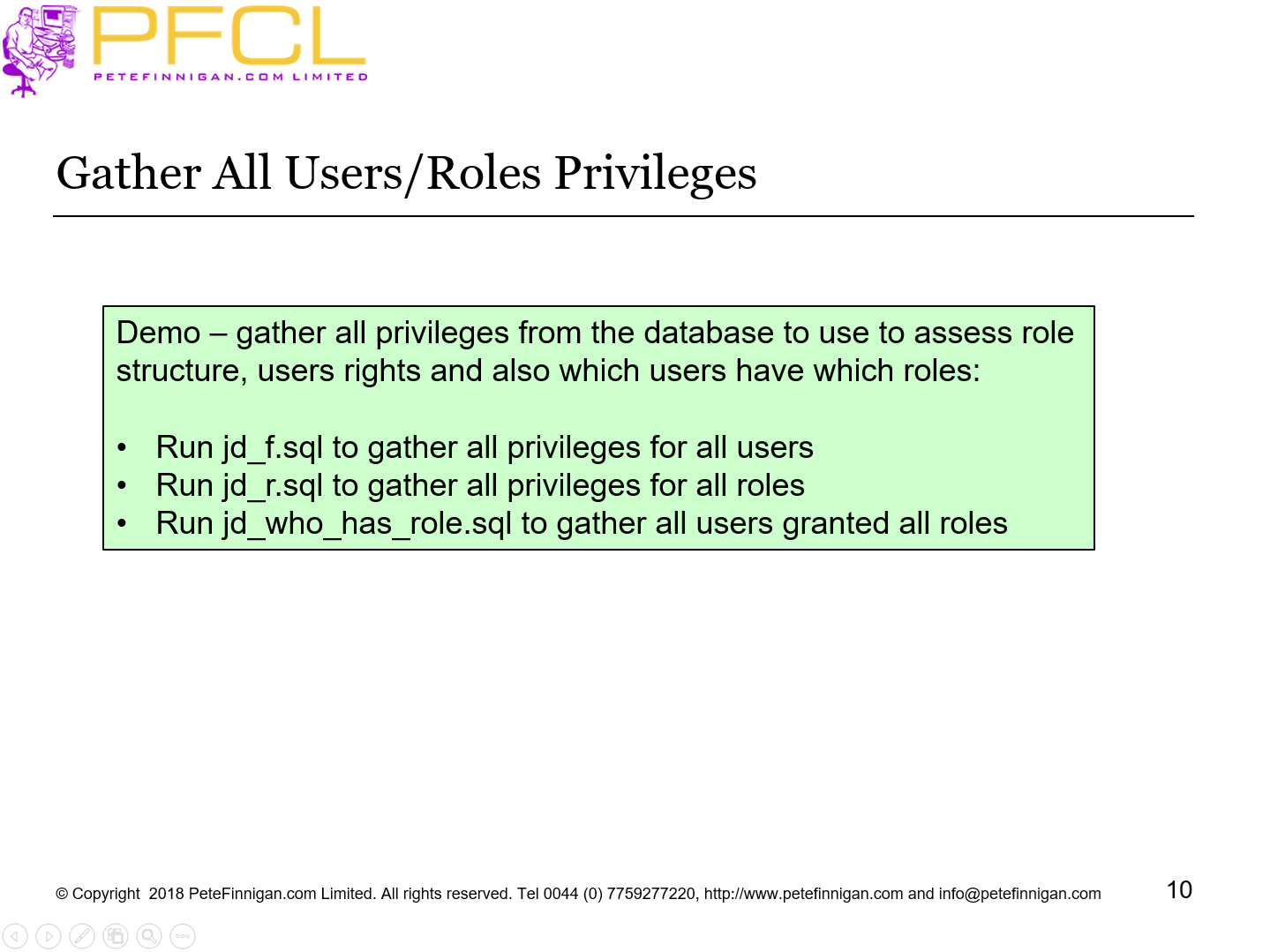
Demo – gather all privileges from the database to use to assess role structure, users rights and also which users have which roles:
- Run jd_f.sql to gather all privileges for all users
- Run jd_r.sql to gather all privileges for all roles
- Run jd_who_has_role.sql to gather all users granted all roles
- Slide 11 - Web Based Application – Focus on ORABLOG
-
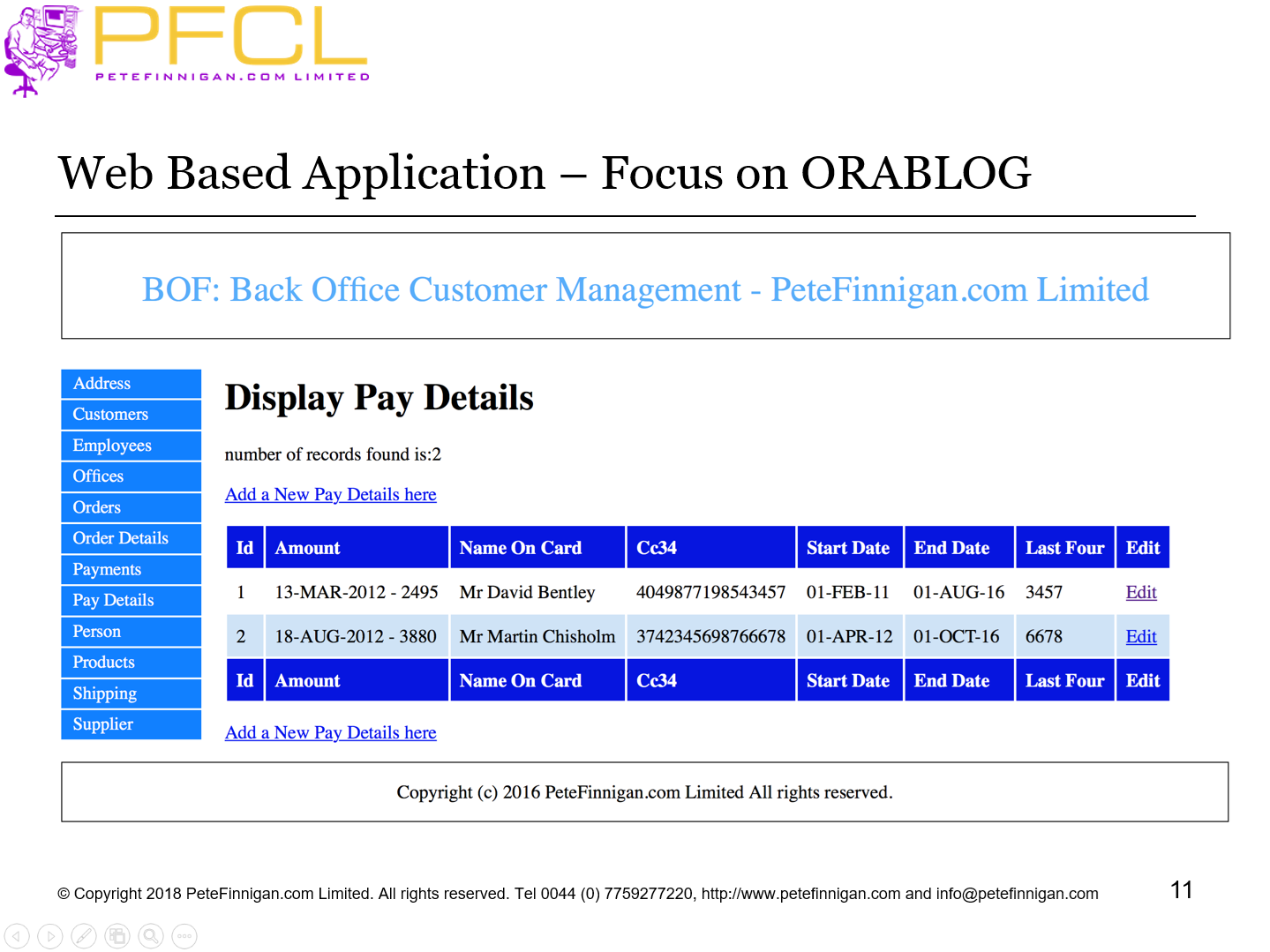
Web Based Application – Focus on ORABLOG
- Slide 12 - Flaws in Least Rights for ORABLOG
-
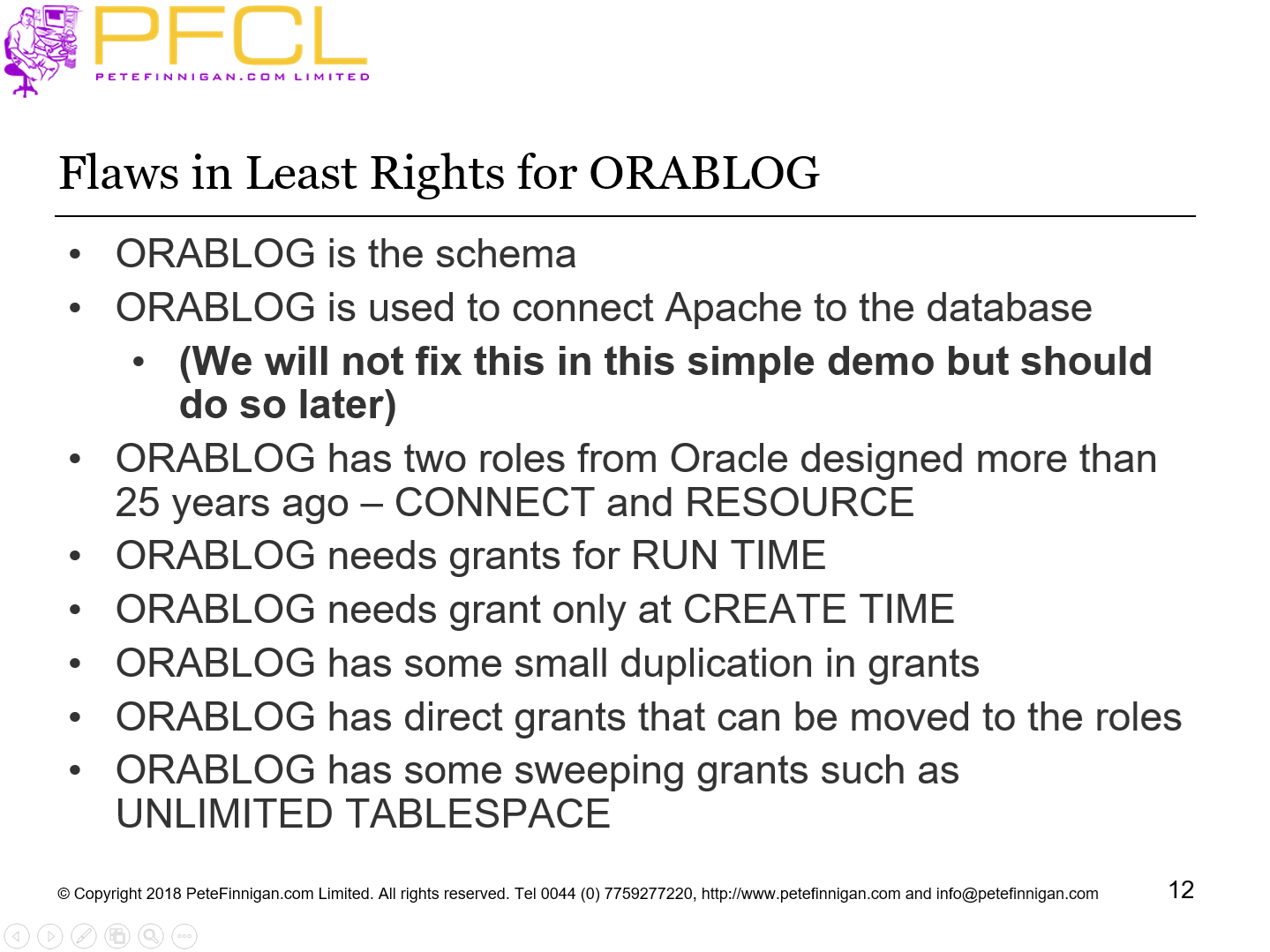
- ORABLOG is the schema
- ORABLOG is used to connect Apache to the database
- (We will not fix this in this simple demo but should do so later)
- ORABLOG has two roles from Oracle designed more than 25 years ago – CONNECT and RESOURCE
- ORABLOG needs grants for RUN TIME
- ORABLOG needs grant only at CREATE TIME
- ORABLOG has some small duplication in grants
- ORABLOG has direct grants that can be moved to the roles
- ORABLOG has some sweeping grants such as UNLIMITED TABLESPACE
- Slide 13 - Demonstration of Privilege Reduction
-
- First concentrate on the use of Oracle designed roles
- These are inappropriate for Orablog and BOF application
- Create new ORABLOG roles with the same rights
- Transfer ORABLOG to use these new roles
- Remove privileges to suit the current ORABLOG design and use from these new roles
- Match roles privileges to objects that exist in the schema
- Move direct grants to the roles
- Remove the roles
- Check the direct grants and reduce
- Remove UNLIMITED TABLESPACE and replace with quotas
- Revoke of RESOURCE will do this in 11.2.0.4 and 12c
Demo: orablog.sql
- Slide 14 - Further Privilege Analysis
-
- Focus on removal of these privileges from all users:
- DBA role and SYSDBA, IMP_FULL_DATABASE, …
- ALL PRIVILEGES
- With admin and with grant
- %ANY%
- Privileges related to USER, GRANT, ROLE, PROFILE and AUDIT
- UNLIMITED TABLESPACE
- CREATE
- Excessive data access – should be limited to the needs of the application or user
This is a hard task and requires a lot of planning, work, testing.
- Slide 15 - Consider DBA tasks
-
- Don’t use SYSDBA or SYS
- Don’t use the DBA role
- Design your own role
- Create your own accounts for accountability
- Its possible to work day to day with very limited rights
- Who knows what each of more than 200 grants does anyway!
- Use proxy to allow tasks such as:
- application support,
- Release and change control
- Slide 16 - Conclusions
-
- Understand the grants made to every user
- Understand what each account is used for (schemas and interactive users)
- Take control of grants
- Don’t use ORACLE roles; they do not match your applications!!
- Remember a DBA does not need all grants all day every day
- Slide 17 - User Least Privilege
-
UKOUG – Liverpool 2018