


A Design Pattern To Secure Your Database
This is a presentation I have at the UKOUG conference in Birmingham in 2025. This discusses how you might protect data in your Oracle database using standard features of the database.
- Slide 1 - A Design Pattern To Secure Your Database
-
- Slide 2 - Legal notice
-
A Design Pattern to Secure Your Database
Published by
PeteFinnigan.com Limited
Tower Court
3 Oakdale Road
York
England, YO30 4XL
Copyright © 2025 by PeteFinnigan.com Limited
No part of this publication may be stored in a retrieval system, reproduced or transmitted in any form by any means, electronic, mechanical, photocopying, scanning, recording, or otherwise except as permitted by local statutory law, without the prior written permission of the publisher. In particular this material may not be used to provide training of any type or method. This material may not be translated into any other language or used in any translated form to provide training. Requests for permission should be addressed to the above registered address of PeteFinnigan.com Limited in writing.
Limit of Liability / Disclaimer of warranty. This information contained in this course and this material is distributed on an “as-is” basis without warranty. Whilst every precaution has been taken in the preparation of this material, neither the author nor the publisher shall have any liability to any person or entity with respect to any loss or damage caused or alleged to be caused directly or indirectly by the instructions or guidance contained within this course.
TradeMarks. Many of the designations used by manufacturers and resellers to distinguish their products are claimed as trademarks. Linux is a trademark of Linus Torvalds, Oracle is a trademark of Oracle Corporation. All other trademarks are the property of their respective owners. All other product names or services identified throughout the course material are used in an editorial fashion only and for the benefit of such companies with no intention of infringement of the trademark. No such use, or the use of any trade name, is intended to convey endorsement or other affiliation with this course.
- Slide 3 - Background
-
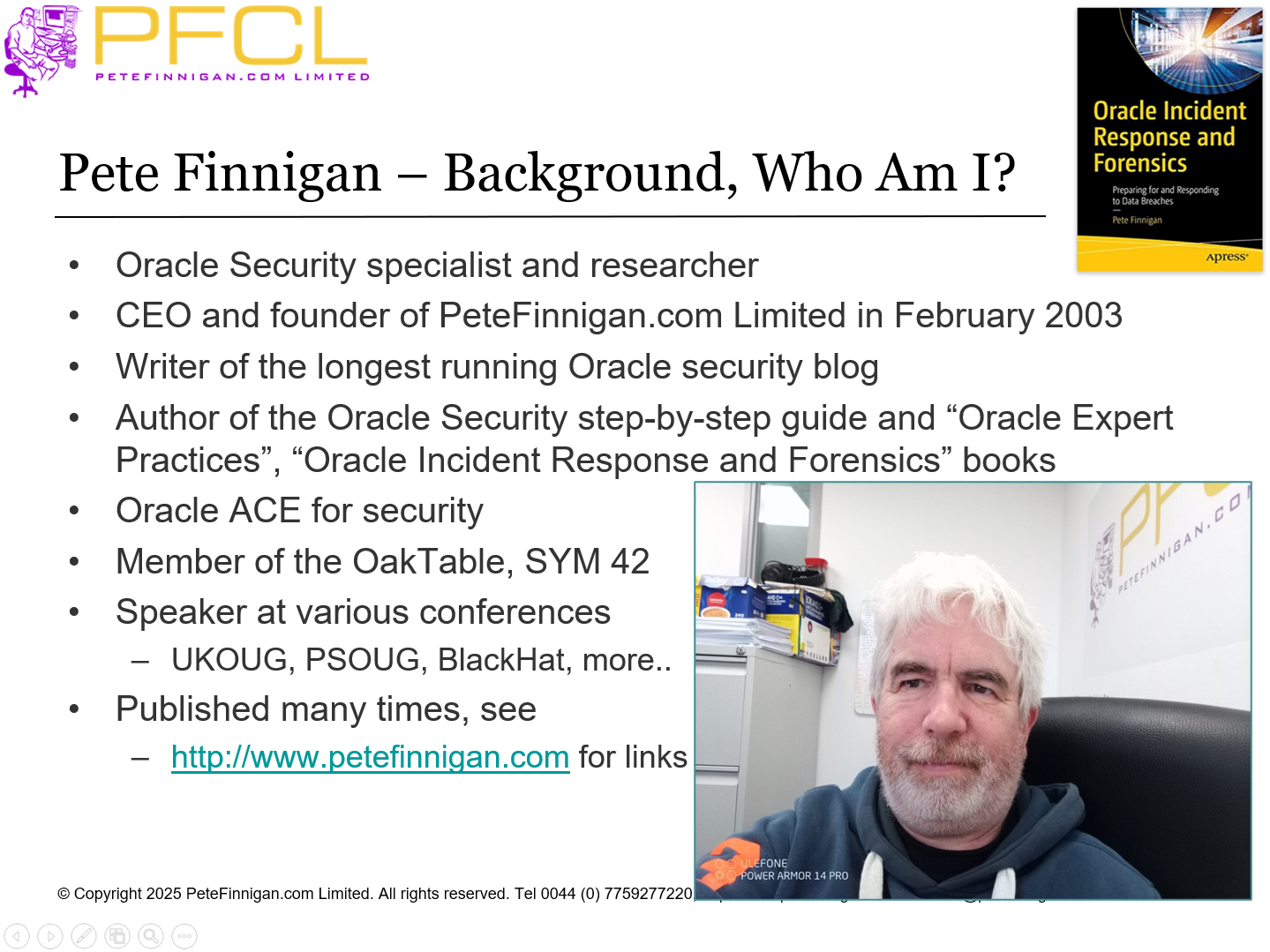
Pete Finnigan – Background, Who Am I?
- Oracle Security specialist and researcher
- CEO and founder of PeteFinnigan.com Limited in February 2003
- Writer of the longest running Oracle security blog
- Author of the Oracle Security step-by-step guide and “Oracle Expert Practices”, “Oracle Incident Response and Forensics” books
- Oracle ACE for security
- Member of the OakTable, SYM 42
- Speaker at various conferences UKOUG, PSOUG, BlackHat, more..
- Published many times, see http://www.petefinnigan.com for links
- Slide 4 - Agenda
-
- Background
- A pattern
- How does AUDSYS.AUD$UNIFIED work
- Design a ReadOnly table
- Implement the design
- Add more features
- Extend the design
- Slide 5 - Background
-
- Slide 6 - Design Pattern
-
- We can use a design pattern to secure data
- What is a design pattern in this context
- We want to use a consistent model to secure data in the same way across the application / database
- Ideally generate based on parameters
- We want to use the same model base and change based on requirements or what we are protecting
- Add remove features
- Allow different access paths
- Slide 7 - Standard Privileges
-
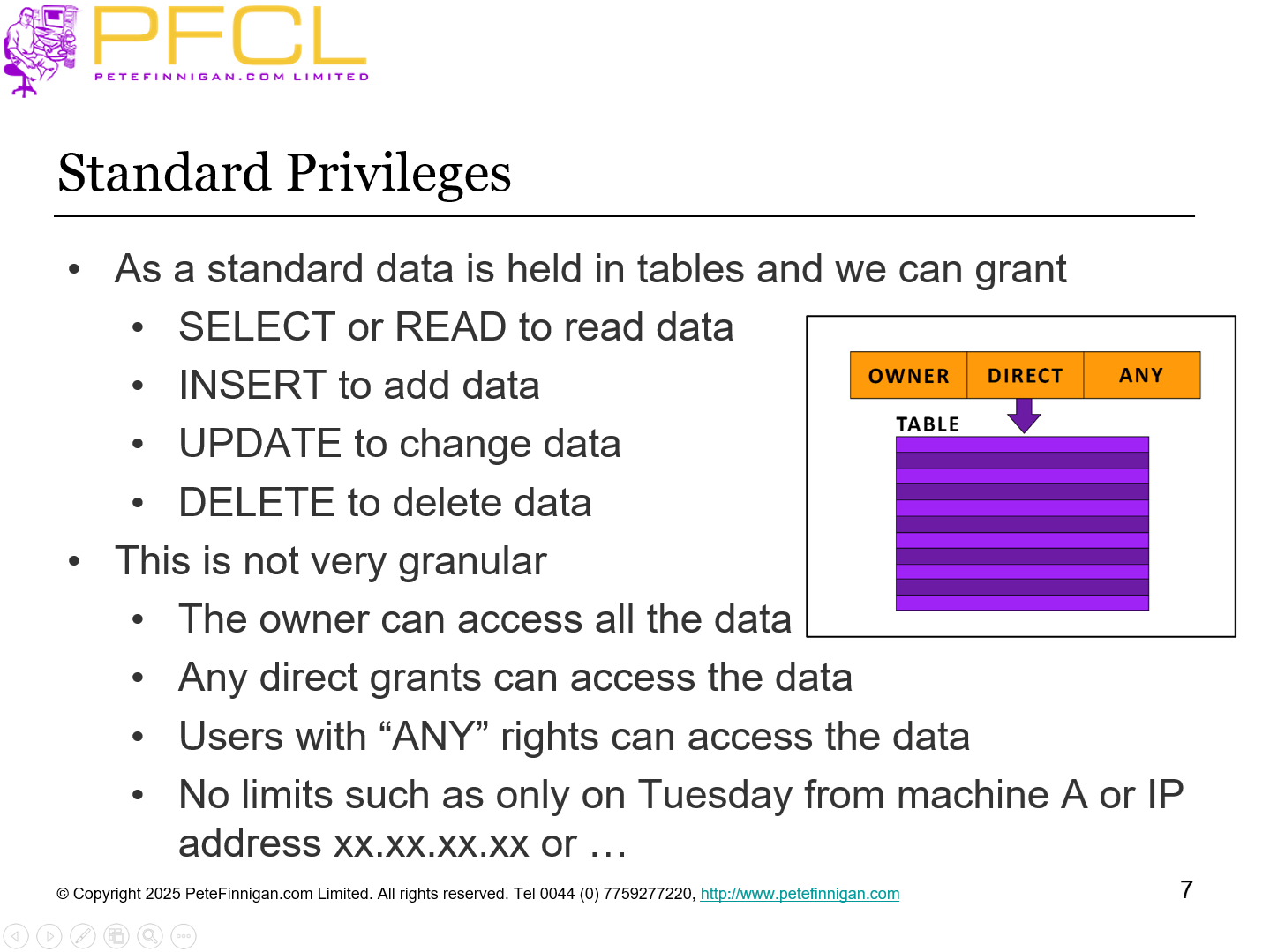
- As a standard data is held in tables and we can grant
- SELECT or READ to read data
- INSERT to add data
- UPDATE to change data
- DELETE to delete data
- This is not very granular
- The owner can access all the data
- Any direct grants can access the data
- Users with “ANY” rights can access the data
- No limits such as only on Tuesday from machine A or IP address xx.xx.xx.xx or …
- Slide 8 - Cost Options
-
- We can use cost options such as Database Vault (DV) or Virtual Private Database (VPD) to achieve similar security
- Using a realm around our data
- This allows access to our data for direct grants and owner
- Blocks sweeping “ANY” access by default
- Can use VPD to limit data actions based on rules/policy
- Can use DV command rules to further limit
- Slide 9 - Cannot Use Cost Options
-
- If you use Standard Edition (SE) or on EE and do not want to purchase DV then different solutions needed
- Database Vault and Virtual Private Database are built into the SQL engine at a low level and are much harder to bypass
- The solutions using DV and VPD are much more succinct to set up
- What I want to is see if we can provide similar security to DV and VPD or indeed Oracles hard coded internal solutions by just using standard features of the database to lock down data access
- I want to stop the DBA or others accessing the data or thwart any attempts to bypass the security
- Slide 10 - A Pattern
-
- Slide 11 - A Pattern
-
- A pattern design can be used to protect data or other things such as a privilege or external interface or more
- I saw that Oracle protects AUDSYS and UNIFIED_AUDIT_TRAIL and state that this data is READ ONLY
- This is not strictly true as
- INSERT is allowed
- In some circumstances DELETE – to purge audit
- No UPDATE is allowed
- I want to use the ideas of the unified audit trail as a pattern to follow but without DV or VPD or Oracles own internal code
- Slide 12 - Normal Privileges are Not Enough
-
- Standard simple privileges on a table are not enough
- A DBA or other grantees can use sweeping rights to bypass direct grants with
- SELECT/READ ANY TABLE
- INSERT/DELETE/UPATE ANY TABLE can be used to “guess” data
- A DBA or other grantees can add grants
- GRANT themselves access to a table
- A DBA or other grantees can remove or disable protections that we add
- Slide 13 - Multiple Patterns / Models
-
- Multiple models can be created, we will choose one as an example
- The same ideas I present can be used to create different models
- i.e. protect access directly to a table without a view
- Extend the ideas to other things like protect a privilege such as ALTER USER
- We can protect existing applications and even third party code
- Ensure upgrades are not broken. i.e. put back scripts and re-apply scripts
- Slide 14 - AUDSYS.AUD$UNIFIED
-
- Slide 15 - How Does AUDSYS.AUD$UNIFIED Work?
-
- We will use AUDSYS.AUD$UNIFIED as an example
- Core table that holds Oracle Unified Audit data
- Sql text and binds are stored in a secure file
- The table is partitioned even though we do not have a license
- SYS creates the table in the AUDSYS schema
- No one can log into the AUDSYS user
- The AUD$UNIFIED table is READ ONLY; not true as
- The C code allows INSERT bypassing database permissions
- DBMS_AUDIT_MGMT can be used to purge by DELETING records
- Limited fields due to the syslog RFC line length are written to SYSLOG
- If an attacker manages to defeat the protection SYSLOG can be used to verify data in the table
- Slide 16 - Cannot Connect to AUDSYS
-
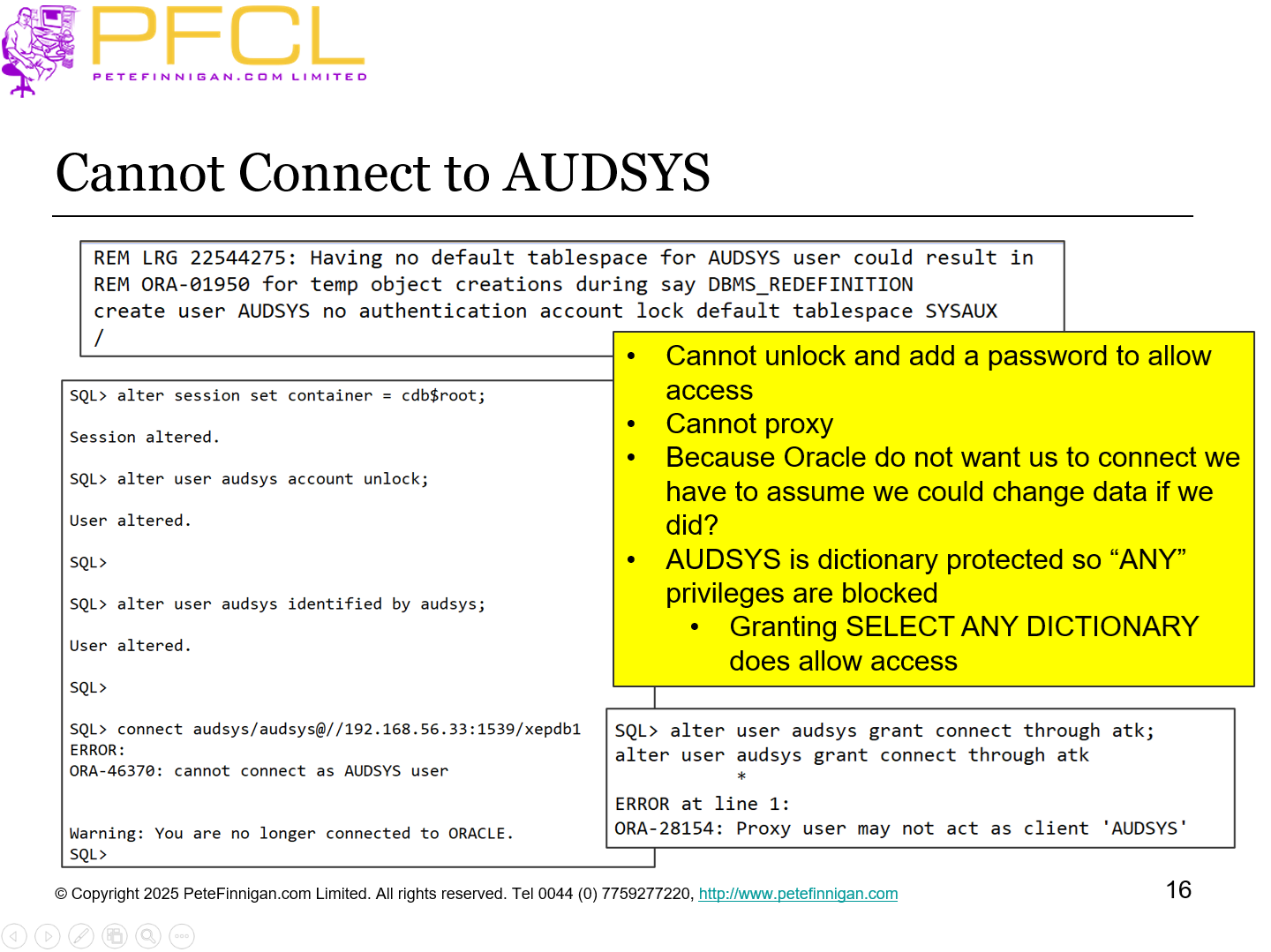
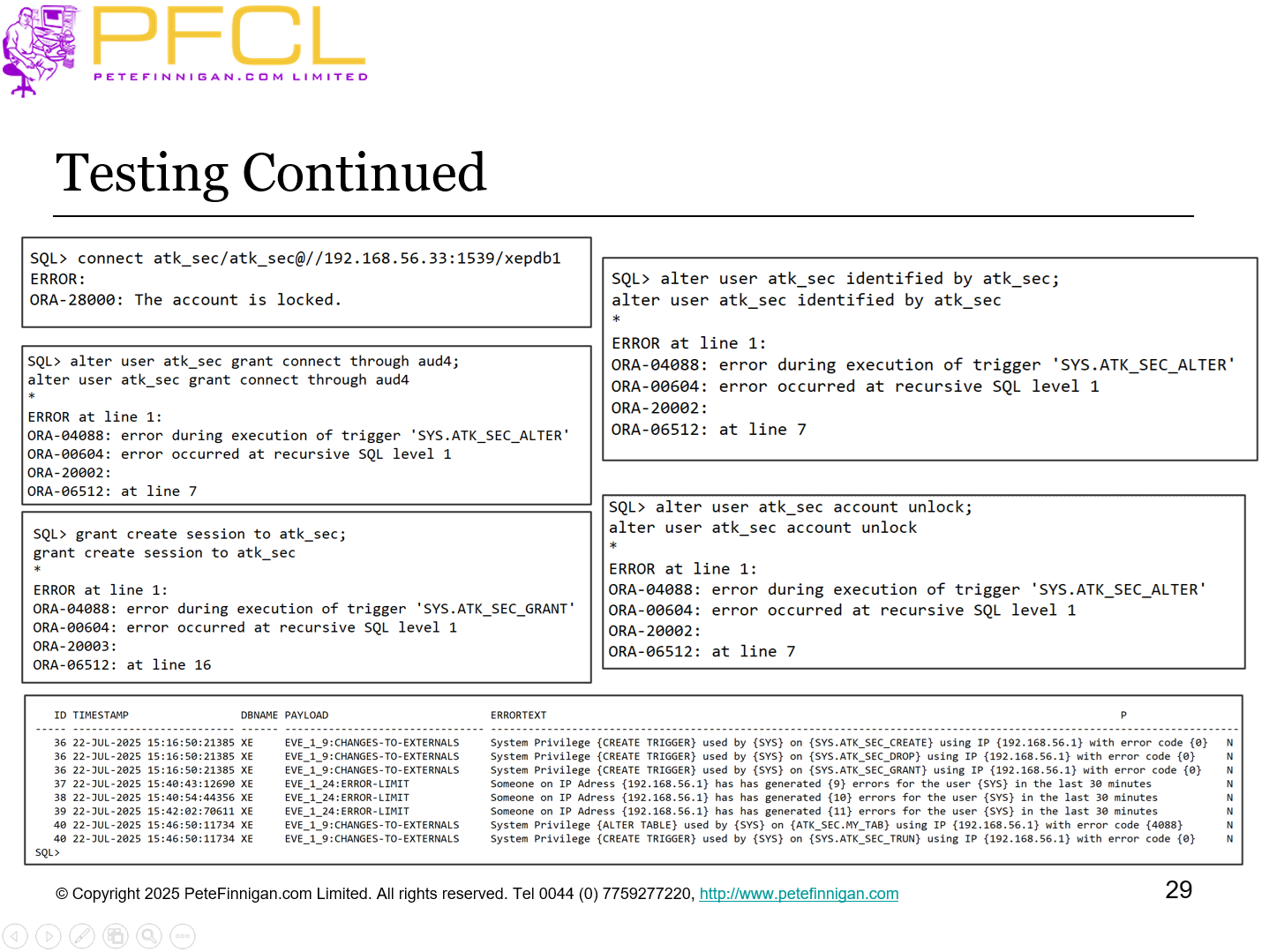
- Cannot unlock and add a password to allow access
- Cannot proxy
- Because Oracle do not want us to connect we have to assume we could change data if we did?
- AUDSYS is dictionary protected so “ANY” privileges are blocked
- Granting SELECT ANY DICTIONARY does allow access
- Slide 17 - Cannot Change AUDSYS.AUD$UNIFIED
-
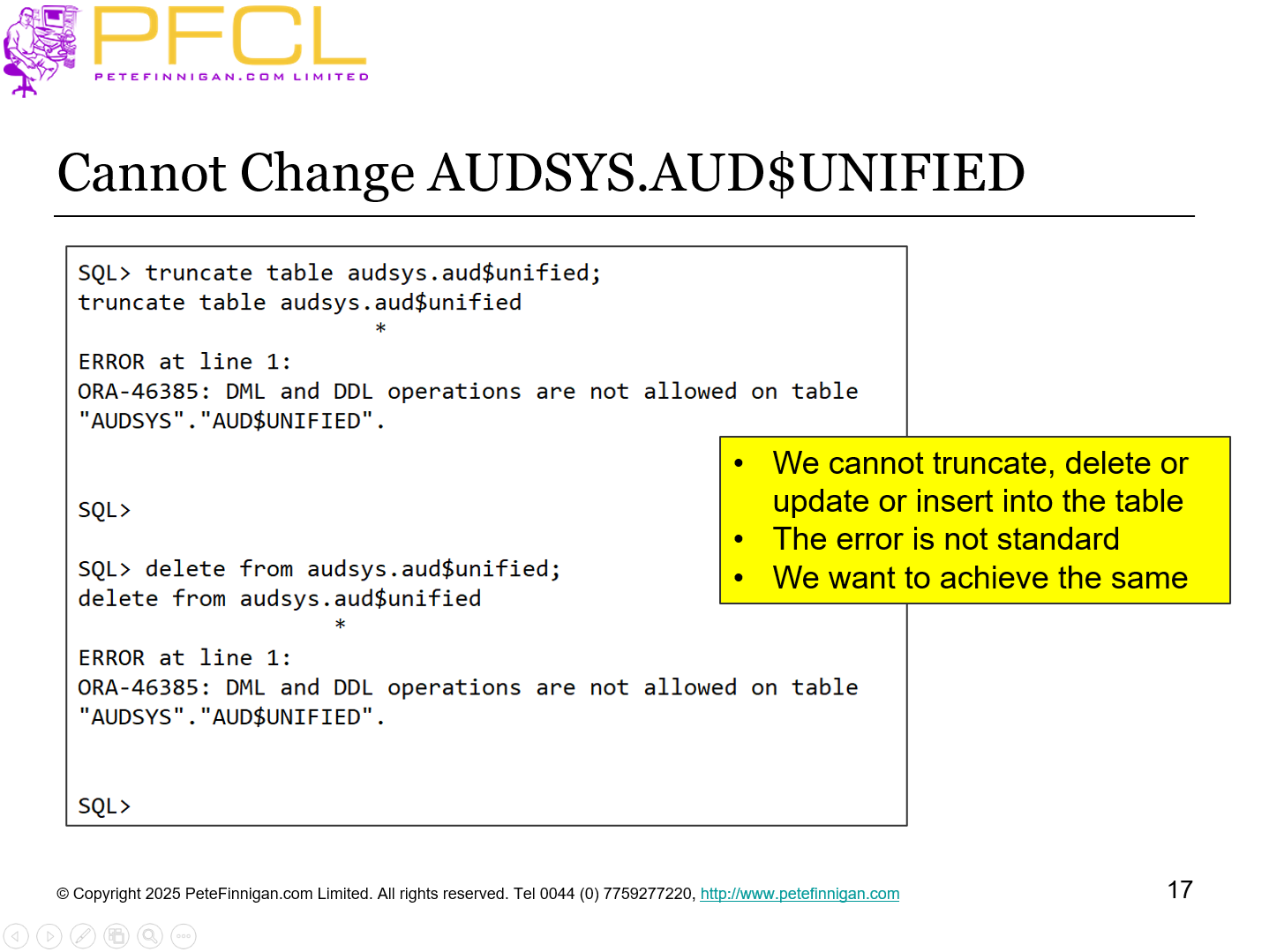
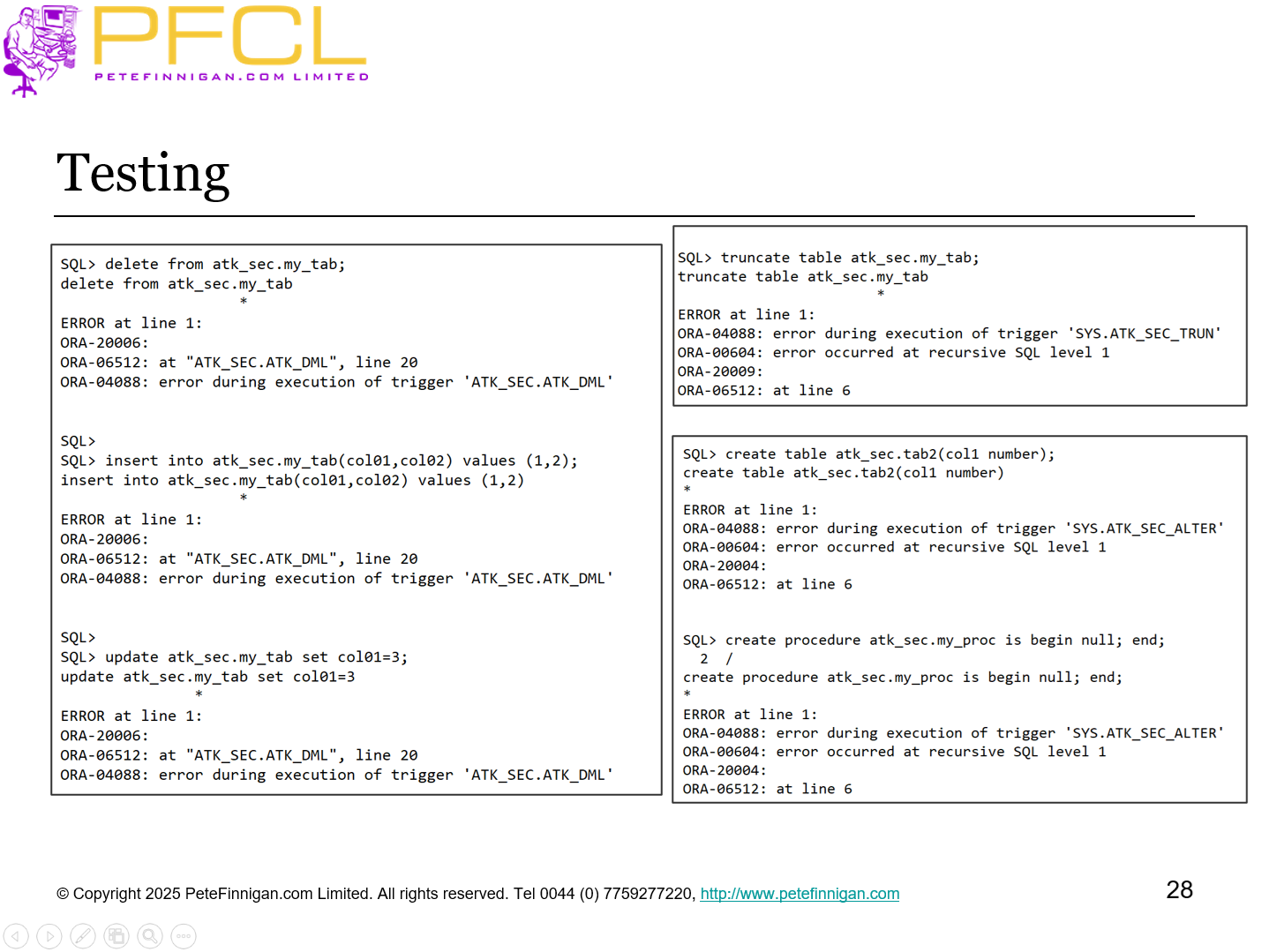
- We cannot truncate, delete or update or insert into the table
- The error is not standard
- We want to achieve the same
- Slide 18 - How Does Oracle Protect AUDSYS.AUD$UNIFIED?
-
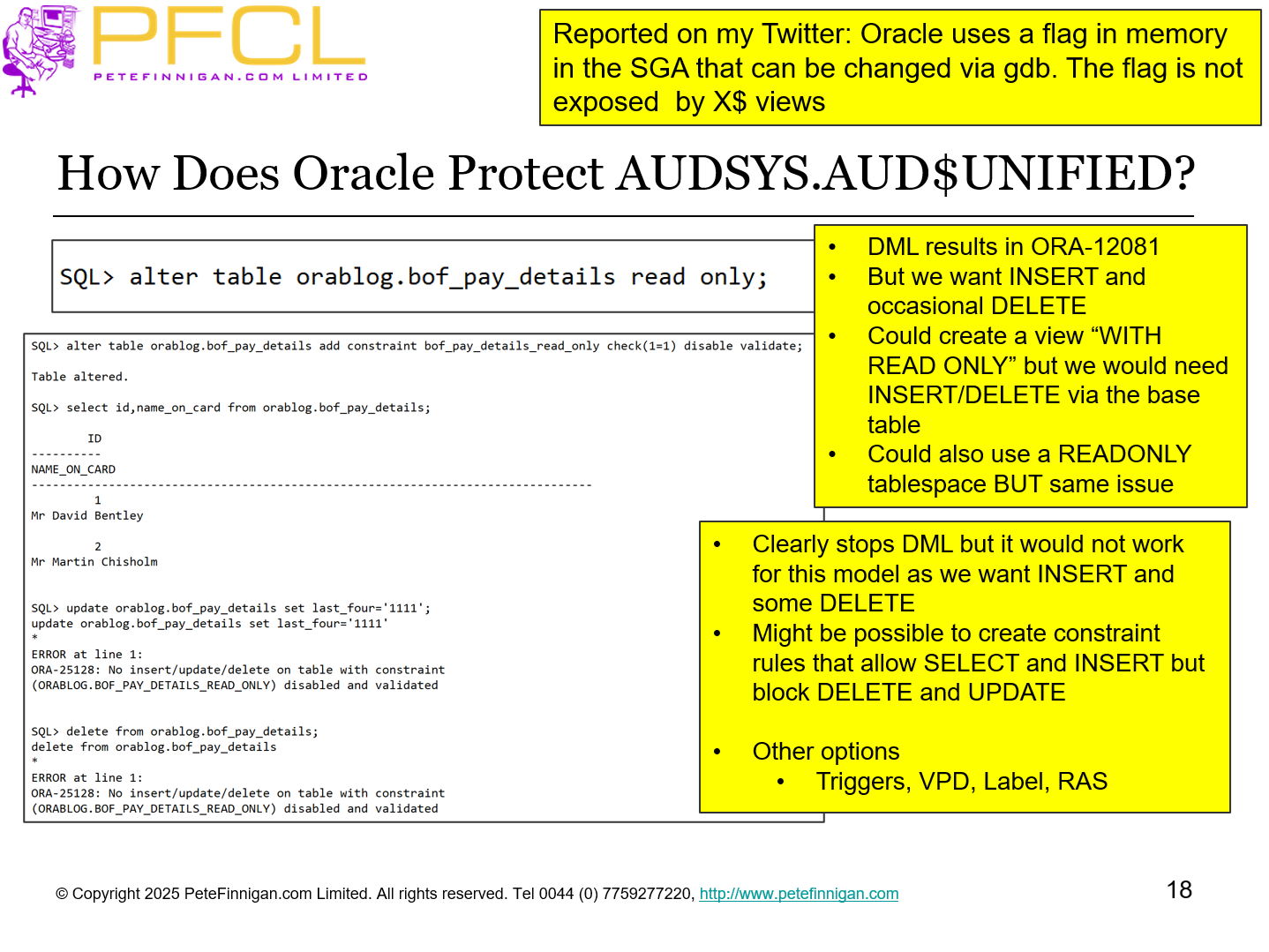
Reported on my Twitter: Oracle uses a flag in memory in the SGA that can be changed via gdb. The flag is not exposed by X$ views
- DML results in ORA-12081
- But we want INSERT and occasional DELETE
- Could create a view “WITH READ ONLY” but we would need INSERT/DELETE via the base table
- Could also use a READONLY tablespace BUT same issue
- Clearly stops DML but it would not work for this model as we want INSERT and some DELETE
- Might be possible to create constraint rules that allow SELECT and INSERT but block DELETE and UPDATE
- Other options
- Triggers, VPD, Label, RAS
- Slide 19 - Design a Read Only Table
-
- Slide 20 - Build a READONLY Table like AUD$UNIFIED
-
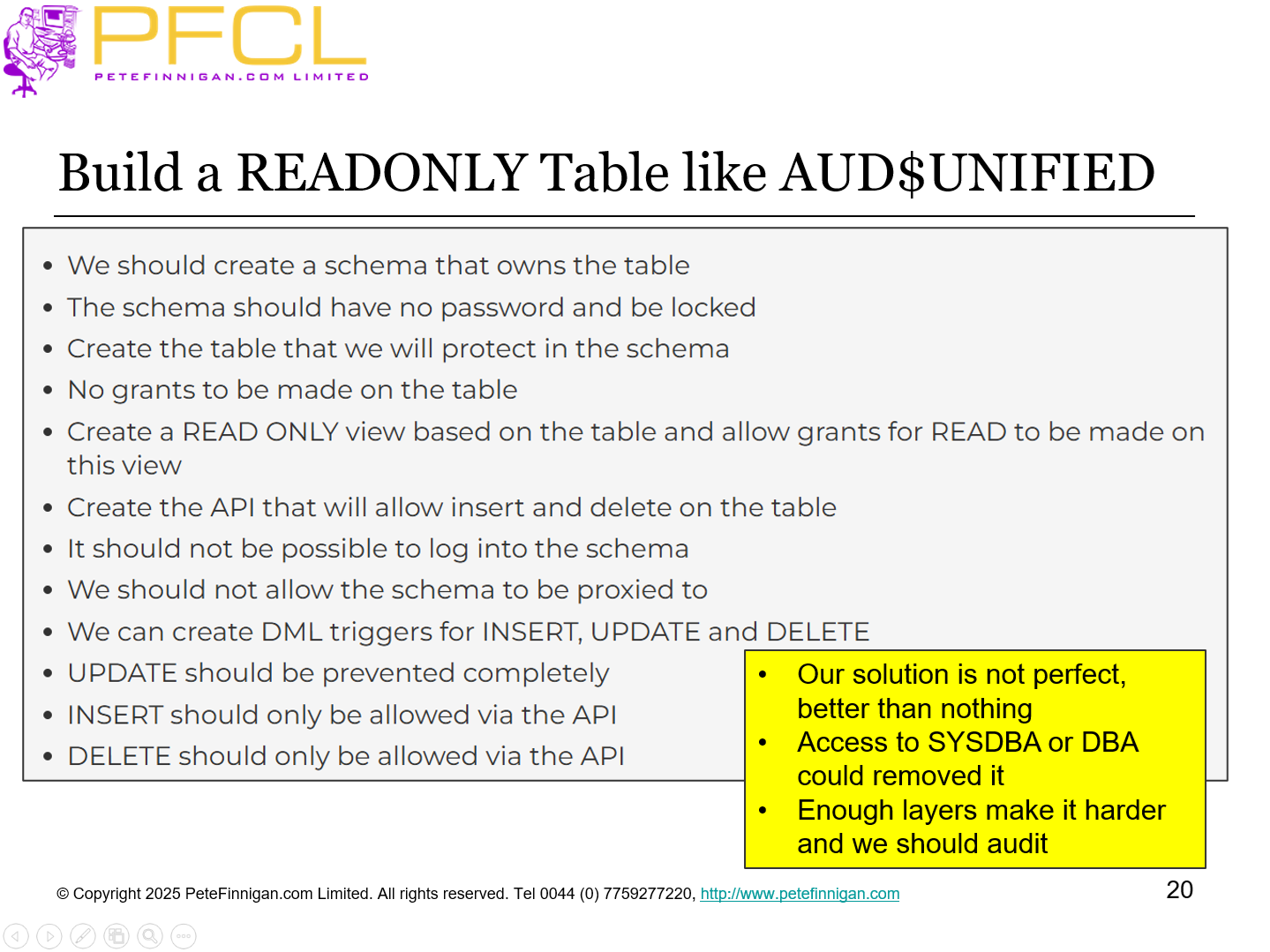
- Our solution is not perfect, better than nothing
- Access to SYSDBA or DBA could removed it
- Enough layers make it harder and we should audit
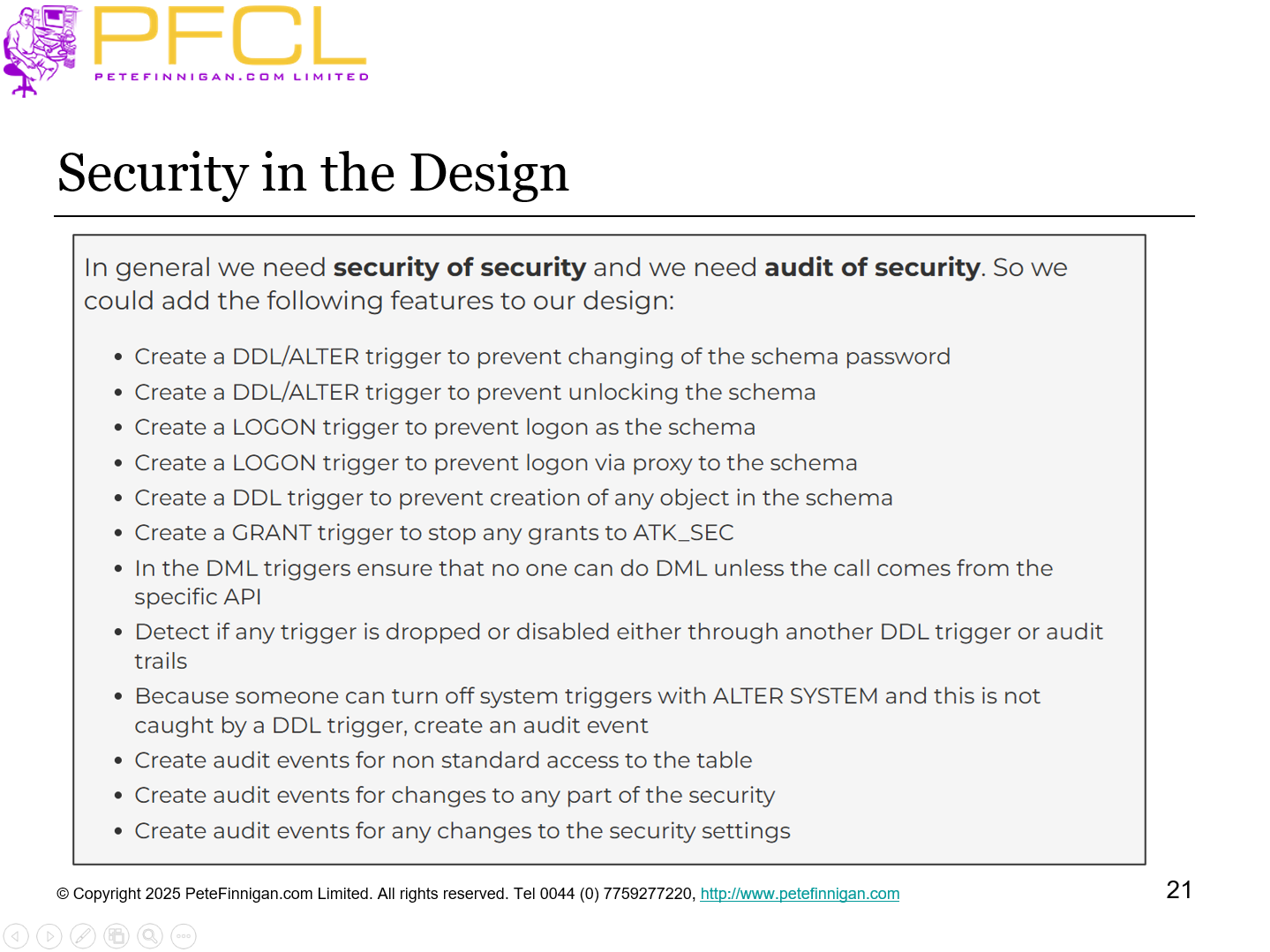
- Slide 21 - Security in the Design
-
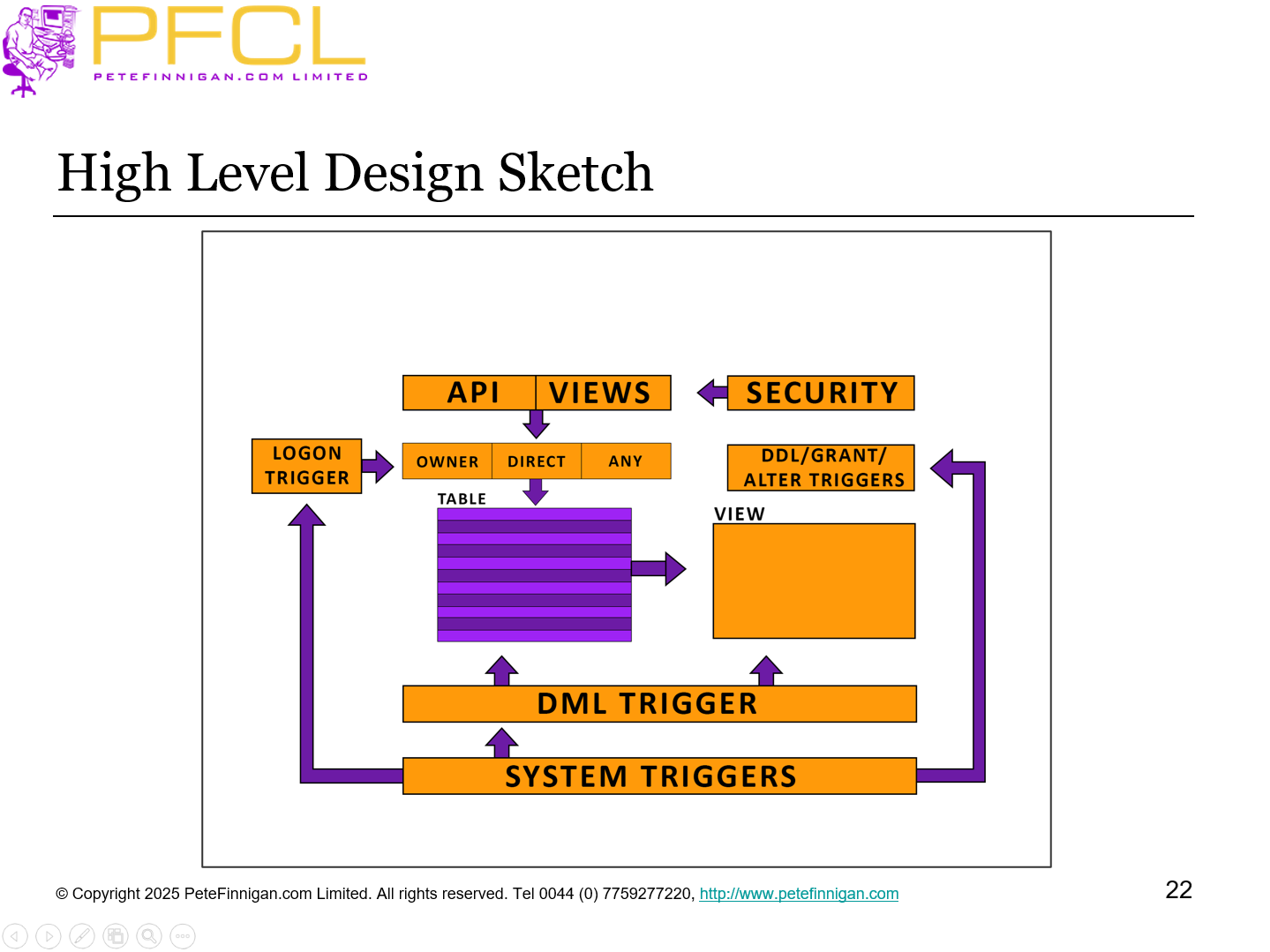
- Slide 22 - High Level Design Sketch
-
- Slide 23 - Implement the Design
-
- Slide 24 - Implement the Solution
-
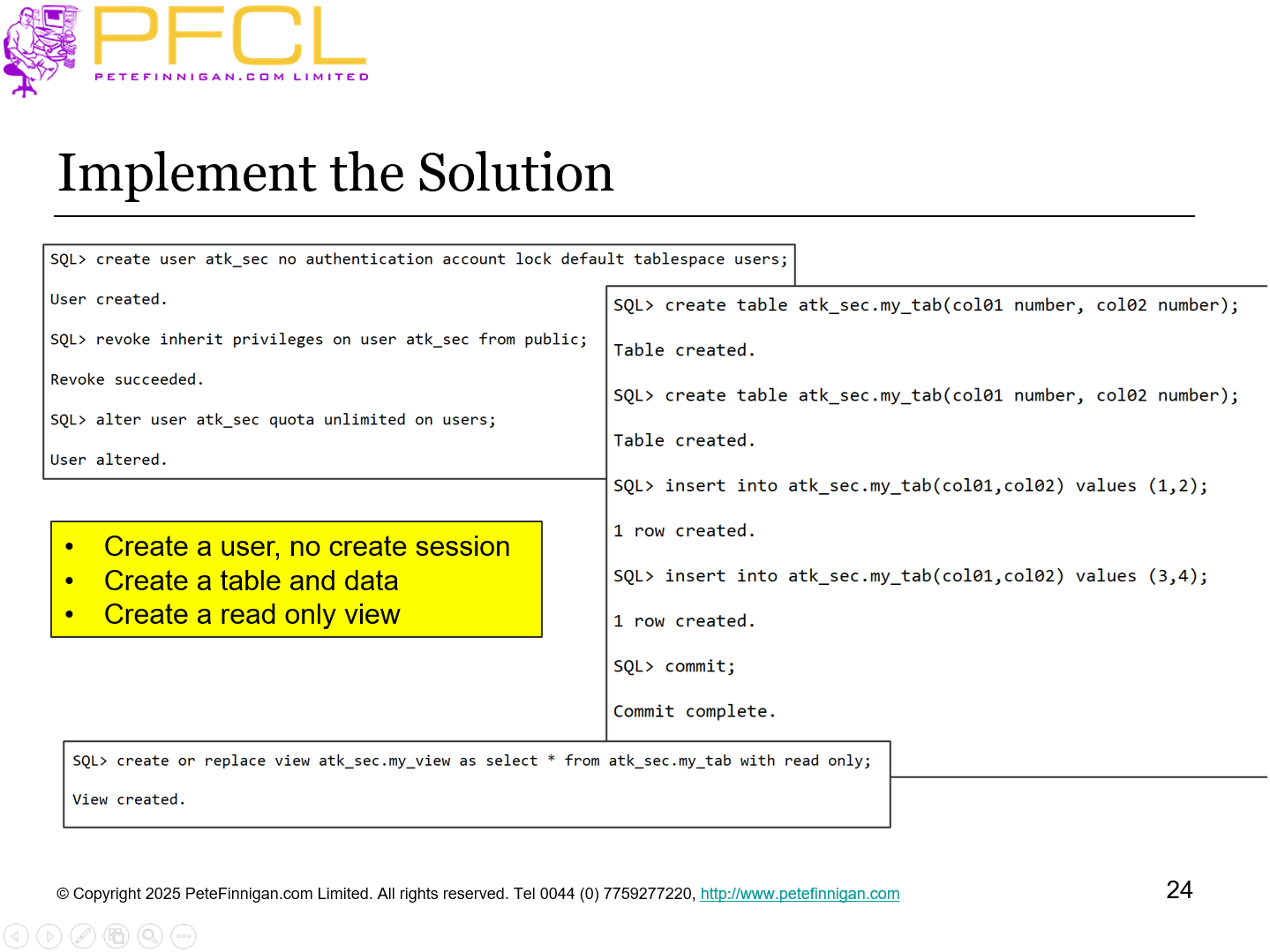
- Create a user, no create session
- Create a table and data
- Create a read only view
- Slide 25 - Build Security
-
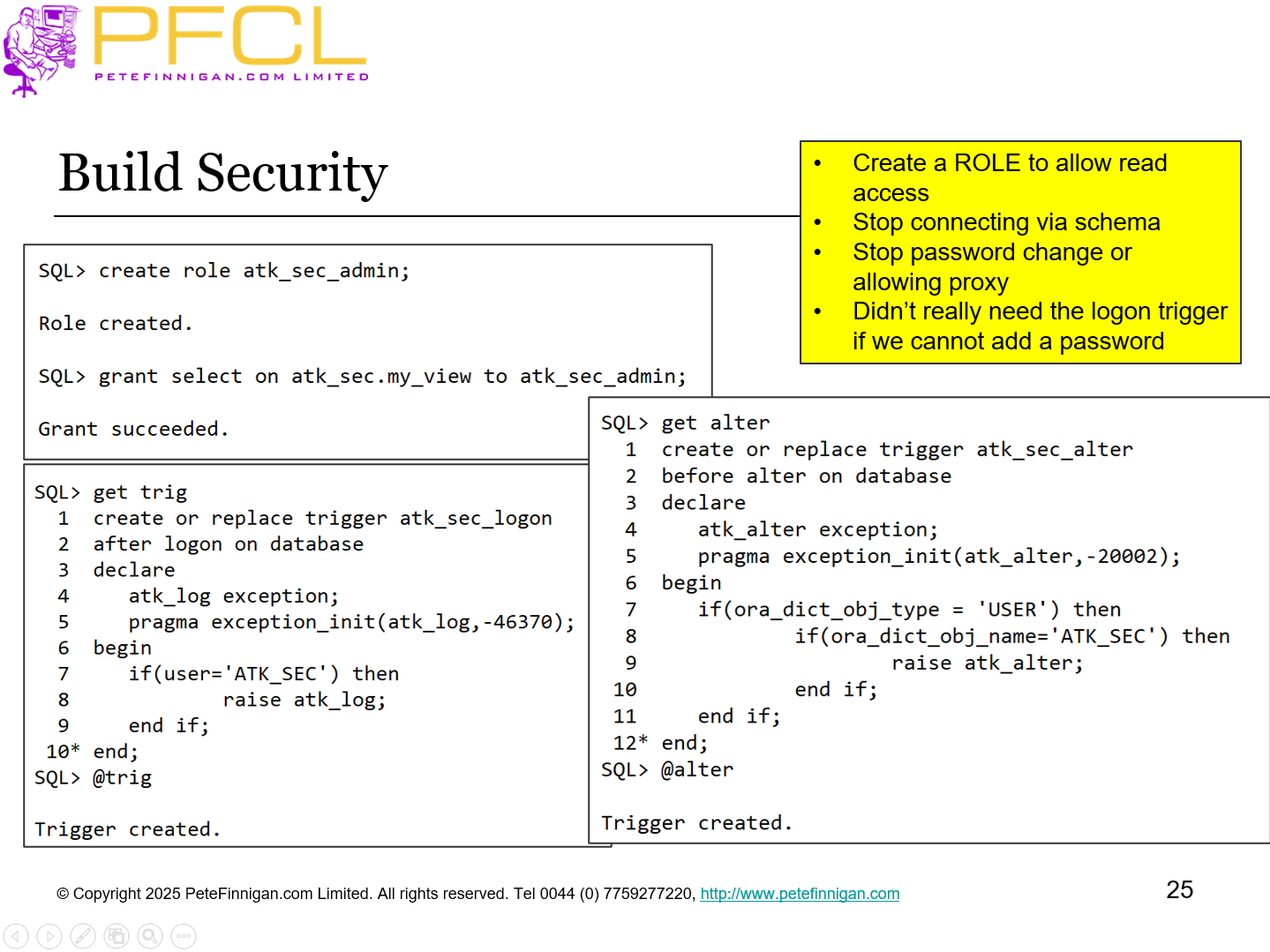
- Create a ROLE to allow read access
- Stop connecting via schema
- Stop password change or allowing proxy
- Didn’t really need the logon trigger if we cannot add a password
- Slide 26 - Protect Data
-
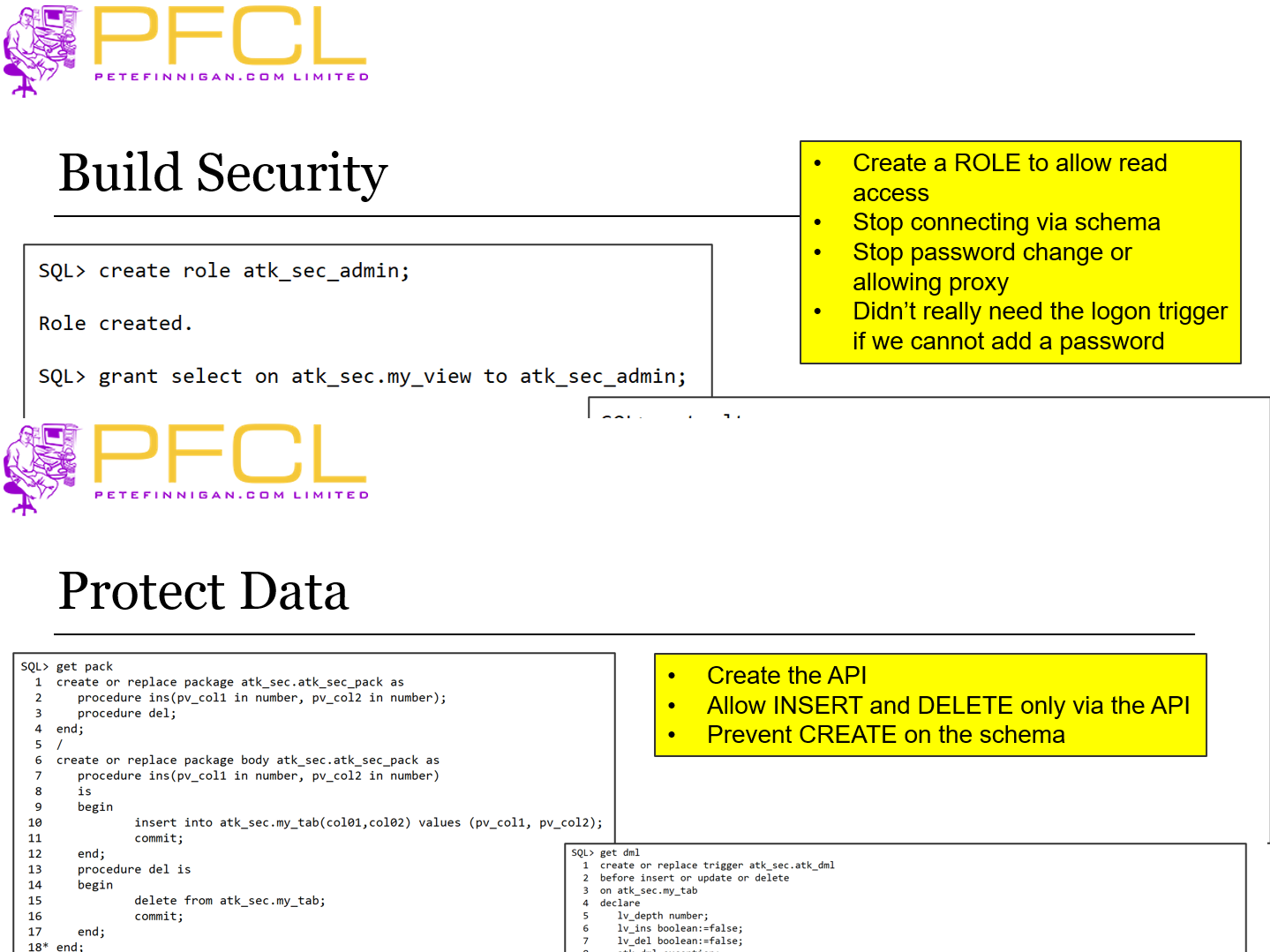
- Create the API
- Allow INSERT and DELETE only via the API
- Prevent CREATE on the schema
- Slide 27 - Add More Security
-
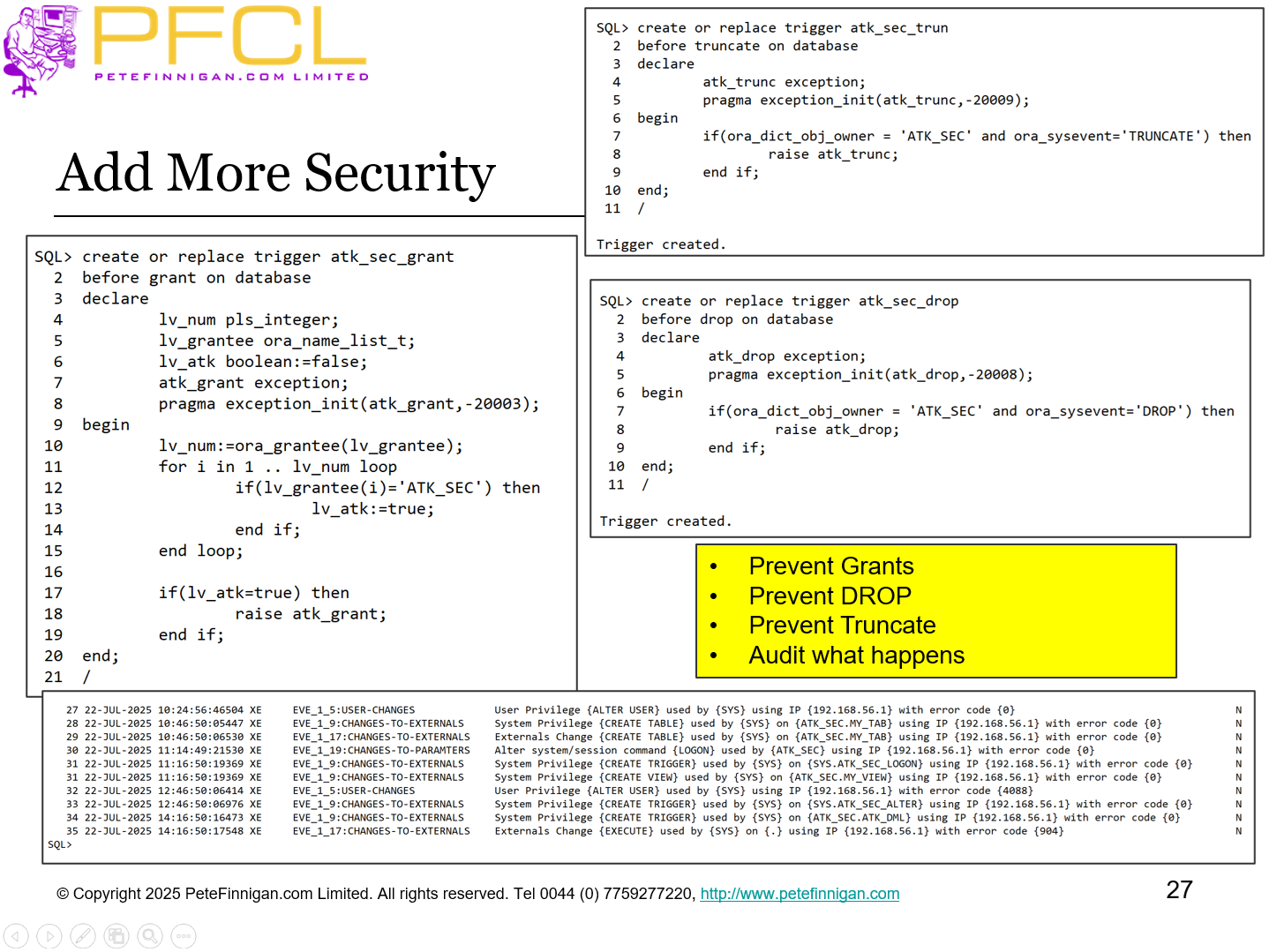
- Prevent Grants
- Prevent DROP
- Prevent Truncate
- Audit what happens
- Slide 28 - Testing
-
- Slide 29 - Testing Continued
-
- Slide 30 - Add More Features
-
- Slide 31 - Can We Block EXECUTE ANY PROCEDURE?
-
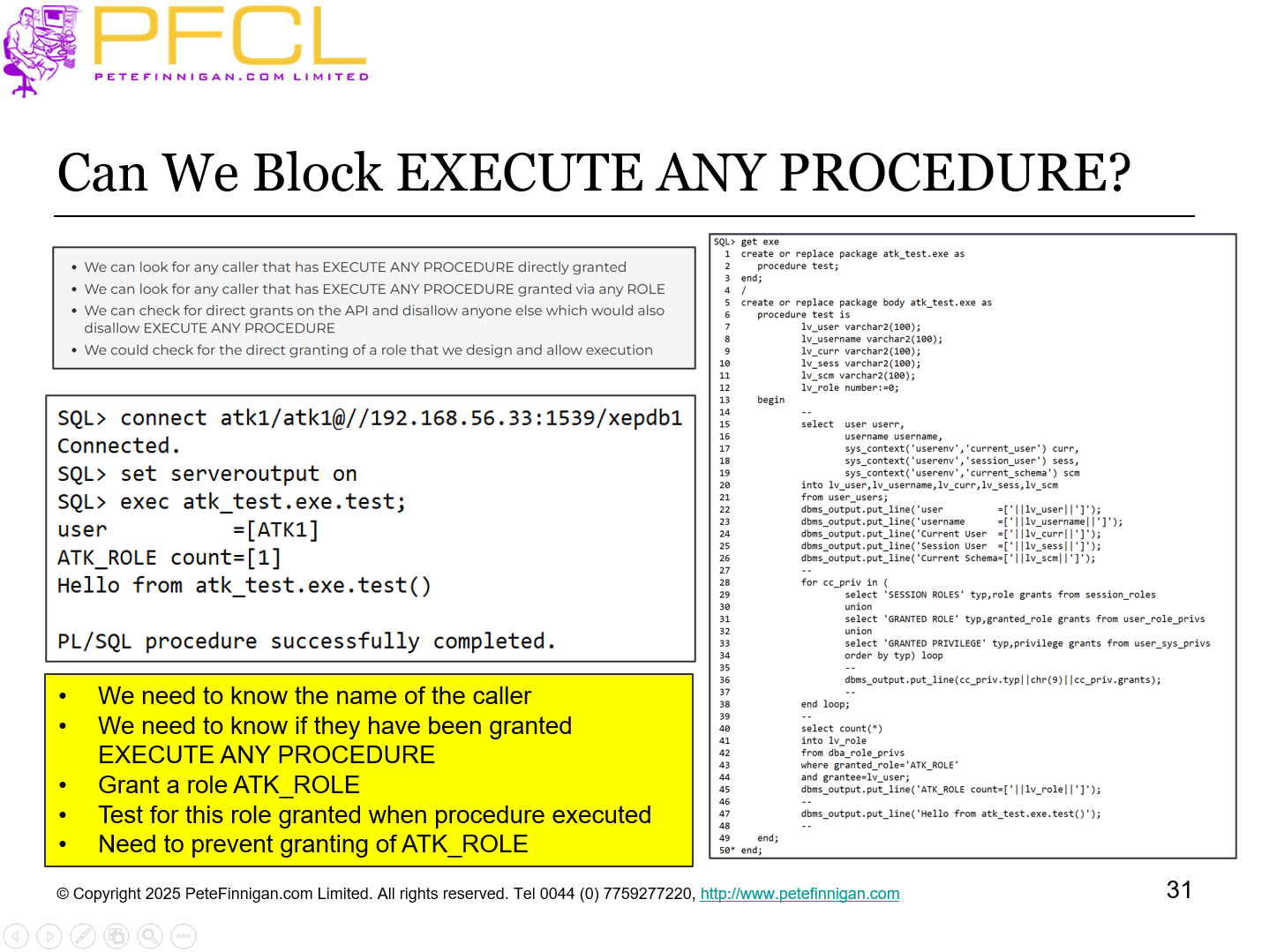
- We need to know the name of the caller
- We need to know if they have been granted EXECUTE ANY PROCEDURE
- Grant a role ATK_ROLE
- Test for this role granted when procedure executed
- Need to prevent granting of ATK_ROLE
- Slide 32 - Detect Disable Trigger
-
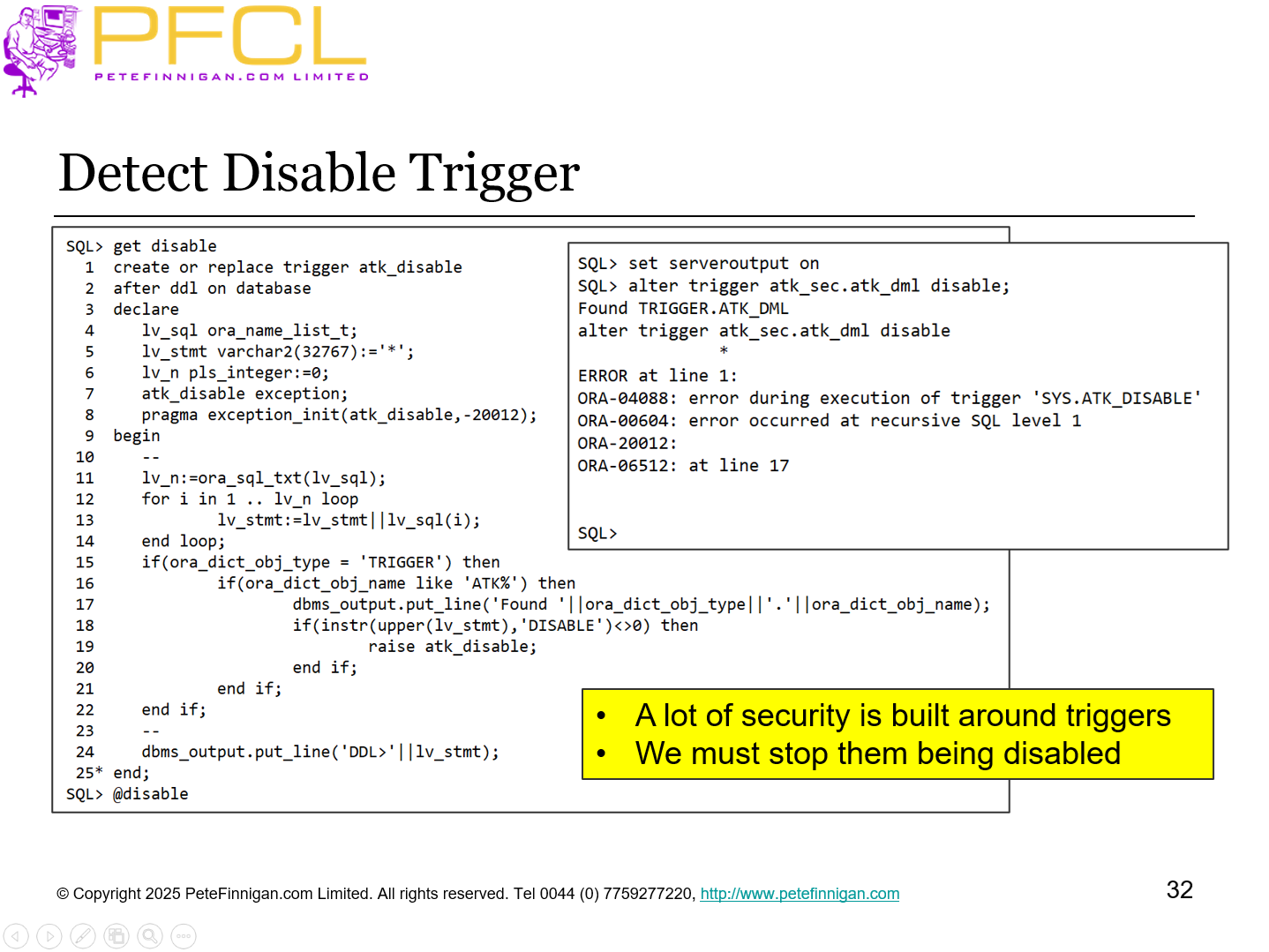
- A lot of security is built around triggers
- We must stop them being disabled
- Slide 33 - Example Summary
-
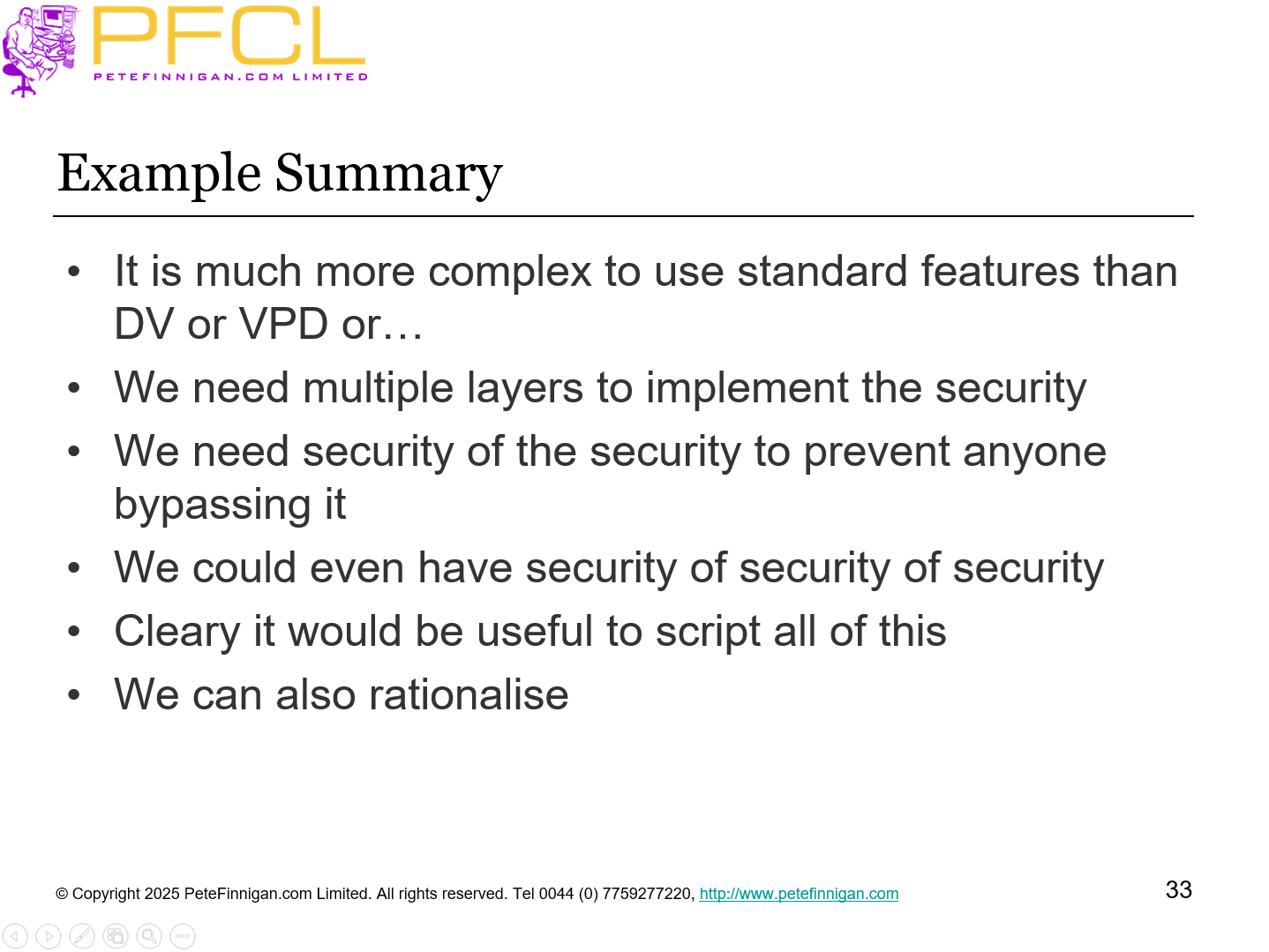
- It is much more complex to use standard features than DV or VPD or…
- We need multiple layers to implement the security
- We need security of the security to prevent anyone bypassing it
- We could even have security of security of security
- Cleary it would be useful to script all of this
- We can also rationalise
- Slide 34 - What is Missing
-
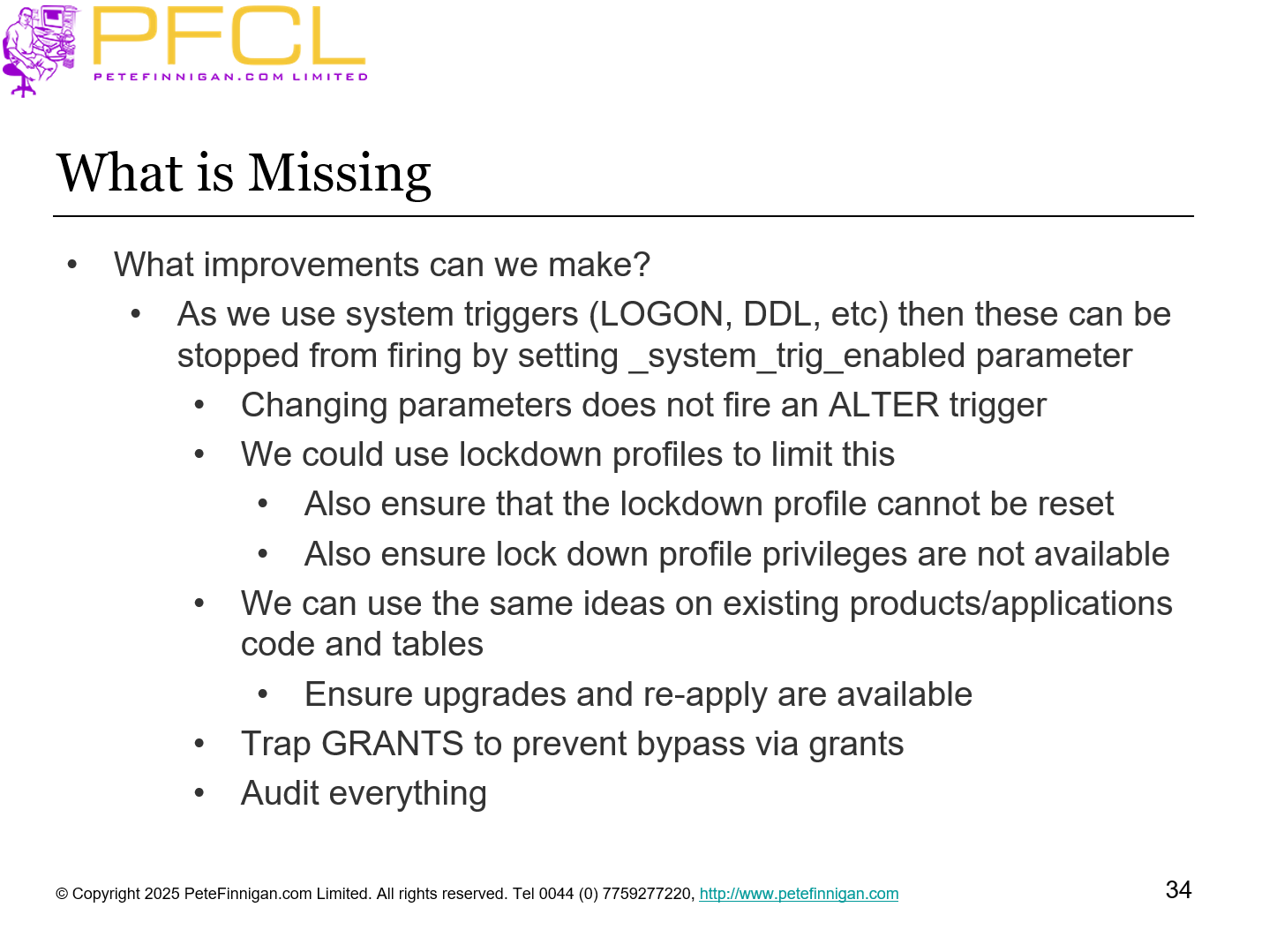
- What improvements can we make?
- As we use system triggers (LOGON, DDL, etc) then these can be stopped from firing by setting _system_trig_enabled parameter
- Changing parameters does not fire an ALTER trigger
- We could use lockdown profiles to limit this
- Also ensure that the lockdown profile cannot be reset
- Also ensure lock down profile privileges are not available
- We can use the same ideas on existing products/applications code and tables
- Ensure upgrades and re-apply are available
- Trap GRANTS to prevent bypass via grants
- Audit everything
- Slide 35 - Extend the Design
-
- Slide 36 - API: Issues / Items to fix with this model
-
- The areas to secure can include
- Access to system privileges such as ALTER USER
- Access to any DDL
- Access to dangerous logic provided by Oracle; network API, File API, jobs, encryption
- Access to Java or C
- Access to vulnerable packages fixed in security patches
- Access to Undocumented packages
- Access to Internal packages
- Access to deprecated packages
- Access to dynamic packages – ones that use dynamic code
- Slide 37 - API: As a Design Pattern
-
- Identify the dangerous thing. i.e. use of ALTER USER…
- Create a separate schema to own the PL/SQL API that allows access
- Create the PL/SQL API
- Grant the privilege or create access to the resource to the API schema
- Create an API to limit how that privilege is used – i.e. enforce least use / rights
- Choose carefully definer / invoker and consider CBAC / Inherit
- Grant just the API to the other users who need access to the dangerous rights
- Add context based controls
- The accessible by clause from 12c or who_called_me before that
- There are differences dependent on what we protect.
- We can include a DDL trigger for ALTER USER but not use of a link
- Slide 38 - API: As a Design Pattern (2)
-
- Add additional controls to the schema to prevent bypass
- Password locked, schema only, limit with DDL triggers, logon triggers…
- Filter inputs, white list and black list
- We can also include a prolog / epilog – see later slides – to filter and protect access to the API
- The API should include
- The best of all PL/SQL secure coding
- No comments
- Obfuscate / wrap
- Separate the common security code into a separate package
- This allows template approach
- The developers don’t get to see the security code details
Audit or log all access to the API or changes to the API
- Slide 39 - Using Resources Securely
-
- Resources such as DIRECTORY, Links, Libraries etc present a problem in how to securely use them – the API model can be used
- Create dynamically
- This means they “live” for a short period of time but the owner has the rights to create many of them
- The access rights need to be built and torn down
- The resource can be closed
- Multi-threaded access is a mess – DB is multi-access
- Statically pre-create
- The owner does not need rights to create
- The resource “lives” continuously
- An access API can exist but could be bypassed
- Limit access to the schema, lock, login trigger
- Slide 40 - Conclusions
-
- We can simulate what Oracle does with AUDSYS
- We can simulate what can be done with DV and VPD
- The design is more complex
- We need layers of security to make it harder to remove
- Its free and can be don in any database
- Slide 41 - Questions
-
If Anyone has questions, please ask now or catch me during the event!!
- Slide 42 - A Design Pattern To Secure Your Database
-